- Utah contributes coins, pins and historical building pieces to America's Time Capsule.
- The capsule will be buried at Independence National Historical Park on July 4.
- The capsule won't be opened until 2276, when the U.S. celebrates its 500th birthday.
SALT LAKE CITY — Ron Fox held up a small gift box as he stood on the top floor of the state Capitol on Wednesday, and jestingly bemoaned how he would be able to fit everything displayed on a table in front of him in it.
Perhaps that's a good problem to have. The table was filled with coins, pins, cards and even pieces of iconic buildings with ties to state history that Fox, co-chair of the America 250 Utah Commission, will help Utah store in the box that will be shipped to Philadelphia, where it will be joined by similar artifacts from other U.S. states and territories.
All of those will make up "America's Time Capsule," which will be buried at Independence National Historical Park on July 4 as part of the nation's America 250 celebrations.
"We've got so many things that we can be proud of — the inventions, the technology, the leaders that we have, both here today and the ones we had historically," he said. "We care about Utah and its history."
America 250, the nonpartisan organization that Congress created to celebrate the nation's 250th birthday, announced the capsule in February. It will collect all sorts of items from across the country and store them at the site where the Declaration of Independence was signed, on the exact 250th anniversary of that moment.
The capsule will remain there for the next 250 years, meaning that it won't be opened until 2276.
"Congress called on us to create a lasting marker of this milestone, and we have worked with the country's leading scientific and preservation experts to do so thoughtfully and responsibly," said Rosie Rios, Chair of America 250, when the project was announced. "When it is opened in 2276, we want future generations to have a clear, authentic window into who we were at 250 — what we valued, what we built, and how we saw ourselves as a nation."
That includes a piece of Utah.
What's in the box?
Items that Utah will include in America's Time Capsule:
- Signatures from Utah's congressional delegation, Utah Legislature and Utah Supreme Court.
- Signatures from the dozen most prominent religious leaders in the state.
- Printed symbols of Utah's eight sovereign tribal nations.
- A printed list of 100 of the most historical figures in Utah, broken down into small cards.
- Small replicas of Utah's current and historic state flags.
- Silver quarters of Utah statehood, Arches National Park and Zikala Sa.
- An 1896 U.S. silver dollar, commemorating the year of Utah's statehood.
- Granite cornerstone markers from the Utah State Capitol and the Salt Lake Temple.
- A gold coin from May 10, 1869, marking the celebration of the completion of the nation's first transcontinental railroad.
- Olympic pins from 2002 and 2034.
Thinking 250 years ahead, Americans can look at these items and think back on how the world has changed since they were buried, much like Americans today think about what the world looked like 250 years ago, said Utah Senate President Stuart Adams, R-Kaysville.
"America is truly the hope of the world, and it's fun to be able to participate in this," he said.
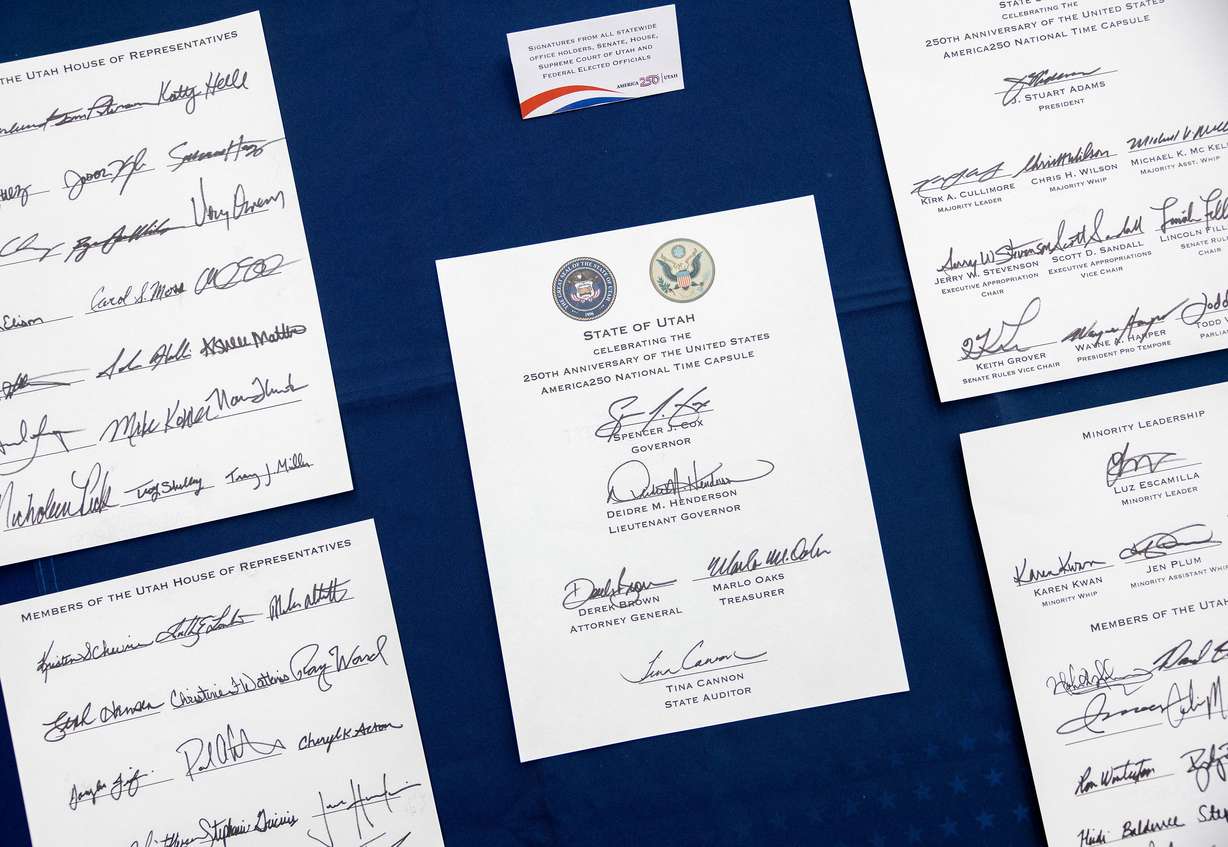
Fox and others chose the items after reviewing what could fit in the box, while whittling down various elements in state history. Coins were an easy item, especially a silver dollar minted in 1896, the year Utah became a state. He points out that many silver coins from this era were made from silver mined in Utah.
Pieces of marble from the Utah Capitol and Salt Lake Temple, rounded down to a coin-like size, were also included, highlighting some of the state's more iconic buildings designed during America's first 250 years.
One of the more distinctive features is a list of 100 of the state's most influential people to date, whittled down to small business cards that highlight their importance.
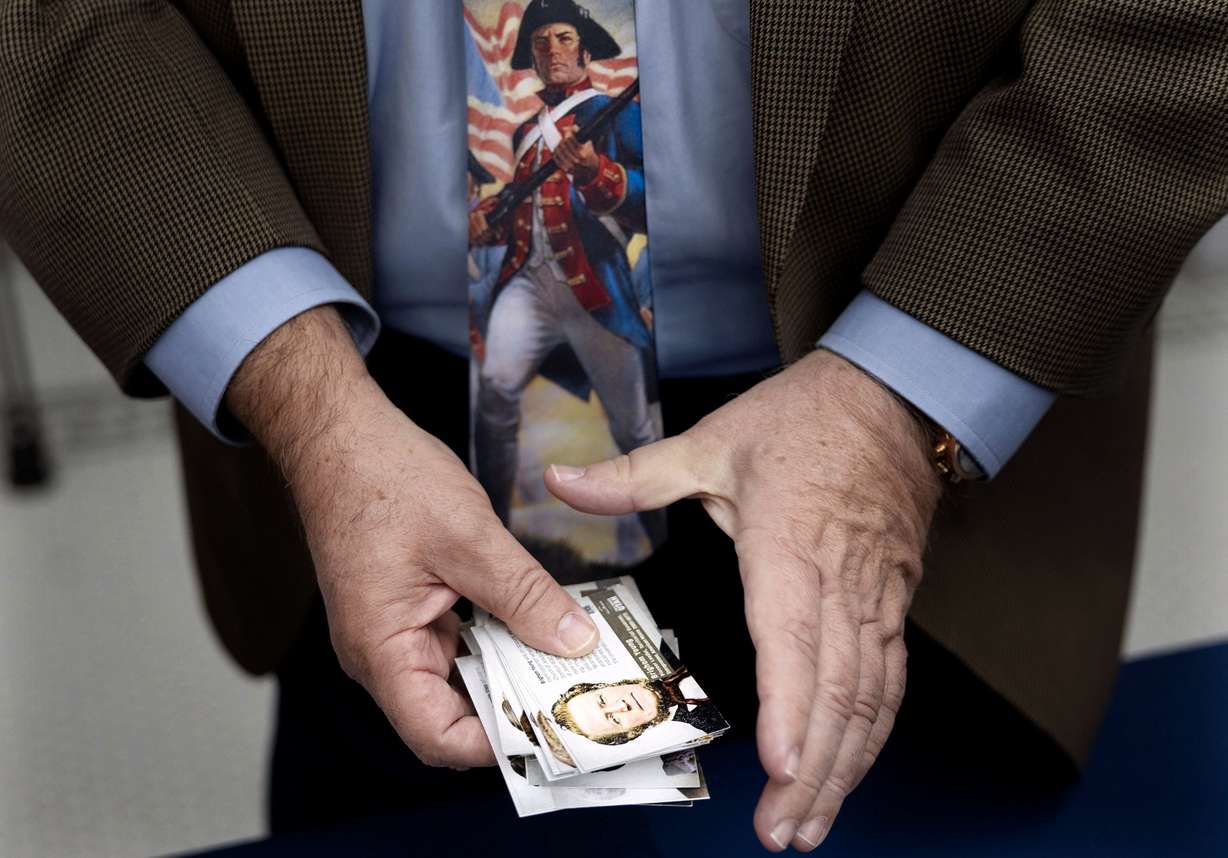
Michael De Groote, an author and history enthusiast who assisted on the project, began sifting through replicas of the cards to highlight who was included. There are famed members of the state's political scene, such as former Gov. Simon Bamberger and religious figures, such as Brigham Young. Business, entertainment, sports and community sectors are also represented, ranging from Mormon pioneers to modern times.
The list was compiled after exploring various industries and setting ground rules, such as representing only people who have already died, De Groote said. He points to his personal favorite, Elizabeth Xavier Tait, an Indian native who ultimately trekked 18,500 miles over 11 months to reach Utah in the 1850s, a story he finds astonishing.
He hopes those who find the real set of cards — with a material meant to last 250 years — will be equally impressed in 2276.
"Utah and all places are a collection of people coming together. Utah is the Beehive State. Utah is the symbol of people coming together to work together for the common good," he told KSL. "These 100 people show that."