- Utah's peak snowpack runoff has passed, as the state's ongoing drought worsens.
- Statewide stream flow is half the median average; reservoirs won't gain much additional water.
- More than 90% of Utah is in severe drought or worse; Drought Response Committee is monitoring situation.
SALT LAKE CITY — Utah natural resources officials say they met with local leaders and water providers across the state this week to help them prepare for what's expected during what is normally the state's driest season, after determining that this year's peak snowpack runoff has officially passed.
Peak runoff typically begins about this time in the season; however, the Utah Division of Water Resources reported Thursday that it has "already come and gone" with statewide stream flow anticipated to be half of the state's median average. The current statewide snowpack is the same as the median average for late May toward the end of the normal runoff.
That means the state's reservoirs aren't expected to gain much, if anything, for the rest of this year, which wasn't much of a surprise after the state's snowpack peaked at a record low in March.
The division and other members of the Utah Department of Natural Resources met with county leaders on Tuesday to update them on the already bleak situation from previous water forecasts.
"To address extreme drought, we are asking county leaders to coordinate with water providers and review drought contingency plans and consider if a county-specific drought declaration is warranted," said Joel Ferry, director of the Utah Department of Natural Resources, in a statement. "While the state remains a resource for data and guidance, water planning — including any potential restrictions — takes place on a local level to reflect conditions in the area."
The update comes as more than 90% of Utah is now in severe or worse drought conditions, up nearly 10 percentage points from the previous week, according to the U.S. Drought Monitor reported on Thursday. All of the Wasatch Front and most of northern Utah are now in severe drought with the change.
Close to 60% in extreme or exceptional drought, which is the same as last week. It covers most of eastern and central Utah, with pieces of other regions.
Utah's reservoir system is currently 71% full, slightly better than the median for late April but 11 percentage points below this time last year. Larger reservoirs, especially in Utah's northern half, are generally in a decent position, while smaller reservoirs that rely on good snowpack every year or every other year are "struggling," the Utah Division of Water Resources also pointed out.
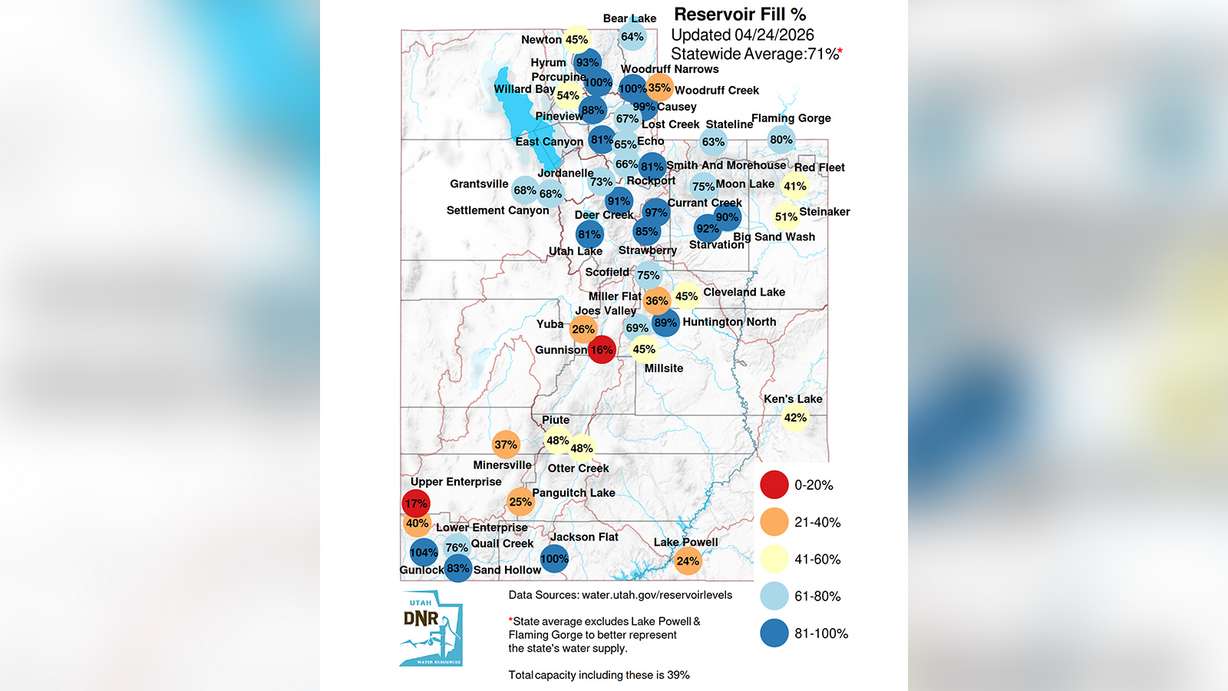
Nine of the state's 50 largest reservoirs are already at 40% capacity or less, according to the division.
Meanwhile, Utah and other Colorado River Basin states met this week to approve a federal emergency plan to release between 660,000 acre-feet and 1 million acre-feet of water from Flaming Gorge, near the Utah-Wyoming border, so it can flow to Lake Powell at the Utah-Arizona border.
That decision was made after forecasts indicated that Lake Powell, already down to 24% capacity, could receive its worst natural inflows this spring due to poor snowpack runoff.
Gov. Spencer Cox has not issued any emergency declaration this year, but the state's Drought Response Committee, composed of representatives from various state agencies, said it is "closely monitoring conditions" as it considers whether to recommend a declaration to the governor.
Cox issued a drought declaration last April that applied to 17 counties after central and southern Utah experienced snowpack conditions equally as harsh as this year. That order instructed the committee to review "hardships and other circumstances" caused by drought in affected counties and recommend actions to address those challenges.
It also recommended that water supplies and irrigation companies across affected areas "encourage efficient landscape watering" and contact the Utah Division of Water Resources over a potential drought response plan.