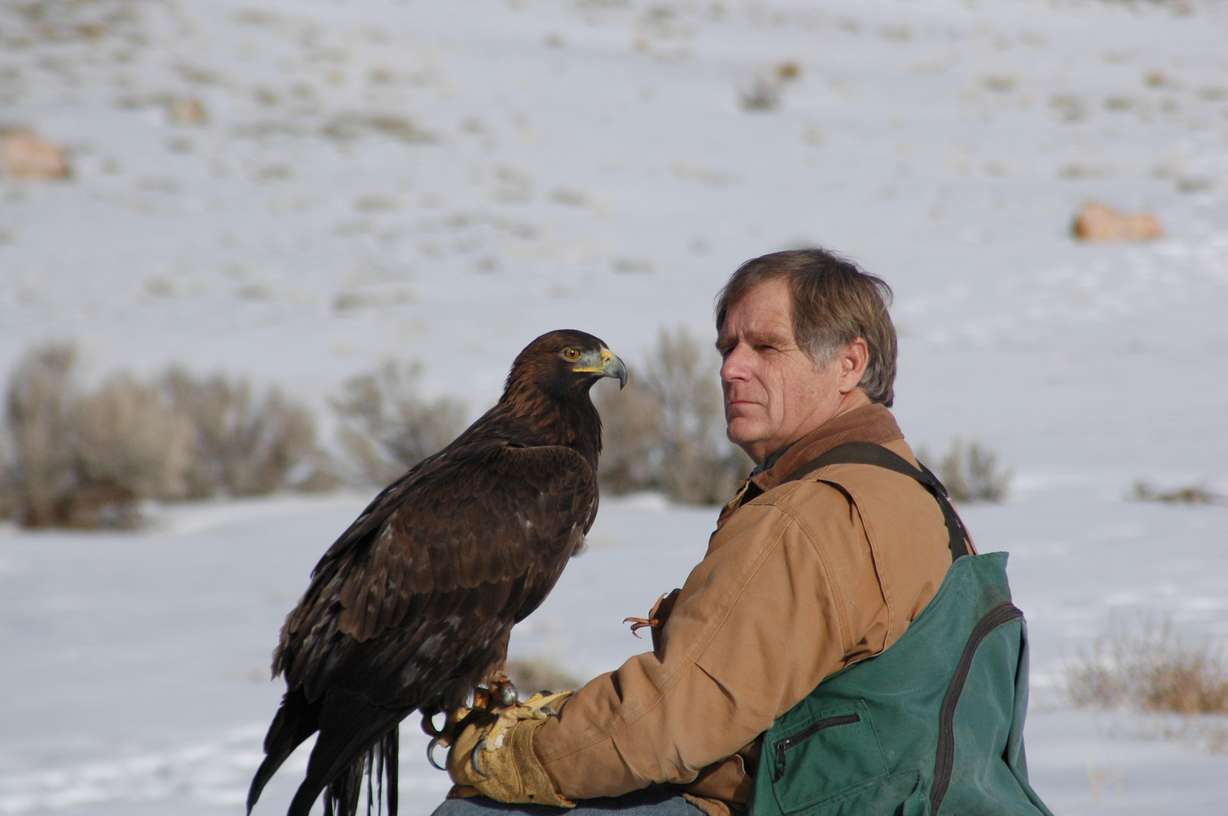
- Martin Tyner, a licensed falconer, celebrates a 20-year bond with a golden eagle named Scout.
- Tyner overcame his childhood fear of birds to rehabilitate and train raptors.
- He runs the Enoch Wildlife Rescue and advocates for wildlife conservation through falconry.
ENOCH, Iron County — When Martin Tyner was a little boy, he was afraid of birds. In the past 50-plus years, however, he has faced that fear and turned it into a lifetime of helping rehabilitate and build relationships with birds of prey.
On Monday, Tyner, a federally licensed falconer, celebrated a 20-year relationship with a golden eagle he calls Scout.
"(Scout) is a very dear friend," Tyner said. "It's not unlike having a dog or a cat that's been your buddy forever; the difference is that he's a wild animal."
Falconry is the ancient and highly regulated art of training raptors (hawks, falcons, eagles or owls) to hunt wild game in their natural habitat. Those trained in falconry foster a trusting partnership with the bird of prey.
Building trust with wild animals came naturally to Tyner.
"I was a very quiet, severely dyslexic child who didn't have very many friends," he said. "I spent my misguided youth in Southern California in the foothills taking care of critters, and the critters were my life. ... The local game warden started dropping off a couple of quail or cottontails. He found a young boy that had a knack for working with wildlife, healing them and getting them back into the wild."
Tyner said his love for birds, however, came when his grandparents taught him to love all animals.
"One of my earliest childhood memories is of being terrified of birds," he said. "With the help of very wise grandparents and other mentors, they not only got me past my fear of birds, but I became the first person in North America who was licensed to trap a wild eagle in falconry."
Tyner explained that he had long wanted to have a golden eagle for falconry, but laws prohibited it. For years, he worked with government agencies, including the Division of Wildlife Resources, to rewrite laws and regulations. In those discussions, laws now require that one of two things occur to have an eagle for falconry.
To have a wild animal like a golden eagle that I have the opportunity to bond with and to create a partnership with is truly a gift.
–Martin Tyner
"The first way you could acquire an eagle for falconry was the U.S. Fish and Wildlife Service gives (a qualified individual) an eagle – and it had to be an eagle in a bad situation that can't be released into the wild for specific reasons, but was still suitable to be flown in falconry," Tyner said. "The second way is to trap a full-grown wild eagle that a farmer feels is a threat to his livestock."
Even with that green light to trap the eagle, Tyner said a third component was necessary — "an act of God."
"I had to convince the Utah Division of Wildlife Resources and the Department of Agriculture and the U.S. Fish and Wildlife Service that it would be in the eagle's best interest for me to trap it, remove it and use it as a falconry bird," he said. "I had to get three government agencies to agree at the same time. It's a literal act of God to be able to do that."
In 1990, Tyner got his first golden eagle for falconry, which he named Bud. He had Bud for 16 years, but the bird died from a mosquito bite that resulted in West Nile virus, which Tyner said, "broke his heart." A year later, Tyner was notified of another golden eagle in Wyoming that a farmer asked to be removed. That's when Scout came along.
Tyner explained that part of training Scout for falconry was making sure that he never returned to Wyoming. He said if Scout returned, the farmer would have permission to shoot the bird. So, falconry is a way for Tyner to save wildlife.
"If an eagle is rescued in a depredation situation (where it's a threat to livestock), it is put in a zoological facility and kept in a cage for the rest of its life because you have to guarantee the eagle won't go back to where it came from," he explained. "All birds of prey are migratory. They will return where they learned to fly. If I turned Scout loose in Utah, he'd go back to Wyoming. I had to guarantee that Scout would never return to Wyoming."
The way this is guaranteed is through the falconry relationship, Tyner explained. He said Scout flies free with wild birds, while Tyner "fleshes out" rabbits for the birds to catch.
"If Scout doesn't catch a rabbit, he flies back and lands on my glove and I feed him anyway," Tyner said. "Scout is the hunter, and I'm his dog. I'm a really good dog, so he keeps me."
If Scout does catch a rabbit, whatever is left over is chopped up and given to other animals at the Enoch Wildlife Rescue that Tyner runs.
"I've been caring for sick, injured wildlife for nearly 60 years as a volunteer," he said, adding that the wildlife-rescue facility was built just two years ago
With the thousands of wild animals he has helped rescue and rehabilitate, having one as a friend is rare.
"Even though I was rescuing and rehabilitating injured eagles through all of this time, we don't develop a friendship with the animals," he explained. "We don't touch them. We don't socialize with them. They get as little human contact as possible.
"To have a wild animal like a golden eagle that I have the opportunity to bond with and to create a partnership with is truly a gift."
Tyner and Scout travel the state and country as wildlife ambassadors, presenting at schools and community events. As he looks back at the little boy who was afraid of birds, Tyner said he is grateful for the people in his life who taught him to love all animals.
"I have the same affection for all native wildlife," he said. "I put as much effort and attention into hand-raising a baby hummingbird as I do hand-raising an eagle because they're all magnificent and they all deserve a chance in the wild."

Photos
Most recent Outdoors stories
Related topics
 Arianne Brown