'%3e%3cpath%20d='M34.1406%205.85938C30.3906%202.10547%2025.3047%200%2020%200C14.6953%200%209.60938%202.10547%205.85938%205.85938C2.10938%209.61328%200%2014.6953%200%2020C0%2025.3047%202.10547%2030.3906%205.85938%2034.1406C9.61328%2037.8906%2014.6953%2040%2020%2040C25.3047%2040%2030.3906%2037.8945%2034.1406%2034.1406C37.8906%2030.3906%2040%2025.3047%2040%2020C40%2014.6953%2037.8945%209.60938%2034.1406%205.85938ZM37.0117%2023.543H31.1602V13.5391H27.6328V19.9414C28.1211%2020.6914%2028.3711%2021.582%2028.3711%2022.5625V22.625C28.3711%2023.668%2028.1172%2024.6055%2027.6328%2025.4297V26.6094H36.082C33.4883%2032.9375%2027.2891%2037.3789%2020.0039%2037.3789C10.3711%2037.3789%202.62109%2029.6289%202.62109%2020C2.62109%2010.3711%2010.3711%202.62109%2020%202.62109C29.6289%202.62109%2037.3789%2010.3711%2037.3789%2020C37.3789%2021.1484%2037.2617%2022.2656%2037.0508%2023.3477C37.0391%2023.4141%2037.0234%2023.4766%2037.0117%2023.543Z'%20fill='white'/%3e%3cpath%20d='M22.3086%2018.5352C20.4336%2018.125%2019.9531%2017.8398%2019.9766%2017.1836V17.1406C19.9766%2016.6992%2020.3477%2016.2148%2021.4023%2016.2148C22.582%2016.2148%2023.8867%2016.6797%2025.0781%2017.4766L26.8516%2015.0195C25.4453%2013.8906%2023.707%2013.3398%2021.5547%2013.3398C18.5195%2013.3398%2016.4375%2015%2016.4063%2017.4766V17.5352C16.3633%2020.2617%2018.5859%2020.9805%2021.293%2021.6016C23.0391%2021.9766%2023.5703%2022.3164%2023.5703%2022.9609L23.5469%2022.9766C23.5469%2023.3906%2023.2578%2023.7031%2022.7852%2023.8359C22.5742%2023.9062%2022.1289%2023.9727%2021.5156%2023.9727C20.7617%2023.9727%2019.7539%2023.8633%2018.6328%2023.4844C18.0898%2023.2891%2017.4727%2023.0039%2016.8047%2022.6133L20.1406%2026.625C20.2813%2026.6602%2021.0977%2026.8516%2021.7734%2026.8516C25.0039%2026.8516%2027.0859%2025.2461%2027.1094%2022.6328V22.5703C27.1602%2020.1133%2025.2148%2019.1719%2022.3086%2018.5352Z'%20fill='white'/%3e%3cpath%20d='M5.24219%2013.5664V26.6133H8.75391V23.7578L10.2969%2021.9531L14.2031%2026.6133H18.3867L12.3555%2019.5195L17.4023%2013.5664H13.4531L8.75391%2019.0586V13.5664H5.24219Z'%20fill='white'/%3e%3c/g%3e%3cdefs%3e%3cclipPath%20id='clip0_97_2430'%3e%3crect%20width='40'%20height='40'%20fill='white'/%3e%3c/clipPath%3e%3c/defs%3e%3c/svg%3e)




- Utah's mountain fall foliage could peak between late September to early October, per KSL Weather forecast.
- Valley peak likely after the mountains.
- Weather uncertainties may affect foliage, but experts hope for a beautiful season.
SALT LAKE CITY — Fall is often considered one of the best times of the year across the country and in Utah.
The Farmers' Almanac declared fall as the winner of the best season, per a Facebook poll earlier this year. YouGov completed a survey in 2021, which found that fall was slightly behind spring as Utah's favorite season.
It's easy to see why. Temperatures begin to cool down in the fall; there are many enjoyable seasonal flavors and, of course, beautiful colors. Utah is home to billions of trees, including its beloved quaking aspen, which produce a stunning display every autumn.
But when exactly will Utah's fall foliage peak?
When trees begin to turn isn't an exact science beyond what's needed for the process to begin, but history and long-range weather forecasts help estimate when to expect the colors.
The waves of reds, oranges and yellows form when trees begin to stop photosynthesis for the year, briefly causing their "true colors" to show before their leaves fall off. This begins as sunlight decreases and temperatures begin to drop.
Normal to potentially below-normal temperatures are forecast for parts of Utah over the next few weeks, which could help kickstart this process soon.
"I think the earlier it becomes cooler, the earlier the leaves will start to respond to that," said KSL meteorologist Matt Johnson. "We need the warm, sunny days and the cool, dry nights to get those colors to really pop."
Some spotty colors have already been observed in Utah, which is expected to continue through early September, Johnson said. He dove through peak times in recent years and various climate conditions, while KSL also spoke to a pair of experts to understand how this year's weather could affect timing to piece together an outlook.
Patchy colors are expected in the mountains across the state by the middle of September, with peak conditions beginning to form by the end of the month. Peak colors could continue through early October before past-peak colors are expected toward the middle of October.
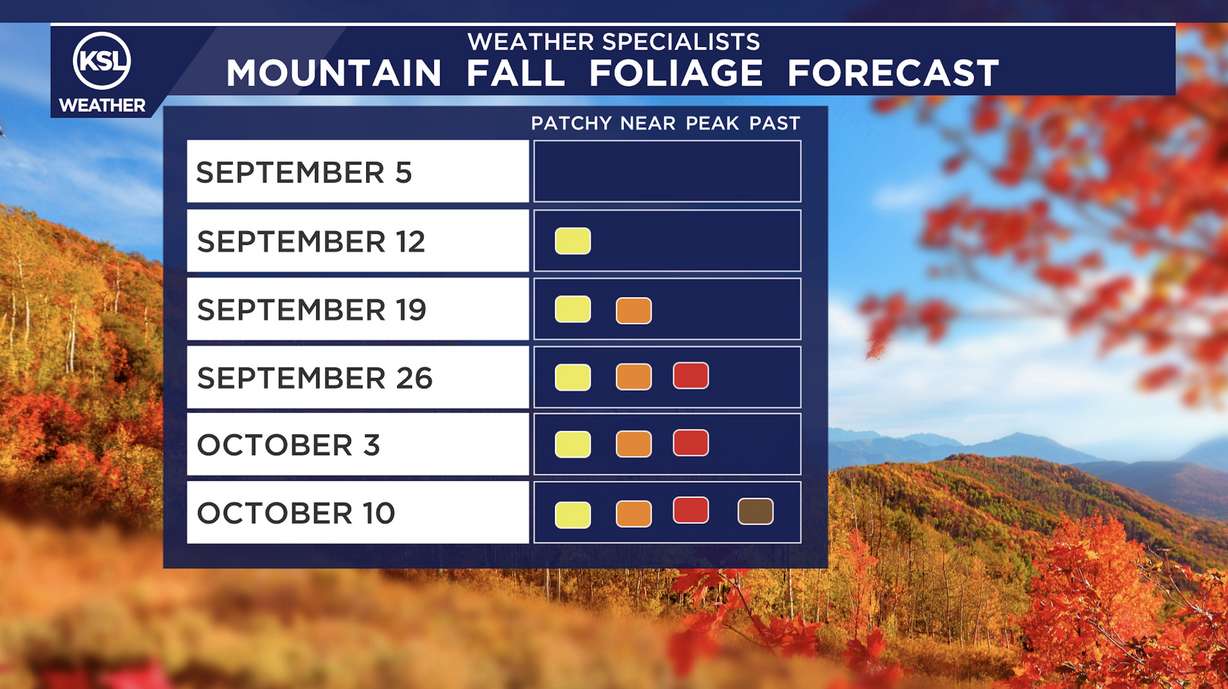
Explore Fall, a national website dedicated to the season and its colors, projected similar timing in its fall outlook.
Peak valley foliage usually begins in October, usually lingering through the middle and end of the month, depending on conditions. Some color could last into November, especially in southern Utah.
It's a delicate process that can be affected by the weather, though.
Prolonged summer heat could delay the timing, while an early freeze or persistent cool and rainy days may cause leaves to die without turning, said Darren McAvoy, an associate professor and forest ecologist for Utah State University.
Other potential factors
There's a level of uncertainty heading into this fall because this year has been so weird, too. Experts aren't entirely sure what this year's record-low snowpack, sweltering summer heat and other odd weather events will mean for people ready to explore the state's outdoors.
"We don't know what's going to happen," said David Bowling, a professor within the University of Utah's School of Biological Sciences.
This year's fall colors could be muted or as enjoyable as ever, but a lot of it may come down to plant health rather than anything else.
Drought is a major factor, especially after record-low snowpacks were reported across the state and not just one region.
Beyond a record number of forest and woodland acres burning this year, many trees have died from drought-related factors or dropped activity in branches to focus on other branches, Bowling explained to KSL. This summer's heat and higher overnight lows can also damage leaves, potentially causing the edges of leaves to turn brown and crispy or drop early.
"If they're totally droughted, some plants will drop their leaves early. ... Because we have had so much drought and because it's been so warm, the plants may be additionally stressed, and they may actually senesce earlier because they're so stressed," he said.
Many trees were also stressed because of a cold snap this spring. It killed fruit-growing potential for many trees while causing some trees to redevelop leaves that had already started to grow after June-like temperatures arrived in March.
This may be less of a factor in higher-elevation areas where leaf growth may not have started.
None of this to say there won't be good colors when the trees turn. Some places that didn't have a good winter snowpack had good spring moisture that could help lessen the blow of the low snowpack, McAvoy said.
Trees and plants are also resilient, and they learn to respond to their environment, even if it wounds them from time to time during their long lives, Bowling added.
Much like there's no exact science to foliage timing, there's really no science exploring how all of these affect the fall colors people enjoy every year.
McAvoy believes Utah's still in for a beautiful season; Bowling is a little more cautious amid the somewhat unprecedented conditions.
"I don't want to say that there's not going to be beautiful colors — I just don't know," he said.