- Utahns face financial strain due to inflation, job market issues and government shutdown.
- A poll shows 51% live paycheck-to-paycheck while 25% struggle with basic expenses.
- Emergency services report increased demand for aid as federal shutdown exacerbates financial challenges.
SALT LAKE CITY — A growing number of Utahns are facing mounting financial challenges thanks to a convergence of issues that include persistent inflation, a weakening U.S. jobs market and a federal government shutdown that has put hundreds of thousands out of work and threatened funding of critical programs.
Among those working to navigate the myriad fiscal hurdles are Emma and Bryan Mendez-Edwards, both college-educated professionals whose previous stability is under fire amid the current economic climate.
"Bryan is a federal worker," Mendez-Edwards said. "And I am currently working at the health department as an epidemiologist on a federal grant. So yeah, it's been a crazy rollercoaster over here."
A federal human resources employee, Bryan, is currently on furlough, and the Heber City couple is concerned the temporary work stoppage could become permanent.

"As this shutdown continues, he's facing a potential federal workforce reduction," Mendez-Edwards said. "My husband has only had seven, eight years — and we're worried it will be a first-in, first-out layoff. That's definitely been a cause for anxiety this year."
The couple's household budget is also under strain from increasing living expenses, along with hefty student loan payments.
"The cost of groceries and utilities are continuing to rise," she said. "With the new administration, the ending of the SAVE program (a federal program which helped limit the size of student loan payments), that's also a concern for us at the moment with increasing student loan monthly costs."
Mendez-Edwards says they're making ends meet with her income and a side job that her husband has taken on. But more worrying times could be ahead.

"Luckily, we do live in affordable housing, with a controlled mortgage, which has been very helpful at this time," Mendez-Edwards said. "My husband is not getting paid, but I am a salaried worker and able to support us.
"But I think once we reach the end of November, things will become more stressful."
And financial stress is an issue now facing a surprising number of Utahns.
How many Utahns are financially vulnerable?
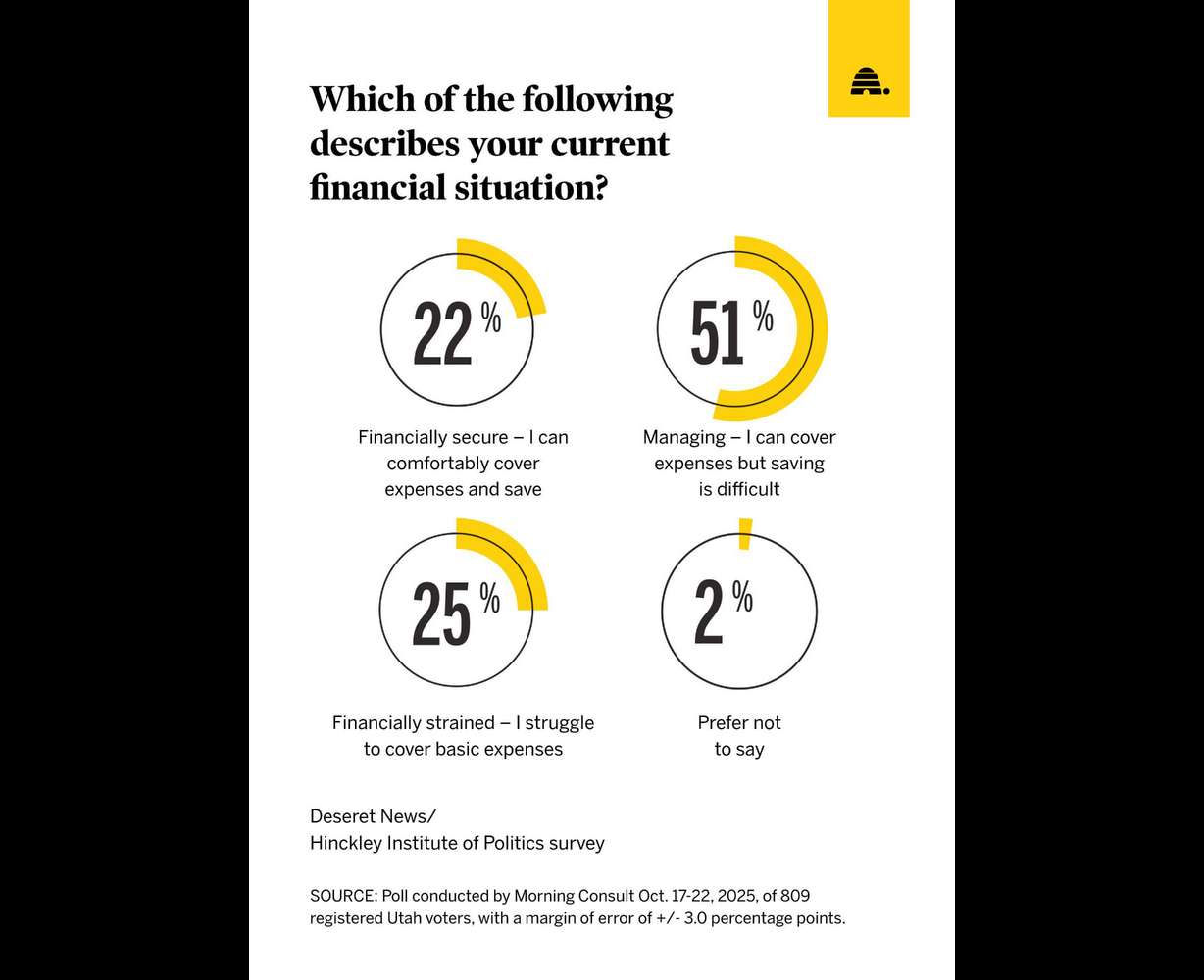
A new Deseret News/Hinckley Institute of Politics poll of 809 registered Utah voters conducted Oct. 17-22 found a majority of people are living paycheck-to-paycheck and 1 in 4 have even more serious struggles.
When asked to choose the best description of their current financial situation, 51% of respondents said they were managing to cover expenses but faced difficulty saving money and 25% report they are financially strained and struggling to cover basic expenses. Less than a quarter of poll participants, 22%, say they're financially secure and comfortably covering their living expenses.
The distribution of those who report facing the worst financial struggles is fairly evenly spread among Gen Zers, millennials and Gen Xers at 27%, 29% and 29%, respectively. However, fewer baby boomers are feeling the pinch, with 18% reporting financial strain.
Among those reporting current financial security, Utahns in the baby boomer generation led the way at 36% with millennials the next best represented age group at 22%.
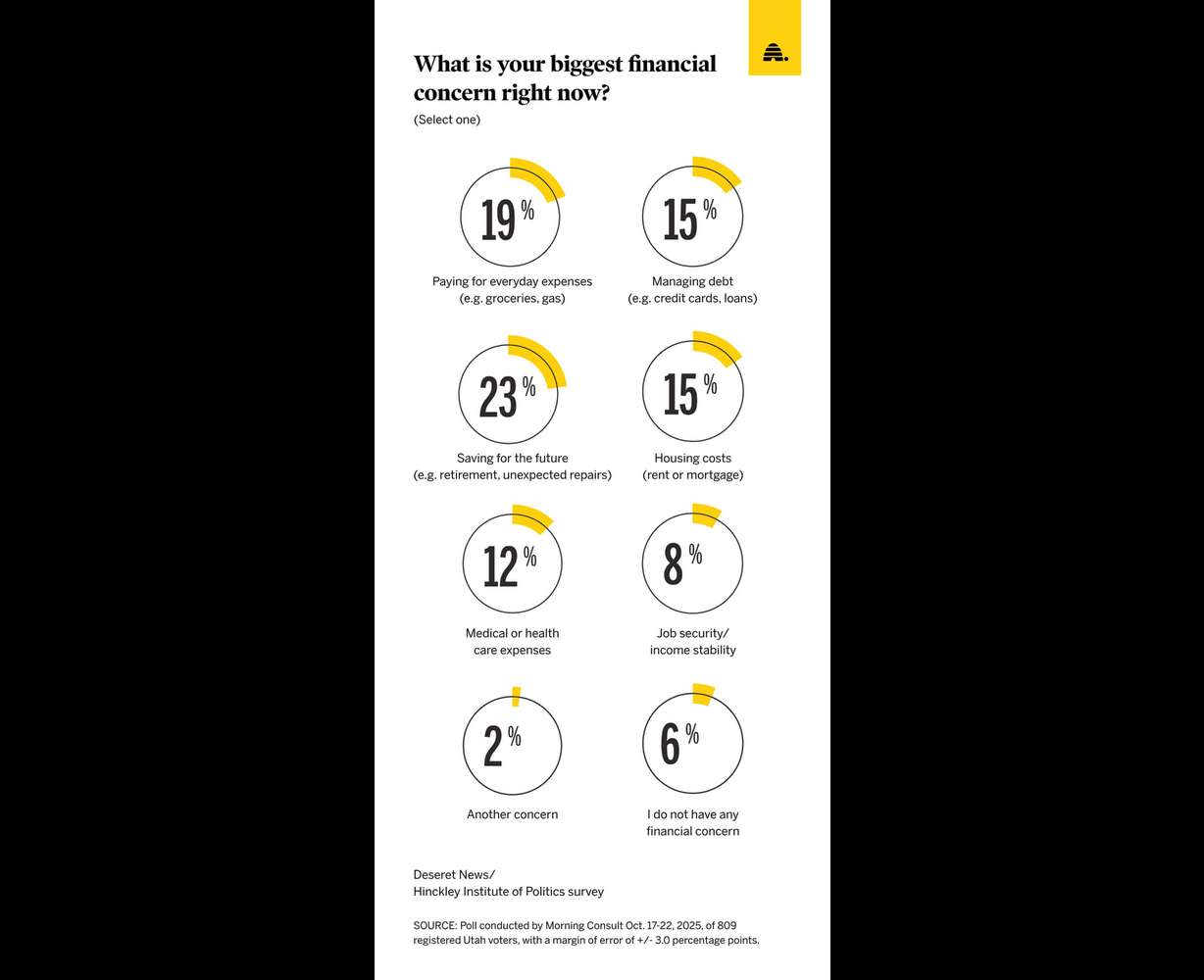
When asked to identify their biggest financial concerns of the moment, 23% of respondents said it was saving for the future, including putting away money for retirement; 19% listed paying for everyday expenses and 15% identified either managing debt or covering housing costs as their most significant financial challenge. Medical or health care issues are the top issue for 12% of poll participants and 8% said job security/income stability was their biggest worry.
The top financial concerns, by age group:
Gen Zers: Saving for the future
Millennials: Saving for the future
Gen Xers: Saving for the future
Baby boomers: Paying for everyday expenses
The poll conducted by Morning Consult for the Deseret News and Hinckley Institute of Politics has a margin of error of plus or minus 3 percentage points.
Looking out for those most in need
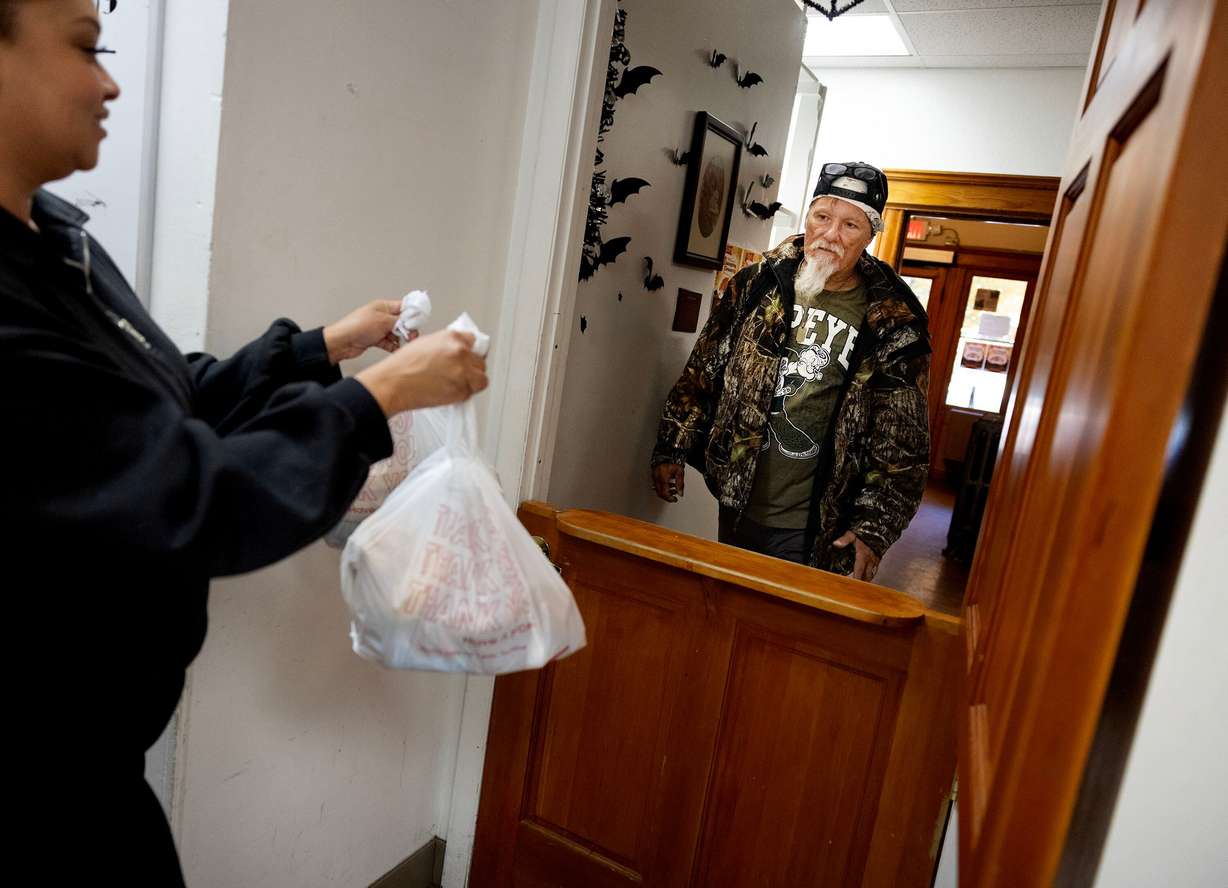
While financial struggles among Utahns are almost equally prevalent across age groups, those at the lowest economic rungs are at the most risk of being pushed to the brink. Emergency service providers like Crossroads Urban Center are at the front lines of the work to provide aid for those in most dire need.
Crossroads Urban Center executive director Glenn Bailey said demand for emergency food and basic needs has climbed sharply over the past several years — and the current federal government shutdown is making an already difficult situation worse.
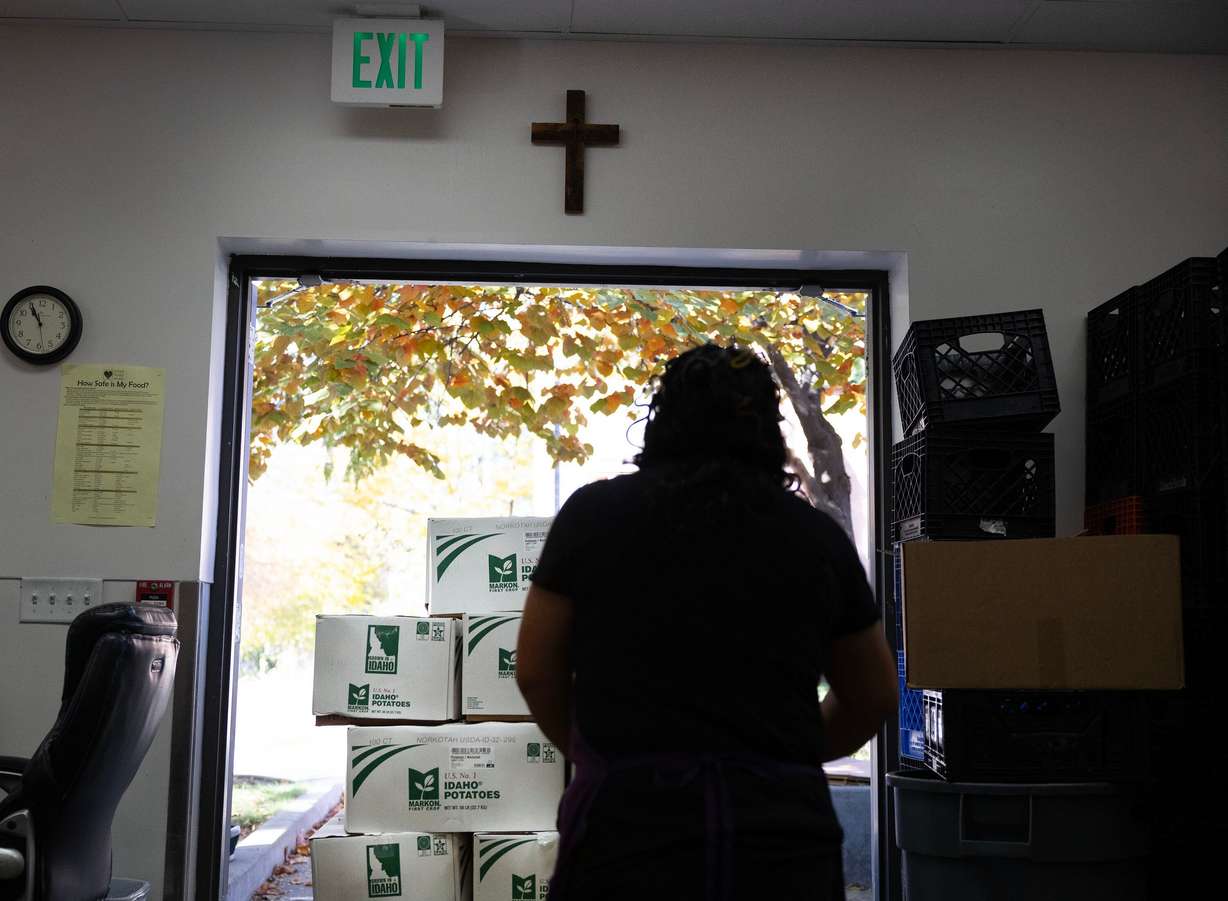
"We've been seeing steady dramatic increases in the need for emergency food as well as stuff we give away at the thrift store for the last three or four years," Bailey said. "With the government shutdown, people having less access to benefits. It's not a good time to be in the emergency food business."
Bailey noted that many clients turn to the food pantry only after exhausting other options.
"People are using the food pantry because they just paid the rent or a utility bill," he said, adding that "less access to tuition assistance, thanks to budget cuts and shutdowns" are leaving people with fewer safety nets.

The Crossroads director said the center's numbers show more families in need, though the overall demographics haven't shifted much.
"Thirty percent of people we serve downtown are homeless, but we are seeing more families for sure, especially at our west-side facility," Bailey said.
And he noted the change of season is set to elevate need to a "particularly acute" level.
"We stop 20–25 utility shutoffs a month with private funding," Bailey said. "We won't get through the whole day on Nov. 1 (when the application window for help with utility bills opens) and it will be gone for the month. Cold weather, increased need, wanting to participate in the holiday can be a very tense time."