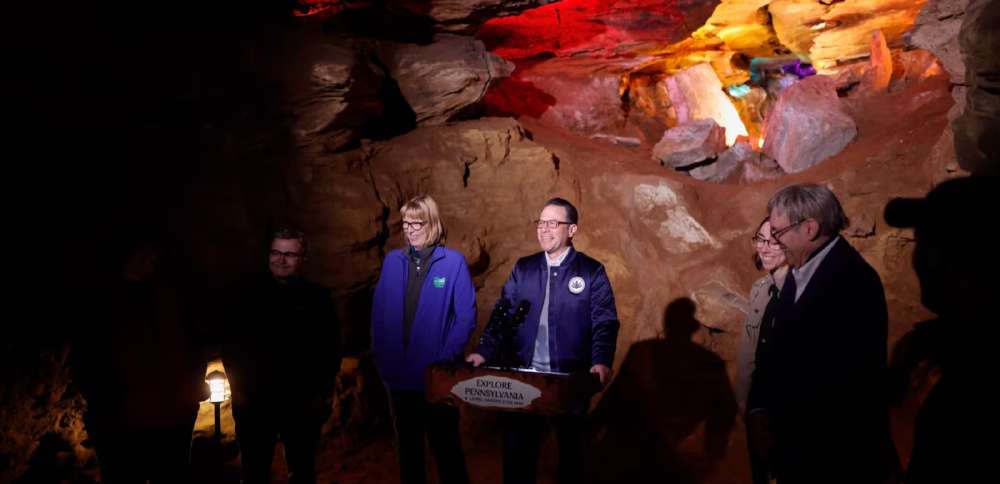
- Laurel Caverns, Pennsylvania's 125th state park, offers unique sandstone caves for exploration.
- The park's opening on Earth Day will highlight efforts to protect and enjoy Earth's treasures.
- Other parks around Utah also can provide the same enjoyment as Laurel Caverns in Pennsylvania.
SALT LAKE CITY — While Earth Day is generally associated with blue, sunny skies and green, forested areas, many in Pennsylvania might be celebrating Earth's special day in a dark, cold cave.
Pennsylvania's 125th state park, Laurel Caverns, includes 426 acres of mountainous terrain and cave systems that stretch 4 miles long. It's by no means close in size to any of the largest caves in the country, but it is one of the largest calcareous sandstone caves in the world, along with being the largest in Pennsylvania.
Sandstone caves such as Laurel Caverns are unique because, unlike many other deep caves, they generally do not form stalactites, since those are often formed in caves made out of limestone, meeting the right conditions.
"Parks like Laurel Caverns give our kids a new place to learn, our families a place to make memories, and all of us a chance to get away, take a breath, and just enjoy nature," Pennsylvania Gov. Josh Shapiro said in a release.
Along with his enthusiasm for the new park, he recognized the 125th milestone by highlighting nature's ability to bring people together.
"I think it's also important in these times of great division to come together and not pay so much attention to who you voted for, but pay attention to the terrain you get to walk together, the beautiful waterfalls, in this case, these underground caves," he told CBS News. "All of a sudden when you're doing that with folks, those differences sort of blend away, and instead you find our common humanity, you find that common decency, you find that commonality that brings people together."
Which is why it's fitting for the park to be opened on Earth Day, April 22, a day that unites the world in an effort to protect and also enjoy the treasures the planet holds.
Before being donated to the state, the caves were operated by the Cale family, conducting tours for visitors to see its underground waterfall, chandelier hall and its gravity hill illusion, where, if you place a ball on a specific rock, the ball appears to be rolling upward.
Caves in Utah
Home to a wide variety of caves, Utah offers plenty for cave enthusiasts to visit, ranging from show caves to more challenging caves to explore. From a heart-shaped stalactite to evidence of human habitation, Utah's caves each provide something unique for its visitors.
So, if you want to escape the upper-ground this Earth Day or this summer and explore the dark underground, one of these caves might be the place to go.
Timpanogos Cave
Operated by the National Park Service, Timpanogos Cave is perhaps the most popular cave in Utah. Set to open mid-May, visitors hike 1½ miles up a steep trail in American Fork Canyon to take a guided tour that features helictites, an underground lake and a massive stalactite making a heart shape known as "the heart of Timpanogos."
Mammoth Cave (Cedar City)
No, not the famous Mammoth Cave in Kentucky. This southern Utah cave was formed from lava flows less than 2,000 years ago, according to Bryce Canyon Country. The cave features four chambers with unique features like volcanic rock and some areas with ice formations. The cave is open year-round for self-exploration, although some parts are gated off to protect hibernating bats during parts of the year.
Danger Cave
Getting its name from a near-death incident when a large boulder broke off from the face of the cave and just missed a crew of archaeologists excavating the site, "Danger" took place of its original name, "Hands and Knees," Intermountain Histories says. Located near Wendover, Danger Cave holds evidence of human inhabitants from nearly 11,000 years ago, including artifacts, materials and human remains. The cave is a state monument and can only be explored when you register for a tour during the spring and fall.
Mossy Cave
This alcove found in Bryce Canyon National Park isn't necessarily what you think of when you think of your typical cave, but by definition, it is a cave. This formation features an overhang in sandstone named for its green moss found inside, the national park website says. In the winter, you will find large ice formations from water seeping through the above rock and freezing in the deep shade.