Estimated read time: 8-9 minutes
- Tyler Robinson's defense argues media coverage biases potential jurors, threatening a fair trial.
- Prosecutors support cameras in court, claiming transparency counters misinformation and conspiracy theories.
- Judge Tony Graf will rule on camera use May 8; preliminary currently hearing set for May 18.
PROVO — Electronic media coverage of the Tyler Robinson capital murder case is biased and prejudicial, his defense team argued Friday, and threatens his right to seat a fair and impartial jury.
Prosecutors, however, say while it is true that the widespread attention the case has received has generated a number of conspiracy theories, particularly on social media, not all of them disfavor the defense. Because of that, Chad Grunander, the chief deputy in the Utah County Attorney's Office, says microphones and cameras should be allowed in the courtroom during Robinson's case, including livestreaming of his hearings.
"Mischief lurks in the dark or in secret," he told 4th District Judge Tony Graf on Friday. "Let's shine a light on these proceedings, a bright light, so the public can have confidence in these proceedings."
On Friday, Graf heard arguments for nearly seven hours on two issues: whether cameras should be allowed in the courtroom, and whether Robinson's preliminary hearing, currently scheduled to begin next month, should be delayed. Robinson, who turned 23 on Thursday, is accused of shooting and killing political activist Charlie Kirk on the campus of Utah Valley University on Sept. 10, 2025. He is charged with capital murder and faces a potential death sentence if convicted.
In January, Robinson filed a motion requesting that "television cameras and microphones, still photographers, radio microphones and other similar implements of the electronic or broadcast media" be kept out of the courtroom during his legal proceedings. The motion was filed under seal because Robinson claimed he didn't want the news stories and press conferences his team cited as reasons for banning cameras to then be republicized by the media.
Robinson contends that "highly sensational" electronic media coverage threatens his due process and his rights to seating a fair and impartial jury.The Utah County Attorney's Office countered that the publicity surrounding the high-profile case has also raised concerns for the office. But unlike the defense team, prosecutors say that's exactly why cameras and microphones should remain in the courtroom.
Defense's arguments
The defense called two witnesses on Friday: Christine L. Ruva, a professor and chair of psychology at the University of South Florida Sarasota-Manatee who has studied how pretrial publicity affects potential jurors; and Bryan Edelman, of California, who holds a doctorate in social psychology, and assisted the defense of Bryan Kohberger, who was convicted in the 2022 murders of four University of Idaho students.
Edelman conducted a survey on March 13 of about 200 Utah County residents to find out who is being exposed to coverage of the Tyler Robinson case, how closely they are following the legal proceedings and what impressions they have gotten out of it so far.
According to his survey, 99% of those questioned had heard of the Robinson case in some form with only three saying they didn't know anything about the case. About 64% of respondents believe Robinson is guilty, and 35% believe he should receive the death penalty, according to the survey. Edelman also said that only 25% of residents are watching the court hearings on livestream while the majority of those polled are watching television news coverage at a later time or getting information about the case on social media.
For nearly an hour, defense attorney Michael Burt played videos from local and national news outlets regarding their coverage of Robinson. Many of the clips focused on Robinson's brief initial court appearance via Webex and a second brief hearing in which his attorneys were appointed. Burt argued that in all the videos shown, the news anchors focused on video from those actual hearings only for a moment before turning to a panel of analysts — including body language experts — who offered their opinions on the case.
"Now we're completely speculating with conjecture" and "making ridiculous statements," Edelman said, calling that coverage "all speculation and sensational."
"It's turning into a reality TV show," he said.
Daniella Rivera, KSLBoth Edelman and Burt contend the discussion by the analysts had nothing to do with that day's hearing and only prejudiced potential jurors. The defense also pointed to the inflammatory language following Robinson's arrest used by national and state leaders, such as President Donald Trump and Gov. Spencer Cox, and how it could potentially taint a jury pool. In some instances, the coverage replayed soundbites from the press conference Utah County Attorney Jeff Grey held in September.
Grunander countered, however, that it's third parties that are creating the sensational content and not the livestream itself. And just because 99% of poll respondents had heard of the Robinson case, awareness does not equate to an unfair trial.
Grunander went through other parts of Edleman's survey, noting that 81% of respondents said they had not seen or heard Trump's remarks regarding Robinson, 56% had not heard of Robinson's alleged confessions, and 65% were unaware of the DNA evidence that was reported.
The state's lone witness, Cole Christensen, an investigator with the Utah County Attorney's Office, testified that he conducted his own survey of media coverage of the Robinson case and found there are negative feelings by some for all the parties involved, Robinson, prosecutors and even Charlie and Erika Kirk. The state argued this shows the media coverage is not simply fueling anti-Robinson sentiment.
The defense's other witness on Friday, Ruva, testified that any positive pretrial publicity Robinson may receive does not outweigh the initial wave of negative publicity he received.
"When you front-load pretrial publicity with all the negative pretrial publicity then it's difficult to overcome that initial bias," she said, noting that people like Trump, Cox, Vice President JD Vance and FBI Director Kash Patel have painted Robinson in a negative light.
Graf says he will announce his ruling on whether to continue to allow cameras in the courtroom on May 8.
During the first part of Friday's hearing, Graf listened to arguments from both sides about whether Robinson's preliminary hearing, scheduled to begin May 18, should be postponed.
Robinson and his defense team say they have not yet received the "appropriate discovery" needed to prepare for the preliminary hearing, specifically DNA reports from the FBI and ATF.
"We have a right at a preliminary hearing to both examine and cross-examine witnesses," defense attorney Richard Novak argued in court. "We can't do that when the ATF and FBI have not provided us with appropriate discovery.
"We can't present any expert testimony on DNA without having the underlying data," he continued.
Novak encouraged Graf to have the state ask the FBI why it hasn't turned over that data yet, even though, as early as September, the FBI alleged in preliminary reports that Robinson's DNA was found on key pieces of evidence, such as the rifle allegedly used to shoot Kirk.
Prosecutors respond
Prosecutors responded by reminding the judge that the state has a low bar at the preliminary hearing stage to show probable cause. Ryan McBride, with the Utah County Attorney's Office, said for a preliminary hearing, there is "one purpose and one purpose only: to determine probable cause."
McBride said the state has four categories of evidence it plans to provide at the hearing: surveillance video from UVU; circumstantial evidence tying Robinson to a rifle and bullet casings found following the shooting; several alleged confessions made by Robinson; and DNA. Even if all the DNA evidence hasn't been turned over or analyzed yet, McBride said, for the purpose of a preliminary hearing, any of the other three categories alone establishes probable cause.
"They're not going to be able to defeat a confession … multiple confessions," he said.
"Core" evidence that the state intends to use at the preliminary hearing has already been shared with the defense, McBride said. Expert testimony, he said, is not necessary in the early stages of the court proceedings.
If the preliminary hearing is continued, McBride guessed it would be pushed back at least six months and possibly longer. Graf questioned each of Robinson's four defense attorneys and asked how long they would need to prepare for the hearing with the evidence they already have. The defense team collectively noted they needed at least four more months to review the very large amount of discovery that had been shared in the case. Lead attorney Kathy Nester also noted that she had been tied up with the recently completed Kouri Richins murder trial and has not had sufficient time to review evidence in the Robinson case.
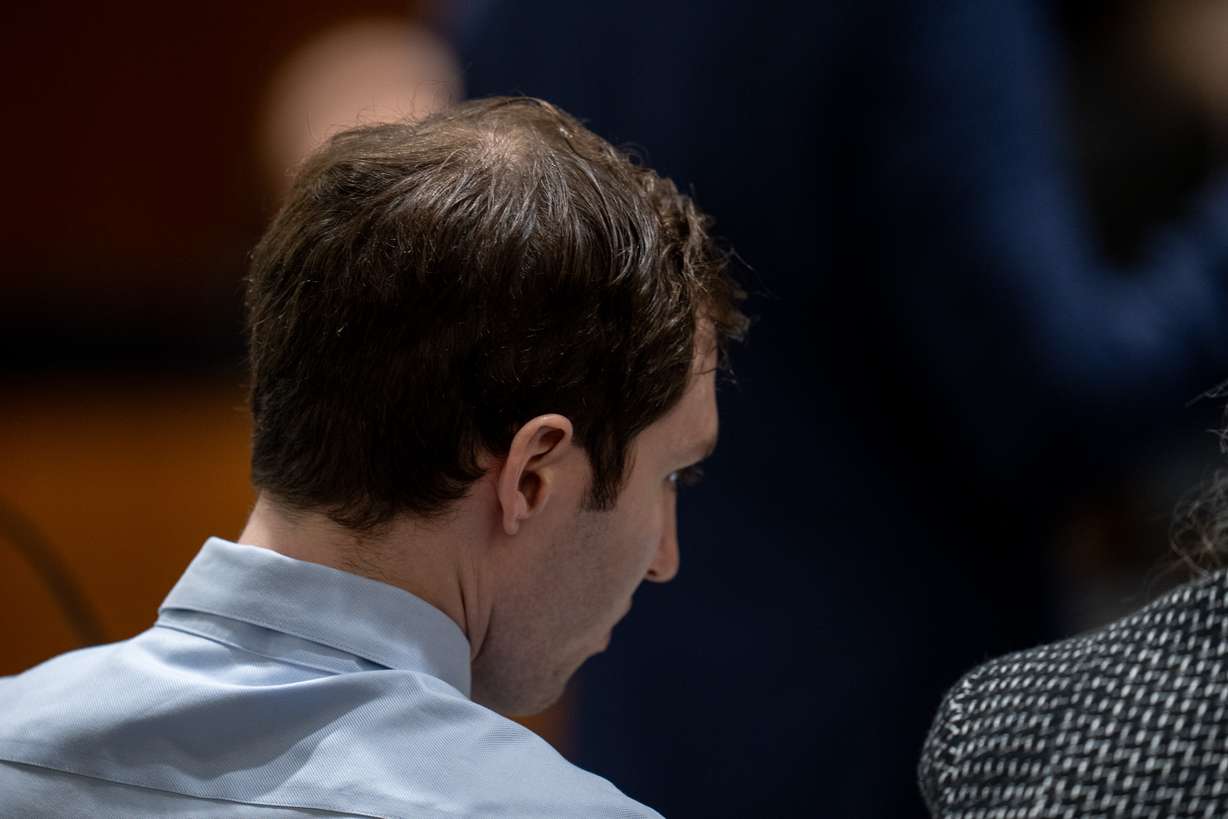
At the end of Friday's hearing, Graf read a statement reminding attorneys on both sides that they could be held in contempt of court if they make extra statements about the case to reporters outside the courtroom. Although he did not call out any names, the statement appeared to be in response to motion by Robinson asking to have the Utah County Attorney's Office held in contempt for statements allegedly made by prosecutor Chris Ballard, the department's spokesman, to media outlets following the revelation of DNA evidence on a bullet fragment recovered during Kirk's autopsy.