
- Kearns High School students transformed an old crop garden into a pollinator garden.
- The garden aims to support Utah's pollinators amid worsening drought conditions.
- Grants and community support fund the project, expanding it into an outdoor classroom.
KEARNS — Students at Kearns High School are working to create a space for pollinators to thrive in a time where Utah's drought conditions continue to worsen, adding to the stress on vital pollinators.
The KHS Pollinator Garden was previously used as a crop garden for a science class at Kearns. Eventually, the crops became too difficult for one teacher to care for, and the area became a mess of weeds and dirt with empty garden beds implanted into the Earth.
Daisy Villalpando, president of the leadership team with Salt Lake Community College's Partnership for Accessing College Education scholarship program, talked about what it took for the garden to become what it is today.
"Our goal with this is for it to be an outdoor classroom, for the garden to expand and to teach students about environmental stewardship," Villalpando said.
Jared Burgess, a science teacher at Kearns, made plans with art teacher June Christiansen to create the space after Burgess received a grant for a pollinator garden, and discovered Kearns' old, worn down crop garden area. While Burgess said he loved flowers, his goal was to help Utah's pollinators.
After some time of working on the garden with the assistance of some people, Burgess realized his students may want to join in on restoring the area.
"At first I was a little bit apprehensive because I was like, 'Forty kids by myself and they're all ninth graders, is this really gonna work out?'" Burgess said. "And so, we came out the first time and they did really, really well and I was like, 'You know what, this might actually be something we can continue.'"
From there, students worked to clear out all the trash, grass and even bikes from the area. Mulch was eventually put down, and the students grew excited to visit the garden more and more.
"I kept telling them we were gonna make a pollinator garden and they didn't believe me because we didn't plant anything until the end of May, and we started working out here in February," Burgess said.
Burgess said he used the grant he was given to buy items needed for the garden. Students planted seeds, fixed the garden's watering system and worked together to create the pollinator garden they were promised.
"It's a little bit different work than we did at the beginning," Burgess said. "It was a lot more shovel work and stuff, and now we're just kind of learning to maintain it and learning to make it more of a pollinator paradise or oasis."
Pollinators and future plans
The pollinator garden is not just important to the students; it's important for the one population it was created for — pollinators.
"Not everyone has flowers," Burgess explained. "There's a lot of grass, there's a lot of trees, but there's not always food for them to eat."
While making plans for the garden, Burgess ended up talking with Christiansen about the importance behind bees and other pollinators being present in Utah, which is home to about 1,100 native bee species, according to Utah State University Extension.
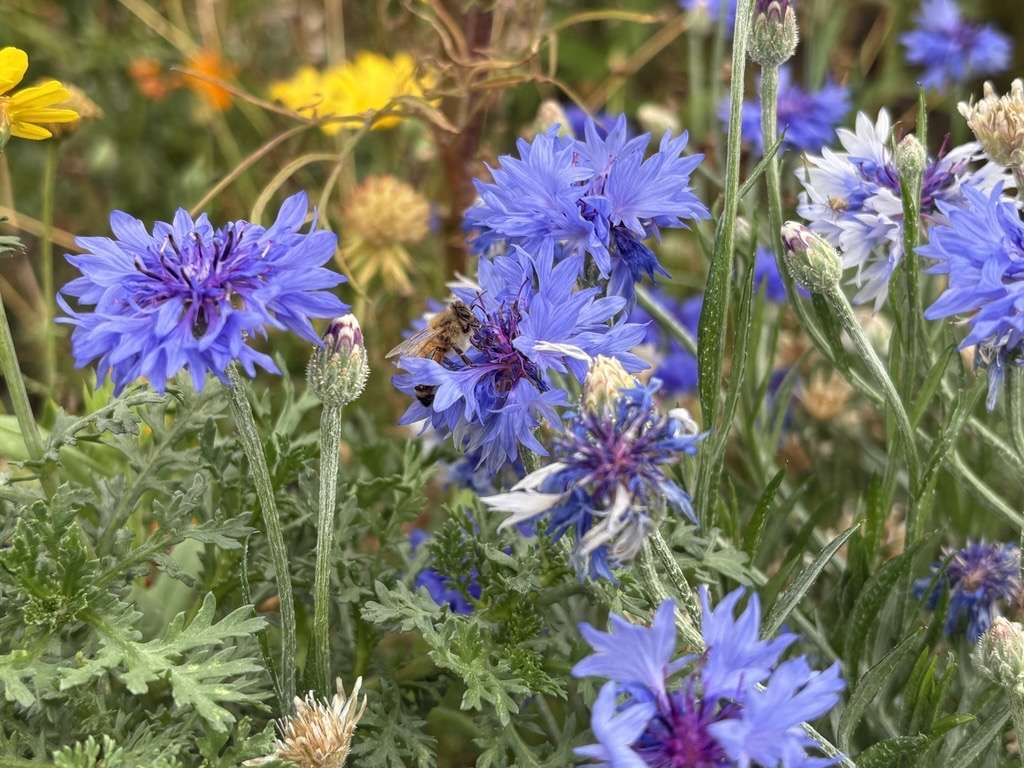
Just this summer, Burgess said the students witnessed 10 to 15 or more pollinators present in the garden.
"Some of them were so small we couldn't even tell what they were; we couldn't catch them, and others were a little bit bigger," Burgess said. "We had some carpenter bees that are giants. It was just a lot of fun to come out here and to look at what was going on and to just look at the different animals that were here."
The pollinator garden is 100% free of pesticides because Burgess said pesticides have the ability to kill bees, and the insecticides can travel with the bees as they move, affecting other bees and their larvae as well.
Burgess hopes to teach his students more about the pollinators they see every day. In order to do that, he has applied for an Education Innovation Program grant that will allow him to change one of his classes from zoology to zoology of pollinators next school year.
The educational opportunities don't stop there. Students are expected to teach the public about pollinators, how to garden and more in the future.
Christiansen said she wants to bring her art class out to the garden, welding and metalwork students hope to create garden decor to add to the area and the school's garden club would like to expand the area even more.
Burgess said the wood shop at Kearns even helped out by providing a protective barrier made of wood for the garden's water system.
In support of the garden, Rep. Ashlee Matthews, D-West Jordan, showed up to a fundraiser held on Sept. 23, which raised about $3,000 for garden supplies. The Rocky Mountain Power Foundation also provided a grant of about $2,500 to help students out with tools and other projects in relation to the garden.
The hope is for those funds and possible future funds to expand the garden into a space for an outdoor classroom. Villalpando said she's grateful for the garden and appreciates everybody who has been involved in the effort of building a space like the KHS Pollinator Garden.
"It's beautiful to be able to have this, especially in a time when climate change is here, especially in Utah," Villalpando said. "It's just a really beautiful thing to have."
Burgess said at the end of the day, it's vital for the students to recognize that their efforts are important.
"I've enjoyed watching these kids learn how to work, and work in a setting where they're not necessarily getting paid and they're just learning some of the skills," Burgess said. "They might do some of it at home, but this is a large scale situation and they're doing it for everyone's benefits."