- The Weber State University Sustainability Home will serve to encourage homeowners to implement energy-efficiency upgrades.
- Those wanting to implement upgrades will be able to tour the Ogden house, designed and built by Weber State students and faculty, and take part in workshops at it.
- The home, completed in 2020, is electrified and was built with an array of energy-saving features.
OGDEN — An energy-efficient home originally designed and built by Weber State University students and faculty to promote construction of more homes like it is now taking on a new function.
The house at 2807 Quincy Ave. will instead serve as a model home and base of operations for an initiative meant to encourage homeowners to implement their own energy-efficient upgrades, big and small. The target audience is "anybody that wants to make a simple energy-efficiency upgrade, even if it's just putting in an energy-(efficient) light bulb, to somebody that wants to put solar on their home," said Bonnie Christiansen, who's leading the effort.
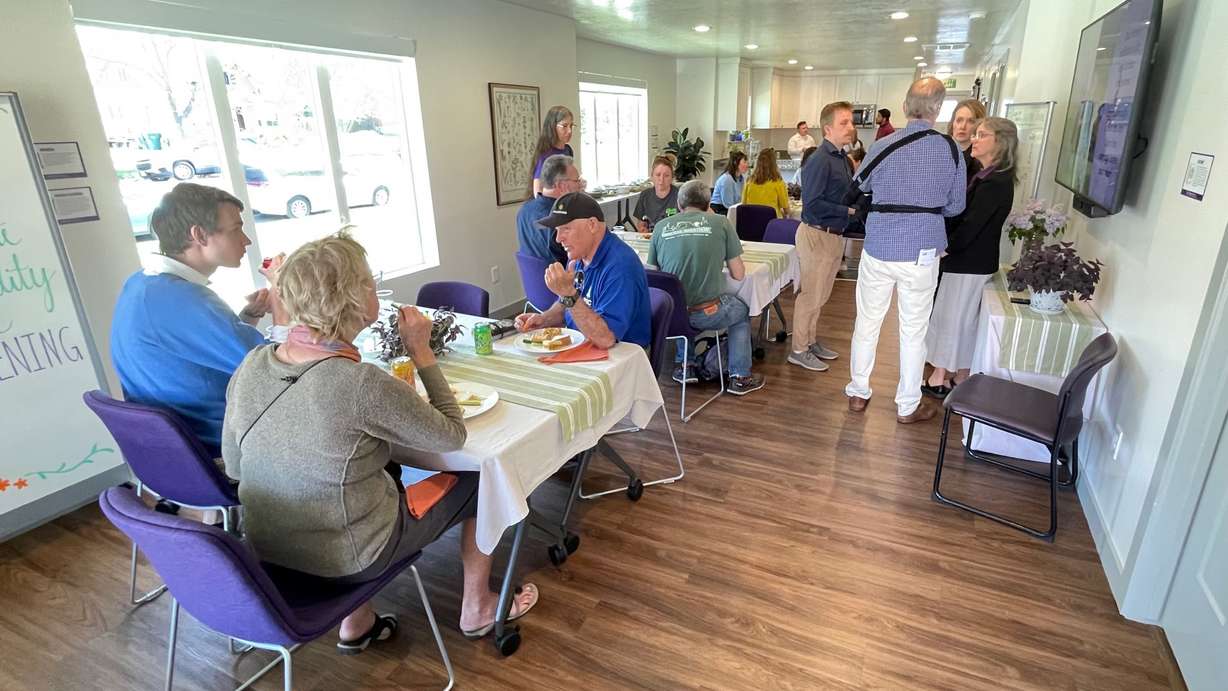
The Weber State Sustainability Home, as it's now dubbed, was first completed in 2020 and initially occupied by a family. That family has since moved, and on Tuesday, university officials gathered to kick off its new function as a demonstration home within Weber State's Sustainability Practices and Research Center, which Christiansen helps manage.
"Sometimes all you need is someone to show you what's possible," she said. "Our goal is to educate and empower people. Sustainability is partly about learning and keeping up with technology so we can move toward a cleaner environment."
The initiative is an extension of university efforts, launched in 2007, to reduce the carbon footprint of the college campus via implementation of energy-efficient technology. Those efforts have led to $30 million in savings.
"This is what it looks like when environmental responsibility and fiscal stewardship align, and now, with the launch of the Weber Sustainability Home, we are extending our work to individuals and families, offering practical tools and guidance to make everyday choices that are both environmentally responsible and cost effective," said Leslie Durham, the interim university president.
The new program is geared to people in Ogden and, with the help of an outreach coordinator, locales around the state.
The 2,500-square-foot home was built as part of a U.S. Department of Energy program, the Solar Decathlon competition, meant to encourage interest among university students in "the energy workforce" and promote use of energy-efficient technology. It is fully electrified, powered by 39 roof-top solar panels, and relies on a heat pump for heating and cooling. The construction is "air-tight," helping maintain the home's interior temperature, and the house features many other energy-efficient attributes.
Shelby Lofton, KSL"Off-the-shelf" technology was used in designing and building the home and, when it was first completed, Weber State officials estimated energy costs to run the home would total just $100 a year.
Now, the home will serve as the headquarters of efforts to encourage others to investigate energy-efficient technology. WSU officials will host public workshops at the home, provide guidance to those seeking more complex advice and collaborate with other organizations to get word out about the initiative. A $2.49 million grant from the Utah Department of Environmental Quality, to last through 2029, will help cover staffing costs and "energy-efficiency giveaways" to help the public implement upgrades in their own homes.
The initiative also aims to give WSU students like Adriana Van Vliet hands-on experience in the sustainable energy sector. Van Vliet, studying energy engineering, will help with community outreach.
Those taking part in the initiative will get hands-on training for fixes they can implement in their own homes, she said, and even some materials, free of charge. Relatively simple upgrades can include installation of weather stripping, caulking gaps around windows and installing LED lighting.
"Since it's a demonstration home, we have people come and walk through and give them a run-through of what an energy-efficient, net-zero home looks like," she said.

Related stories
Most recent Environment stories
Related topics
 Tim Vandenack