
Estimated read time: 5-6 minutes
- U.S. measles cases hit a 35-year high with 4,080 confirmed cases by Oct. 8.
- Vaccine interest increases as outbreaks occur in Pennsylvania Utah and South Carolina.
- CDC reevaluates measles death counts; six deaths reported but only two confirmed.
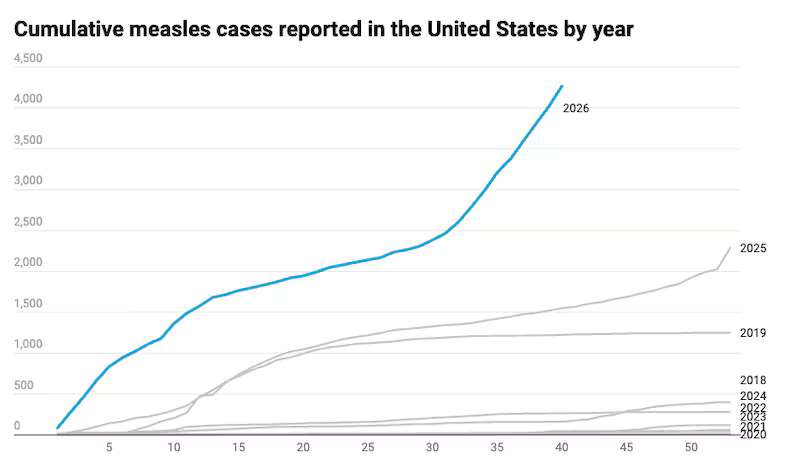
ATLANTA — Last year, with 2,289 measles cases confirmed, there was speculation the U.S. would lose its status as a country where measles was considered eliminated. It was a decades-high count.
But 2026 has left those numbers in the dust, marking a 35-year high with more than two months to go.
As of Oct. 8, the count of confirmed U.S. measles cases was 4,080, with infections reported in 47 jurisdictions, most of them associated with 42 confirmed outbreaks. Nearly six in every 10 of those cases have been in children. Ten percent of the infections were severe enough to require hospitalization.
Those numbers come from the Centers for Disease Control and Prevention, which notes that the biggest outbreaks have been in Pennsylvania, Utah and South Carolina this year.
The CDC acknowledges the numbers are an undercount, since more cases have been reported but are not yet lab confirmed.
The Johns Hopkins "U.S. Measles Tracker" reported that as of Oct. 9 there have been 4,267 measles cases.
How are measles deaths counted?
At least six people have reportedly died, though the official CDC count is two at the moment, as federal officials gather more information and review cases.
As Reuters explained, the U.S. has considered the death of anyone infected with measles "to be related to the virus, which can directly impair organs or exacerbate underlying health problems." But Robert F. Kennedy Jr., the secretary of the U.S. Department of Health and Human Services, has changed that.
"Instead, the CDC's National Center for Health Statistics will first confirm that measles was identified as an underlying cause of death on a person's death certificate — a process that can take weeks, according to health experts. The CDC has also said it was re-evaluating how measles deaths are defined, without explaining the need for such a review," per the article.
According to Reuters, "Local public health officials generally focus on the underlying cause because it reflects the disease responsible for setting the fatal process in motion."
Reuters said that Kennedy, who has in the past been an outspoken critic of the measles vaccine, has "sparred publicly with Pennsylvania Gov. Josh Shapiro, a Democrat, over the state's report of measles-related deaths before changing how such fatalities are counted. The CDC has so far accepted only two out of five measles-related deaths reported by U.S. states so far this year."
ABC News is reporting that vaccine interest is rising as measles spread continues.
"We have seen increased interest in the MMR vaccine since the start of the outbreak," Lindsay Pringle, manager of community health and wellness at Penn Medicine Lancaster General Health, told ABC. "Public awareness of measles and its potential complications have grown during this time, which may influence vaccination decisions."
MMR stands for measles, mumps and rubella and the vaccine was introduced in 1971.
Kirk Benge, health officer and executive director of Utah's TriCounty Health Department, told ABC News that local officials have worried about declining vaccination rates for years.
Noting an increase in exemptions, he said, "We did issue a local request to the school district to require students that were not vaccinated to stay home for several weeks and I think we saw the outbreak in our area subside relatively quickly compared to a lot of areas in the state."
He also noted "an interest in the community among parents wanting to catch their child up on the MMR vaccine," per the article, resulting in a 500% increase in parents getting their child that vaccine as of March 2026 compared to March 2025 so they could stay in school.
Three states with lots of cases
In Pennsylvania, public health officials note 1,222 cases as of Oct. 14. Six people in Pennsylvania have died from measles complications, according to CIDRAP, the University of Minnesota's Center for Infectious Disease Research and Policy at the University of Minnesota.
Per CIDRAP, those who died include "two infants, a 20-year-old woman with leukemia who was undergoing chemotherapy; a 40-year-old woman with asthma and chronic obstructive pulmonary disease; and an 18-year-old who developed disseminated encephalomyelitis, a rare neurologic complication of measles."
Utah has had 527 confirmed cases in 2025-2026, per the state's Department of Health and Human Services, while the 2025 count was 197. Of those in 2026, 267 were in the Southwest Utah health district. There have been no recent exposures reported to the state.
According to Johns Hopkins, Spartanburg County in South Carolina has had 610 cases so far this year, making it the individual county that has had the most cases.
About measles
The American Academy of Pediatrics "Red Book" chapter on measles said those most at risk of getting measles are those who are unvaccinated or incompletely vaccinated (two doses are routine) and those with known exposure to measles or recent travel to areas with active community spread.
Those at greatest risk of severe measles or complications include those younger than 5, adults older than 20, pregnant women and people with compromised immune systems.
Complications can occur even in people who were previously healthy and may include:
- Ear infections
- Diarrhea
- Pneumonia (from the virus itself or bacterial superinfection)
- Encephalitis
- Death
Besides that, measles infection increases the risk of other types of severe infections — sometimes for months or years. Having measles has, in some cases, wiped out the immune system's memory of previous exposures to infections or vaccines, a mechanism called "immune amnesia."
The Pediatrics Academy also notes there is "no specific antiviral therapy for treatment of measles infection."