'%3e%3cpath%20d='M34.1406%205.85938C30.3906%202.10547%2025.3047%200%2020%200C14.6953%200%209.60938%202.10547%205.85938%205.85938C2.10938%209.61328%200%2014.6953%200%2020C0%2025.3047%202.10547%2030.3906%205.85938%2034.1406C9.61328%2037.8906%2014.6953%2040%2020%2040C25.3047%2040%2030.3906%2037.8945%2034.1406%2034.1406C37.8906%2030.3906%2040%2025.3047%2040%2020C40%2014.6953%2037.8945%209.60938%2034.1406%205.85938ZM37.0117%2023.543H31.1602V13.5391H27.6328V19.9414C28.1211%2020.6914%2028.3711%2021.582%2028.3711%2022.5625V22.625C28.3711%2023.668%2028.1172%2024.6055%2027.6328%2025.4297V26.6094H36.082C33.4883%2032.9375%2027.2891%2037.3789%2020.0039%2037.3789C10.3711%2037.3789%202.62109%2029.6289%202.62109%2020C2.62109%2010.3711%2010.3711%202.62109%2020%202.62109C29.6289%202.62109%2037.3789%2010.3711%2037.3789%2020C37.3789%2021.1484%2037.2617%2022.2656%2037.0508%2023.3477C37.0391%2023.4141%2037.0234%2023.4766%2037.0117%2023.543Z'%20fill='white'/%3e%3cpath%20d='M22.3086%2018.5352C20.4336%2018.125%2019.9531%2017.8398%2019.9766%2017.1836V17.1406C19.9766%2016.6992%2020.3477%2016.2148%2021.4023%2016.2148C22.582%2016.2148%2023.8867%2016.6797%2025.0781%2017.4766L26.8516%2015.0195C25.4453%2013.8906%2023.707%2013.3398%2021.5547%2013.3398C18.5195%2013.3398%2016.4375%2015%2016.4063%2017.4766V17.5352C16.3633%2020.2617%2018.5859%2020.9805%2021.293%2021.6016C23.0391%2021.9766%2023.5703%2022.3164%2023.5703%2022.9609L23.5469%2022.9766C23.5469%2023.3906%2023.2578%2023.7031%2022.7852%2023.8359C22.5742%2023.9062%2022.1289%2023.9727%2021.5156%2023.9727C20.7617%2023.9727%2019.7539%2023.8633%2018.6328%2023.4844C18.0898%2023.2891%2017.4727%2023.0039%2016.8047%2022.6133L20.1406%2026.625C20.2813%2026.6602%2021.0977%2026.8516%2021.7734%2026.8516C25.0039%2026.8516%2027.0859%2025.2461%2027.1094%2022.6328V22.5703C27.1602%2020.1133%2025.2148%2019.1719%2022.3086%2018.5352Z'%20fill='white'/%3e%3cpath%20d='M5.24219%2013.5664V26.6133H8.75391V23.7578L10.2969%2021.9531L14.2031%2026.6133H18.3867L12.3555%2019.5195L17.4023%2013.5664H13.4531L8.75391%2019.0586V13.5664H5.24219Z'%20fill='white'/%3e%3c/g%3e%3cdefs%3e%3cclipPath%20id='clip0_97_2430'%3e%3crect%20width='40'%20height='40'%20fill='white'/%3e%3c/clipPath%3e%3c/defs%3e%3c/svg%3e)


Estimated read time: 4-5 minutes
- Utah and Wyoming urge renewed negotiations on Colorado River water conservation.
- Failure to agree may lead to the Department of the Interior imposing a plan after Oct. 1.
- Utah stresses shared cuts, infrastructure improvements and capped releases to avoid litigation.
SALT LAKE CITY — The clock is ticking to decide who conserves how much water from the Colorado River during low water years. With the final deadline now less than four months away, Utah and Wyoming are trying to get their neighbor states to renew negotiations.
The water year ends Oct. 1.
If the seven basin states fail to reach an agreement by then, the Department of the Interior will impose a plan. Arizona and Colorado have both indicated they will pursue litigation if they feel the Interior's plan is unfair.
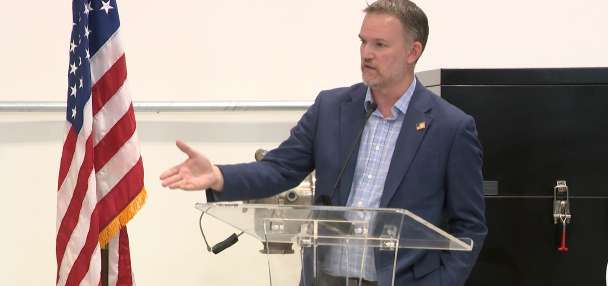
"The window to solve this without lawyers, judges and generational damage to basin relationships is shrinking faster than Lake Powell," said Amy Haas, the executive director of Colorado River Authority Utah, during her testimony before the Senate Energy and Natural Resources Committee on Wednesday.
Upper Basin states (Utah, Colorado, New Mexico and Wyoming) and Lower Basin states (Arizona, California and Nevada) have been locked in a stalemate about negotiations for more than two years.
Political and environmental leaders from Utah and Wyoming convened on several occasions in Washington, D.C., this week to discuss how to get the ball rolling toward an agreement.
Utah joins forces with Wyoming's political delegation

Utah Gov. Spencer Cox, Sen. Mike Lee, R-Utah, and Sen. John Curtis, R-Utah, joined Wyoming Gov. Mark Gordon, Rep. Cynthia Lummis, R-Wyo., and Sen. John Barrasso, R-Wyo., to discuss long-term Colorado River, Flaming Gorge Reservoir and Lake Powell management.
The river provides water to about 60% of Utah's population and serves a significant portion of Wyoming's southwestern population.
"We came to Washington, D.C., to have serious conversations about the future of the Colorado River Basin, and those conversations were productive," Gordon said in a statement following the meeting.
Cox added, "Utah remains committed to a seven-basin-state solution that protects the long-term future of the Colorado River."
"Any durable agreement must recognize the realities facing the Upper Basin, where communities are already living with significant shortages and doing their part to conserve water. We believe the best path forward is a fair, negotiated solution that keeps all states at the table and avoids years of costly litigation," he said.
Utah's position: No litigation, shared cuts, capped releases

As Haas testified before senators on Wednesday, she described Utah's position in the ongoing river negotiations.
"Federal dollars should go toward infrastructure improvements, storage and conservation. Dollars should go to real, on-the-ground solutions that move the needle on supply, not to enrich lawyers," Haas said.
She urged Congress to not fund lawsuits filed by basin states. "States that sue other states should not be rewarded," she said.
Haas reaffirmed Utah's willingness to make concessions. "To those who contend that Utah and the Upper Division states are unwilling to put anything on the table: that is simply untrue. I'm here to say, Utah is willing to secure commitments to conserve up to 23,000 acre-feet in 2027 and 2028 through our state conservation program."
Annually, Utah uses around 1 million of its originally allocated 1.725 million acre-feet of Colorado River water.
Flaming Gorge cannot be an 'unlimited emergency backstop,' Haas says

Through next April, the Interior Department has required a release of 660,000 to 1 million acre-feet of water from Flaming Gorge to boost lower reservoirs and keep Lake Powell above critical elevations.
The releases are expected to raise Lake Powell's water levels by 54 feet by April 2027.
Haas said Utah "cautiously supported" the decision, but stressed that "upstream releases will not save the system."
"We are proposing that releases from Flaming Gorge and other facilities upstream are capped, fully recovered and effective in protecting Glen Canyon Dam, not simply used to increase downstream releases," she said.

Capping and replenishing all releases from upper basins would prevent them from becoming an "unlimited emergency backstop."
Any releases from Upper Basin reservoirs should "not simply pad or provide extra water for downstream release purposes," she said.
Mike Vickrey, a member of the Green River Valley Cattlemen's Association, added, "From my perspective, a supply-driven model is imperative. As conditions continue to change, we must adapt to the actual amount of available water and continue to search for new sources of usable water."
River leaders ask appropriations to be based on real hydrology

Tom Kiernan, the president and CEO of American Rivers, asked senators to encourage the Bureau of Reclamation to finalize guidelines "grounded in the hydrological reality of the basin."
The root of the basin states' allocation issues come from the original 1922 compact, which was based on unusually wet years, allocating each basin 7.5 million acre-feet of water.
For the past decade, and in many cases much longer than that, each state has used significantly less water than they are allocated.