'%3e%3cpath%20d='M34.1406%205.85938C30.3906%202.10547%2025.3047%200%2020%200C14.6953%200%209.60938%202.10547%205.85938%205.85938C2.10938%209.61328%200%2014.6953%200%2020C0%2025.3047%202.10547%2030.3906%205.85938%2034.1406C9.61328%2037.8906%2014.6953%2040%2020%2040C25.3047%2040%2030.3906%2037.8945%2034.1406%2034.1406C37.8906%2030.3906%2040%2025.3047%2040%2020C40%2014.6953%2037.8945%209.60938%2034.1406%205.85938ZM37.0117%2023.543H31.1602V13.5391H27.6328V19.9414C28.1211%2020.6914%2028.3711%2021.582%2028.3711%2022.5625V22.625C28.3711%2023.668%2028.1172%2024.6055%2027.6328%2025.4297V26.6094H36.082C33.4883%2032.9375%2027.2891%2037.3789%2020.0039%2037.3789C10.3711%2037.3789%202.62109%2029.6289%202.62109%2020C2.62109%2010.3711%2010.3711%202.62109%2020%202.62109C29.6289%202.62109%2037.3789%2010.3711%2037.3789%2020C37.3789%2021.1484%2037.2617%2022.2656%2037.0508%2023.3477C37.0391%2023.4141%2037.0234%2023.4766%2037.0117%2023.543Z'%20fill='white'/%3e%3cpath%20d='M22.3086%2018.5352C20.4336%2018.125%2019.9531%2017.8398%2019.9766%2017.1836V17.1406C19.9766%2016.6992%2020.3477%2016.2148%2021.4023%2016.2148C22.582%2016.2148%2023.8867%2016.6797%2025.0781%2017.4766L26.8516%2015.0195C25.4453%2013.8906%2023.707%2013.3398%2021.5547%2013.3398C18.5195%2013.3398%2016.4375%2015%2016.4063%2017.4766V17.5352C16.3633%2020.2617%2018.5859%2020.9805%2021.293%2021.6016C23.0391%2021.9766%2023.5703%2022.3164%2023.5703%2022.9609L23.5469%2022.9766C23.5469%2023.3906%2023.2578%2023.7031%2022.7852%2023.8359C22.5742%2023.9062%2022.1289%2023.9727%2021.5156%2023.9727C20.7617%2023.9727%2019.7539%2023.8633%2018.6328%2023.4844C18.0898%2023.2891%2017.4727%2023.0039%2016.8047%2022.6133L20.1406%2026.625C20.2813%2026.6602%2021.0977%2026.8516%2021.7734%2026.8516C25.0039%2026.8516%2027.0859%2025.2461%2027.1094%2022.6328V22.5703C27.1602%2020.1133%2025.2148%2019.1719%2022.3086%2018.5352Z'%20fill='white'/%3e%3cpath%20d='M5.24219%2013.5664V26.6133H8.75391V23.7578L10.2969%2021.9531L14.2031%2026.6133H18.3867L12.3555%2019.5195L17.4023%2013.5664H13.4531L8.75391%2019.0586V13.5664H5.24219Z'%20fill='white'/%3e%3c/g%3e%3cdefs%3e%3cclipPath%20id='clip0_97_2430'%3e%3crect%20width='40'%20height='40'%20fill='white'/%3e%3c/clipPath%3e%3c/defs%3e%3c/svg%3e)


- The planned 60-foot Liberty Arch in Utah sparks patriotism, highlighting American history.
- The project is slated to be completed by the end of 2033.
- Local residents plan to file complaints over the monument's approval process and proposed location.
SALT LAKE CITY — Rep. Mike Kennedy, R-Utah, views liberty as a driving force in American history, which is why he's thrilled about a 60-foot-long and 36-foot-tall arch planned for a space near the Utah Capitol.
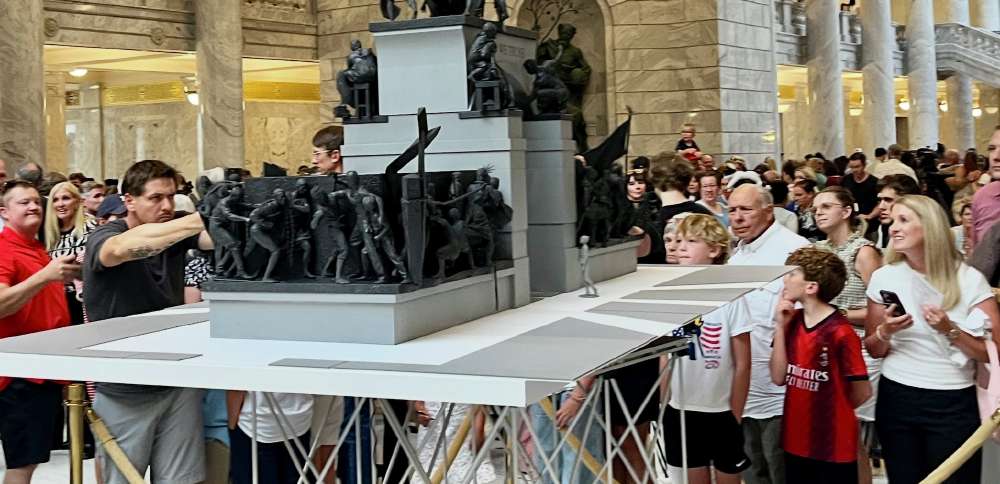
The Grand Liberty Arch, designed by renowned artist Sabin Howard, is expected to become one of the largest bronze sculptures in the West by the time it's completed over the next seven years. Kennedy believes it will highlight the effort to gain liberty over the past 250 years.
"For two and a half centuries, liberty has been an active ingredient in the background of American history, and the driving engine of our national progress," he said on Monday, as a 6-foot model of Howard's piece rotated within the Utah Capitol rotunda next to him. "It is the vital spark that transformed a collection of colonies into a beacon of global innovation and human potential."
However, those who live near its planned location are less excited by the state's plan, not by the sculpture as much as the spot the state has in mind and the process by which it was selected. They believe it will drastically alter a longstanding open space, and question why the project was voted on quickly without much public feedback.
The Grand Liberty Arch
The Capitol Preservation Board signed off on the project in May, with the expectation that the estimated $55 million cost will be raised privately. Former Zions Bank CEO Scott Anderson was working with JLL Salt Lake City Real Estate to raise the funds, meeting with family foundations and large corporations, officials said during the meeting.
Utah Gov. Spencer Cox penned a letter in support of the project in February, saying that he believes in the "significance of this legacy piece." Howard, who recently completed a World War I memorial in Washington, D.C., had his latest vision on display at the Utah Capitol over Fourth of July weekend, so people could better view his vision.
Related:
Sculptor to build $55 million monument depicting American history in Utah
A first-of-its-kind monument that could become one of the largest bronze sculptures in the western United States is under construction in Utah.The sculpture depicts many elements of the past 250 years in the U.S., from the Revolutionary War and the signing of the Declaration of Independence to the building of the country and its westward expansion. An unveiling ceremony was held Monday, where Howard and others were able to describe it and its importance for now and the next 250 years.
"America is dynamic. ... Americans do not stand still," he said. "The Grand Liberty Arch is a celebration of liberty that has transformed our nation."
It's expected to be built in phases over the next seven years, completed in time for the 2034 Winter Olympics and Paralympics. Over 100 people showed up for the ceremony, making sure to snag a photo of the model by the end of it.
A neighborhood's concern
The sculpture is to be located at 17 W. 500 North, on a parcel across the street from the Utah Capitol, informally known by some as the Capitol triangle. Utah owns the land, but it's also not considered part of the primary Capitol Complex, meaning it's not subject to some of the same Capitol grounds rules, Cox said.
Utah House Speaker Mike Schultz, R-Hooper, called it the "perfect location" during the board's May meeting. Renderings show a plan to remove some of the park's longstanding trees, replacing them with cherry trees around the arch that essentially adds to the Capitol's walkway.
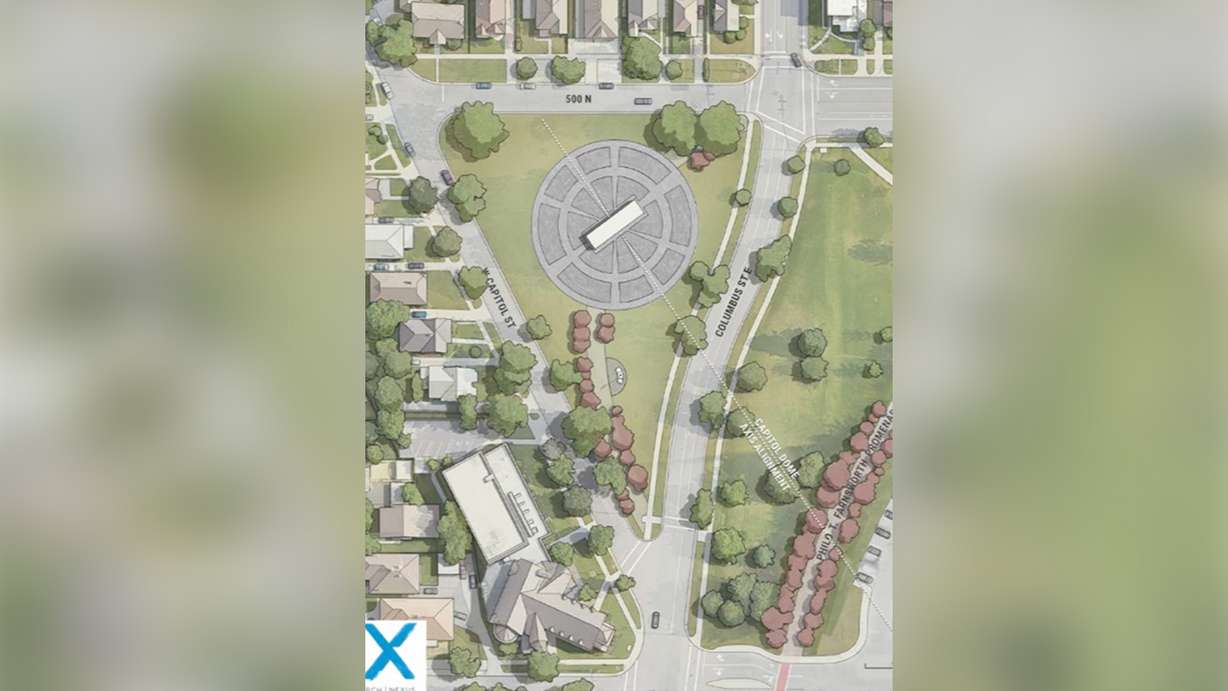
The location has also created a stir within its neighborhood. The Capitol Hill Neighborhood Council ended a June 17 meeting by debating several options to respond to the state's decision.
There were some concerns raised about some of the depictions, but most are concerned about potential impacts to the current open space, which is used for an annual gathering, but also smaller park space since it's located right next to homes, said Jonathan Bruns, chairman of the Capitol Hill Neighborhood Council.
"It's off the main (path), so it's a little ... removed from the main grounds. It's usually a quieter spot," he explained.
With thousands of people projected to cross the street to view the piece, they said it could snarl traffic along Capitol and Columbus streets. Others were concerned by the size and scale of the project and the quick process to select a design, which appeared to include little to no public feedback.
Salt Lake City Councilman Chris Wharton, whose district includes the area, pointed out that the state is exempt from local processes, meaning there's nothing the city or county could do to intervene. As a resident and lawyer, he suggested a formal complaint to the Capitol Preservation Board over the monument process around the Capitol complex, which the neighborhood council plans to do.
The council agreed to submit a formal complaint to the board and Utah Attorney General's Office to make sure that the board followed Utah's Open and Public Meetings Act and normal processes for a monument. It also agreed to submit a public records request on the project for a "comprehensive report of community feedback."
Part of the complaint centers around a discussion of a 100-year monument project for which there were two options discussed in May, separate from the arch. One celebrated the golden spike, while the other highlighted women's suffrage in Utah, but the project was placed on hold over logistics.
Board members didn't abandon the project, but said the arch could ultimately serve as the selection. That made the neighborhood question if it followed the correct process for monuments, Bruns explained.
"It kind of seems like this went around the rules in an odd way. ... We are obviously doing work to make sure it was done by the right processes," he said.
The attorney general's complaint has since been filed, while the rest are in the works, he told KSL. He's unsure if the council would file a lawsuit over the time and money that would strain a volunteer group of residents.
Bruns credited Howard for being responsive, adding that he's hopeful the state can also be understanding of the neighborhood's concerns, whether that's project adjustments or a new location.