
- Kevin Warsh was sworn in as the new chair of the Federal Reserve on Friday.
- President Donald Trump said Warsh had his support, while also cautioning Warsh that "growth does not mean inflation."
- Warsh's swearing-in comes against the backdrop of rising inflation and eroding consumer sentiment.
WASHINGTON — Kevin Warsh was sworn in as chair of the Federal Reserve on Friday at a pivotal moment for the American economy, where surging gasoline prices due to the war in Iran are pushing up inflation and eroding consumer sentiment, potent ingredients for a policy dilemma with political implications.
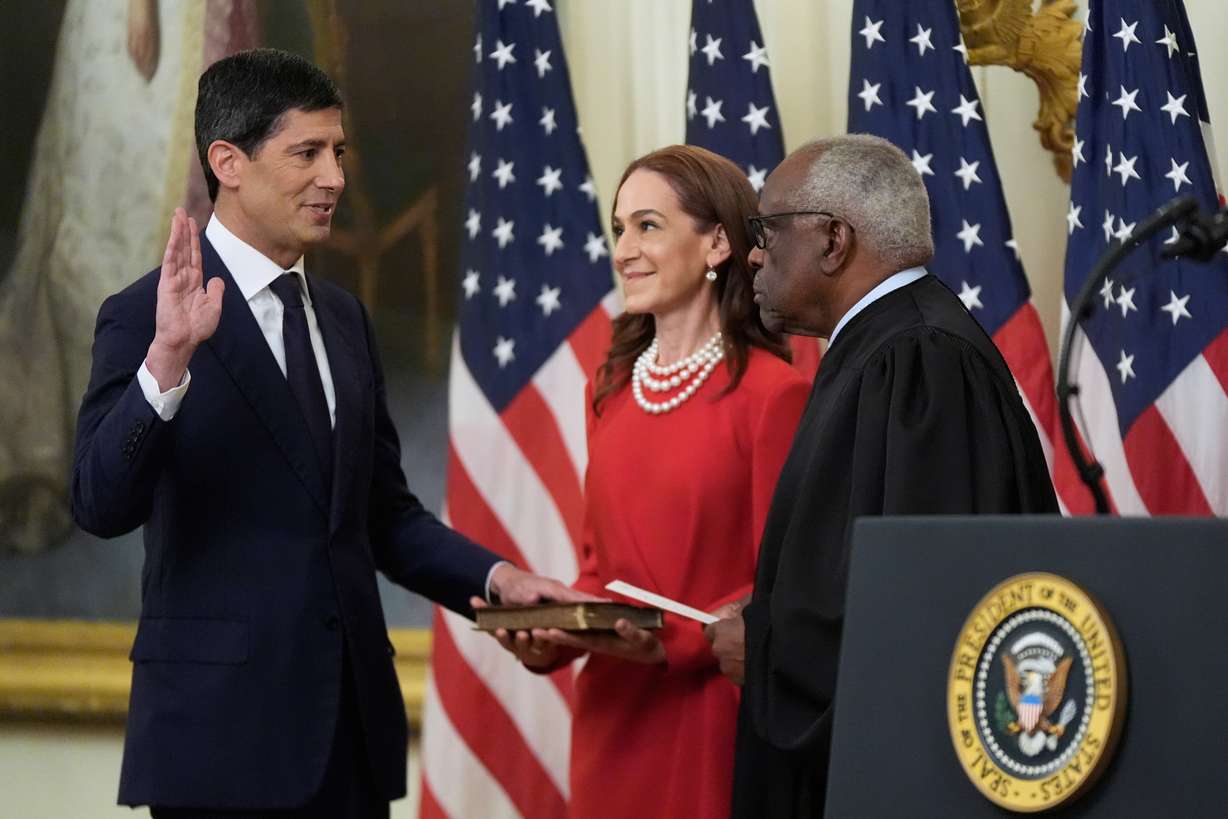
Warsh, wearing a dark suit and tie and accompanied by his wife, Jane Lauder, heiress to the Estee Lauder fortune, was sworn in by Supreme Court Justice Clarence Thomas after a lengthy introduction by President Donald Trump. The White House's East Room was peppered with top cabinet officials, including Treasury Secretary Scott Bessent, and longtime friends of Warsh, including former Secretary of State Condoleezza Rice.
Trump, who has been incessant in his criticism of former Chair Jerome Powell for not slashing interest rates, said Warsh would have the "full support of my administration" and wanted him to be "fully independent" in his new role, but also urged him to recognize that "growth does not mean inflation."
Calling it the "honor of a lifetime to be called back into public service," Warsh, in brief comments afterward, said: "To fulfill this mission, I will lead a reform-oriented Federal Reserve, learning from past successes and mistakes, both escaping static frameworks and models and upholding clear standards of integrity and performance."
Awaiting him is an unfolding boom in AI technology that is reshaping the economy in ways Fed officials say could be profound for workers, companies and consumers, but will be hard for Warsh and his colleagues to assess in real time.

At the same moment, inflation is high and potentially heading higher as the economy copes with shocks, including oil driven over $100 a barrel by the U.S.-Israeli war with Iran, high import tariffs, and utility and other costs rising due to the AI rollout.
Underscoring both the political and economic stakes, the University of Michigan's Surveys of Consumers on Friday showed consumer sentiment fell to a record low, with optimism among Republicans and independents dropping to the lowest level of Trump's second term.
"Our mandate at the Fed is to promote price stability and maximum employment," Warsh said. "When we pursue those aims with wisdom and clarity, independence and resolve, inflation can be lower, growth stronger, real take-home pay higher, and America can be more prosperous, and no less important, America's place in the world more secure."
Waller: Drop 'easing bias'
The debate over Fed policy is already at a high pitch, with Fed Governor Christopher Waller, a Trump appointee who interviewed for the job Warsh won, on Friday making a significant turn in his own thinking and agreeing with a group of recent Fed dissenters that the central bank should drop the "easing bias" from its policy outlook and open the door to a possible rate hike.
With recent data showing inflation broadening and intensifying across the economy, the Fed should "make it clear that a rate cut is no more likely in the future than a rate increase," Waller said shortly before Warsh was sworn in. The comments drove market bets on a rate hike as soon as October.
Warsh, 56, won Trump's backing for the job over a yearlong public audition by the top candidates.
In that span, the new chair laid out ambitious reform goals for a central bank he argues had begun to lose its way by the time he quit his former seat as a governor in 2011 in opposition to Fed bond-buying. Now, though, his first months may be consumed with the more pressing dilemma of whether to raise interest rates to keep inflation from moving further beyond the Fed's 2% target, or to put his credibility as an inflation fighter at risk from the outset.
"Inflation is the Fed's choice," Warsh said at his Senate confirmation hearing, with its control over short-term interest rates a lever it can use to boost or discourage spending, and in doing so, try to keep inflation at the Fed's target. The Fed has missed its target for more than five years and is currently more than a percentage point above it.
Hard choices
How to get inflation back down can involve hard choices that sometimes conflict with the policies and goals of the Trump administration, and sometimes with the Fed's other aim of maximum employment. Warsh will be looking over his shoulder from the start of his term as the Fed's 11th chair, at a global bond market that has begun bidding up interest rates in a sign of growing inflation concern, at colleagues like Waller who have begun setting expectations that higher rates may be needed, and at Trump, who in the past has viewed rate hikes as a political assault on his economic program and been sharply critical of Powell for not lowering borrowing costs.
Warsh's comments and approach to ongoing disputes surrounding the Fed, including a coming Supreme Court decision on Trump's so far unsuccessful effort to fire Governor Lisa Cook, will also be watched and compared closely to Powell's staunch defense of Fed independence.
The Fed's next meeting is on June 16-17, when policymakers vote on interest rates and a new policy statement, and also submit new economic projections.
One of Warsh's first substantive decisions will be whether to submit a "dot" of where he thinks interest rates will be at the end of this year, and in doing so, reveal whether his views are not so different from the colleagues he has slammed for "groupthink," or become an outlier with views that could further confuse markets that are already driving up long-term interest rates.






