- Salt Lake City police met with unsheltered residents to discuss ways to improve resource services.
- Participants highlighted resource gaps and challenges faced by people experience homelessness in Utah.
- Proposed solutions include more shelters and housing options.
SALT LAKE CITY — Julia Eubanks holds a microphone near her lap as she begins to describe her life bouncing in and out of homelessness, and her experiences in Salt Lake City's unhoused community.
Her eyes lock with Salt Lake City Police Chief Brian Redd and other high-ranking city officers sitting a few feet from her in a circle of chairs set up in the basement of a downtown office building.
Eubanks says she struggled with the legal system and homelessness for years, but she contends that every time she's encouraged to meet with a social worker to address her challenges, there are none to be found in the shelters she's ushered to. Many people like her don't have the means to find one and then get there, either.
There are few options for couples like hers and her husband, which adds to her frustration in seeking help.
"You guys are asking for too much without the means to do it at all," she said, speaking loud enough that the microphone wasn't necessary. "There's so little resources, and then to find those resources is a huge problem. ... I want to have a better life, but there's no bridge to get to the resources that (police) claim are out there."
That's why she's here, a place she doesn't want to be, on a Monday afternoon. She's joined by a handful of other people experiencing chronic homelessness, sharing their stories with the police during a first-of-its-kind roundtable discussion between unsheltered residents and police.
It was assembled by the Nomad Alliance, a nonprofit working to address the state's homelessness.
The number of people experiencing homelessness in Utah jumped to more than 4,500 in 2025, an 18% increase from the previous year. Chronic homelessness rose at a greater clip, leading to more people on the streets and greater safety concerns. The point of this meeting was to discuss gaps in Utah's homelessness and addiction systems that lead to ongoing challenges.
"I think there's a big chasm between the unhoused and the police," said Kseniya Kniazeva, the nonprofit's director. "The unhoused are terrified of the police. The police want unhoused to act in certain ways — not be here; not be there. I think the only way to resolve the homeless epidemic is if we come together, communicate and find solutions."
Existing barriers
One by one, those who still experience homelessness shared their story and the challenges of navigating the city's resources. Brian Drown described how his life unraveled after he was jailed for months in a homicide case. He was ultimately acquitted in the case, but he eventually lost his home, forcing him to work out of his truck until he said his equipment was stolen.
He said he was ultimately diagnosed with PTSD and met with various people for help with that, but that didn't solve his predicament. His frustration is that no employer is willing to hire him, and no resources allow him to work for himself.
Others explained how they felt worried and overwhelmed about getting arrested after their circumstances led to homelessness.
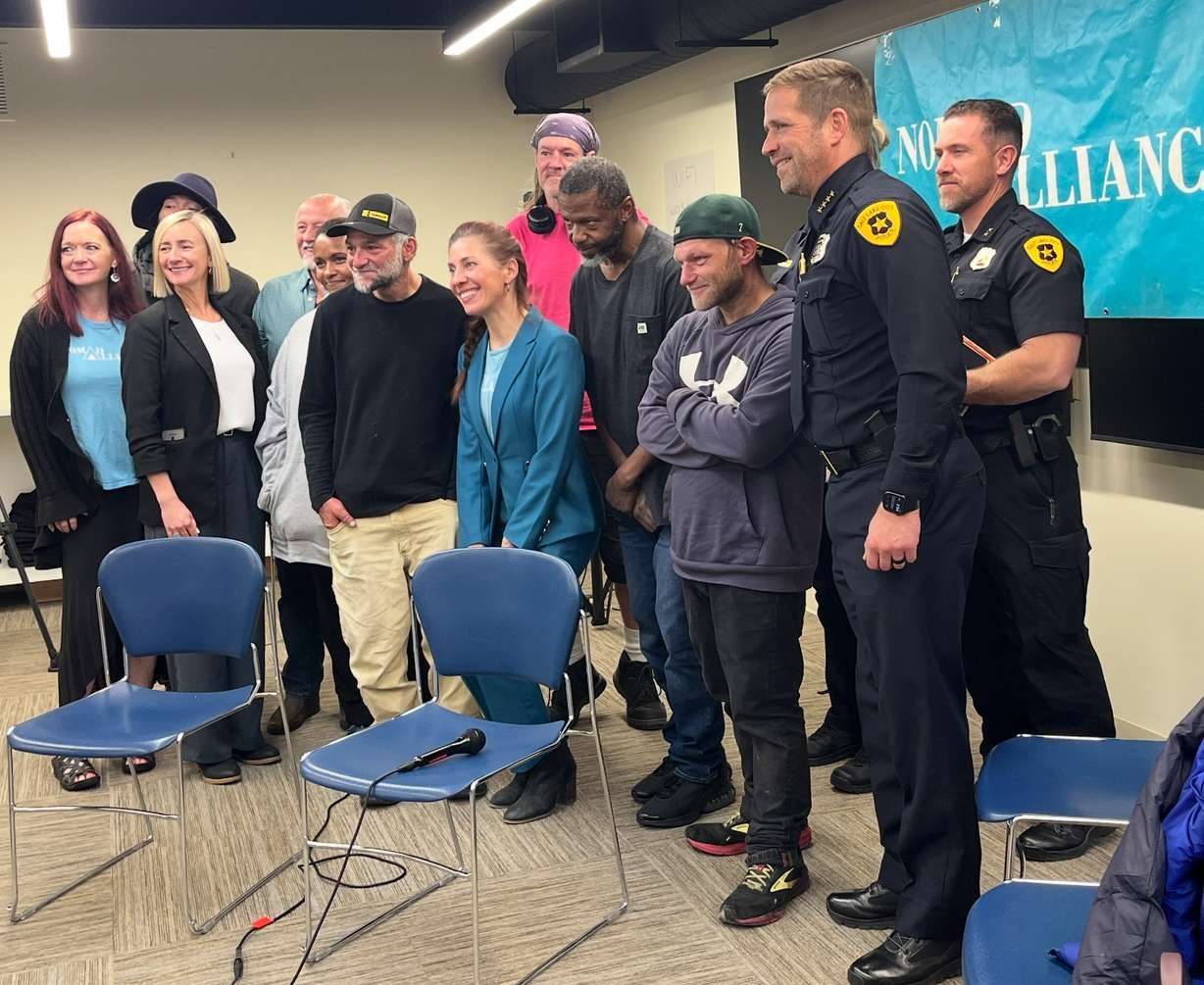
Most in the room said that medical cannabis cards would make it easier to deal with pain without resorting to hard drugs, one of the challenges police deal with. They also agreed that change doesn't happen without accountability, as Redd expressed the predicament police find themselves in, handling issues like camping and crime that sparked a temporary shutdown of a Jordan River Trail segment last year.
"It has to be supportive accountability. There's got to be a path to people as they're held accountable," he said, as the group nodded in agreement.
Potential solutions?
Kniazeva hopes that Monday's roundtable helps find that path.
People don't choose to be homeless. They're forced into it; and once you get down into that deep, dark hole, it's impossible to claw your way out without help.
–Kseniya Kniazeva, director of Nomad Alliance
She presented the police with a board of potential solutions that unhoused Utahns asked for. They ranged from seeking more sanctioned campgrounds or housing options to using vacant buildings as shelter space when they're not in use. Shelters for couples or people with pets are also in high demand, among many other things.
Those, she said, would be much better than jailing people because they're forced to live on the streets, noting that there's a shortage of shelter space and affordable housing in the state.
Monday's meeting helped better understand existing barriers between resource services and those experiencing homelessness or addiction, at the very least, Redd said afterward. Adopting some of the requested changes will likely require amendments in local, county or state statute, though.
"It's such a balance because, as a police department, we're asked to keep the community safe and enforce the law," he said. "The way we do that matters. ... We do enforce the law, but how we treat people in that process matters."
Kniazeva said she's already met with city, county and state leaders, which have sparked some changes in recent years.
She'd like to have similar roundtables to help those who craft policy and those experiencing homelessness so they can better understand each other.
"There are a lot of gaps in the system that there are easy solutions (for)," she said. "People don't choose to be homeless. They're forced into it; and once you get down into that deep, dark hole, it's impossible to claw your way out without help."