- The rise of prediction markets have allowed users to bet on outcomes of events, even those outside of sports.
- Utahns are largely unfamiliar with prediction markets, but many consider them gambling.
- A well-known prediction market, Kalshi, faces scrutiny over legality; Arizona recently filed criminal charges against it.
SALT LAKE CITY — Which team will win the men's NCAA basketball tournament? Will BYU's AJ Dybantsa be the No. 1 NBA draft pick? What will the average traffic be through the Strait of Hormuz on April 1? Will there be a recession this year? Who will win the 2028 U.S. presidential election?
What do those questions have in common? You can find them all on "prediction market" platforms where anyone with a smartphone or computer can buy "shares" or "contracts" based on the outcomes of events such as elections, sports, economy, among others — even war, which has resulted in some ugly incidents.
As March Madness heats up this week, Americans are projected to legally bet as much as $3.3 billion on college basketball through traditional sports books, according to the American Gaming Association. Prediction markets could add another billion dollars or more.
Are prediction markets gambling?
A new Deseret News/Hinckley Institute of Politics poll found Utahns aren't familiar with prediction markets, and even fewer have used one, though familiarity and usage rises among younger people.
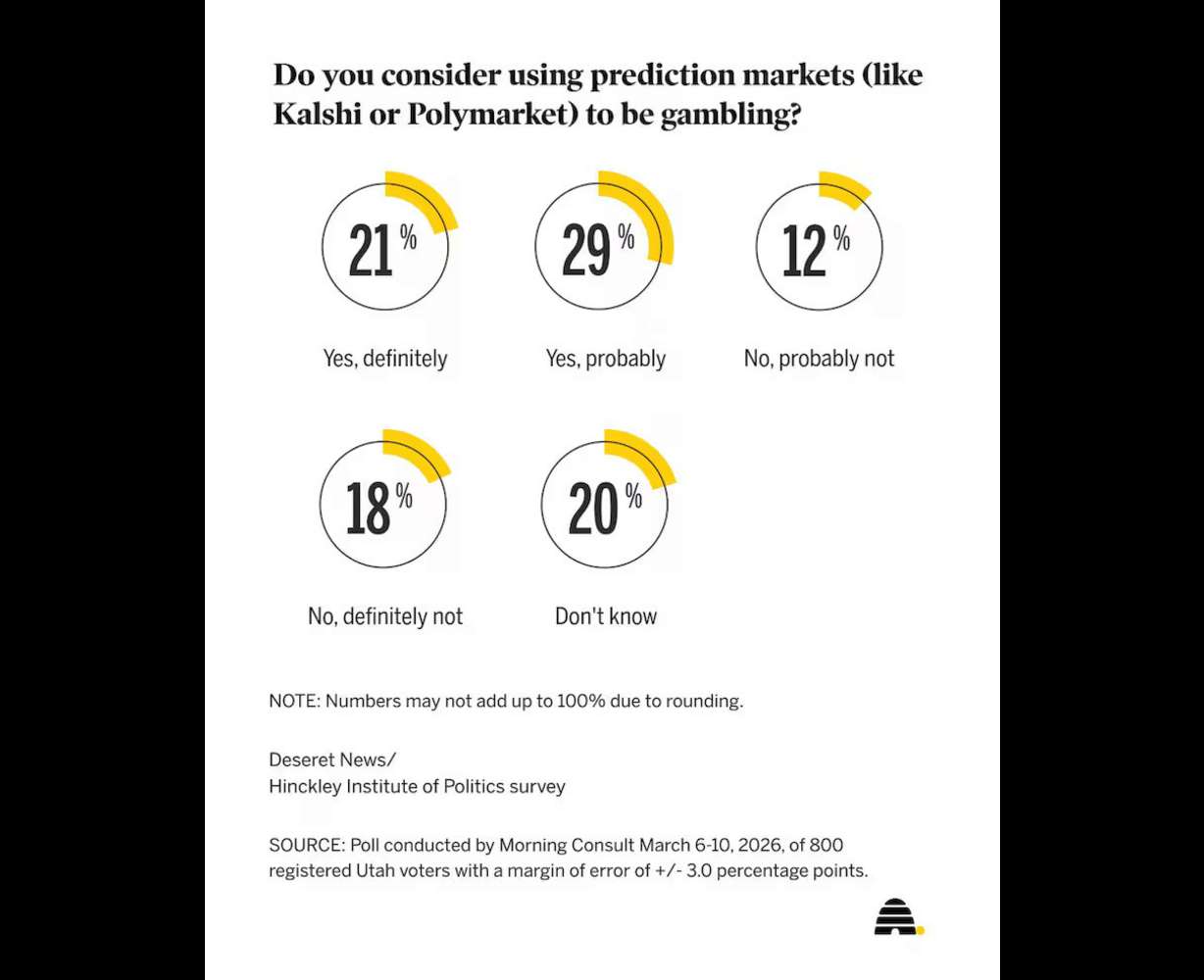
And from what they do know, half of people in the state where all forms of wagering — including sports betting — are illegal consider prediction markets to be gambling.
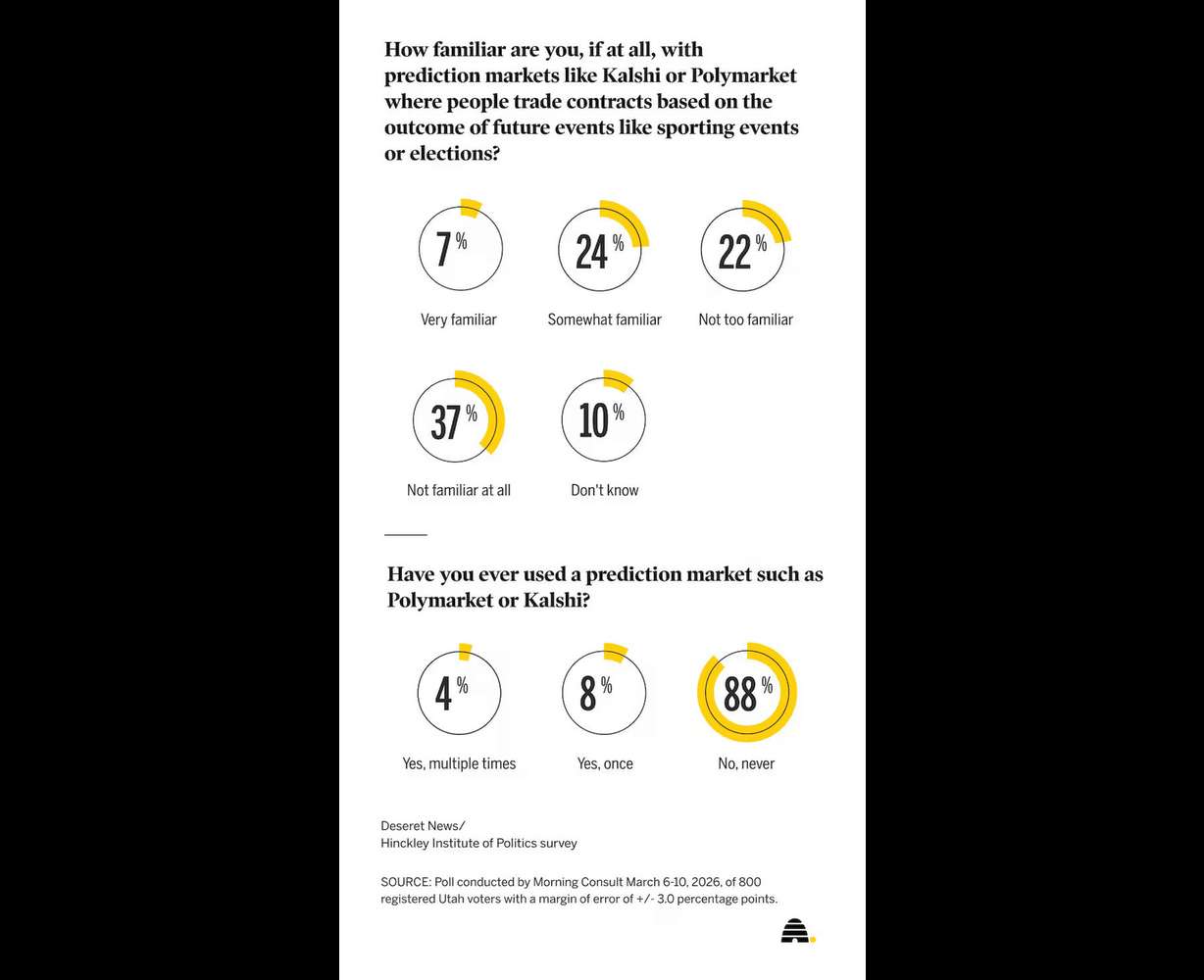
The survey found 31% of Utahns are very or somewhat familiar with prediction markets, while 59% are not. Among 18- to 34-year-olds, however, a plurality of 46% are familiar.
Only 12% have used a prediction market at least once, though it rises to nearly a quarter of 18- to 34-year-olds. Interestingly, a slightly higher percentage of people in that age group consider it gambling compared to those in older age groups.
Men are more than three times as likely as women to have used one. People making more than $100,000 a year were also three times as likely to have wagered on a prediction market platform than those making less than $50,000.
Morning Consult conducted the poll of 800 Utah registered voters March 6-10. It has a margin of error of plus or minus 3 percentage points.
Jenny Groberg, a personal finance expert and founder and CEO of BookSmarts Accounting, has delved into sports betting as she works with clients. She's not surprised few Utahns are familiar with or use predictive market platforms. And she agrees with those who believe it's gambling, whether someone is trading oil in the short term or placing a sports bet.
"Is this betting? It totally is. Regardless of how people want to argue it, it is," she said.
Groberg said gamblers she has talked to also share that view.
"They consider it gambling even though prediction markets claim it's not, that it's buying a commodity. The people engaging in the behavior and the people betting, they know dang well it's betting. And they're grateful that there's the ambiguity so that they can continue the behavior," she said.
Prediction market boom
Prediction market platforms have exploded in the past couple of years. At the beginning of 2024, monthly trading volume came in at about $100 million. By the end of 2025, it had soared to over $13 billion.
"'Kalshi' is 'everything' in Arabic," Kalshi founder Tarek Mansour said at a conference last year, as Deseret Magazine reported. "The long-term vision is to financialize everything and create a tradeable asset out of any difference in opinion."
While advertising from licensed online sportsbooks declined in 2025, digital ad impressions for prediction market platforms grew significantly.
Kalshi is currently the most visible sports betting brand by digital ad impressions, with consumers exposed to its advertising approximately 5.2 billion times last year, compared with 2.9 billion impressions for FanDuel, the next most frequent sportsbook advertiser, according to the American Gaming Association
It appears to be paying off.
Kalshi saw more than $1 billion in trading volume on Super Bowl Sunday, reaching a daily record high, Mansour told CNBC in February. And it didn't involve just the game itself. Wagers on halftime performer Bad Bunny's opening song exceeded $100 million, while bets on who would perform with him topped $45 million.
And now Kalshi and other prediction market platforms are looking to capitalize on March Madness. Men's college basketball was the company's most bet-on sport in February with $2.27 billion in trading volume, per Front Office Sports.
But it's not sports that has caused an uproar in the prediction market space.
Death threats
Emmanuel Fabian with The Times of Israel posted on X this week that "gamblers trying to win a bet on Polymarket are vowing to kill me if I don't rewrite an Iran missile story."
The event they had bet on was "Iran strikes Israel on…?" More than $14.6 million was wagered on the date March 10.
Gamblers trying to win a bet on Polymarket are vowing to kill me if I don't rewrite an Iran missile story
— Emanuel (Mannie) Fabian (@manniefabian) March 16, 2026
This is my account:
https://t.co/SBpGsW9lsH
Fabian wrote that a missile struck a wooded area outside the city of Beit Shemesh on that day. He was flooded with emails from people who wanted him to change the story to change missile to debris or interceptor fragments because they had bet "no" on a missile strike. According to the rules, intercepted missiles did not count regardless of whether they landed on Israeli territory or caused damage.
Fabian steadfastly refused as people threatened to kill him.
Polymarket condemned the threats and said it would ban the traders who harassed him.
Earlier, Polymarket let users wager on when the U.S. would strike Iran, causing critics to question why people could profit from violence and the deaths of hundreds of people. It followed that with an event titled "Nuclear weapon detonation by…?" It attracted more than $847,000 in trading volume before the company pulled it down.
Prediction market companies under scrutiny
Prediction market platforms are embroiled in lawsuits in several states, all of them civil cases until Arizona filed criminal charges against Kalshi this week, accusing it of operating an illegal gambling business.
The state's attorney general alleges the company is unlicensed and never received approval from Arizona regulators. A state gaming commission regulates sports betting, and gambling on elections is illegal in Arizona.
A Kalshi spokesperson called the criminal charges "seriously flawed" and "meritless," per NPR.
Kalshi has preemptively sued states, including Utah, to prevent its operations from being shut down.
Commodity Futures Trading Commission Chair Michael Selig has said the Trump administration is ready to back prediction market companies as they battle state regulators. The agency, which historically monitored futures contracts on things such as livestock, crude oil and gold and silver prices, regulates prediction markets.
"This is a jurisdictional dispute and entirely inappropriate as a criminal prosecution," Selig said in a post on X about Arizona's criminal charges. Selig said the Commodity Futures Trading Commission is "watching this closely and evaluating its options."
On another front, members of Congress are weighing in. At least three bills targeting prediction market practices were introduced this year, including bipartisan legislation filed by Utah GOP Rep. Blake Moore and Rep. Salud Carbajal, a California Democrat.
Their measure would prohibit contracts tied to elections, government conduct, unlawful activity, gaming and anything else the Commodity Futures Trading Commission deems contrary to the public interest. It includes a carveout that allows states to exempt gaming and sports-related contracts from a federal ban.
A gambling crisis?
NerdWallet's 2025 Sports Betting and Gambling Survey, though, found nearly a third of Americans see sports betting as an investment.
Those who bet on sports in the past 12 months say they've spent $3,284, on average, on gambling, which could be a combination of sports betting and other gambling, according to the survey. About 14% say they go into debt to gamble.
The top motivation for sports bettors? The survey found 65% participate to make extra money.
"My feeling is that whether you're trading oil in the short term or placing a sports bet, it's gambling. I know people can slice hairs, but at the end of the day, it's short term. You're looking for a quick dollar," Groberg said.
Whether gambling through traditional sports books or predictive market platforms, Groberg said bettors must report their winnings to the IRS as taxable income, something, according to NerdWallet, only about a quarter of people do. Not reporting could result in a 20% penalty or even tax fraud or tax evasion charges, she said.
"It's complicated, and I don't think people know those nuances," she said.
Groberg said there's a "gambling crisis" in the United States. "There's a lot of money being lost on this," she said.
And she sees dire consequences for individuals and families.
"Finance really comes down to behavior. With sports betting and the predictive betting, it is all tied to behavior. When people are losing money, it affects their family budgets, their income and all those things, and really ends up hurting their families," she said.
"I think it's going to really hurt us long term as a society and a culture and a state."