- Utah embraces AI in education, aiming to enhance human interaction in classrooms.
- SchoolAI, used in 80% of Utah districts, supports deeper student engagement and learning.
- State legislation ensures AI tools assist teachers without replacing their essential roles.
Editor's note: This is the third of three stories in a series that examines Utah's approach to artificial intelligence and its ongoing governance.
LEHI — For decades, we've been told that technology in the classroom is a distraction to be managed — a glowing screen that pulls students away from the mentor. But as Utah enters a new era of "High-Stakes Pragmatism," the script is flipping.
We are no longer asking how to keep AI out of our schools; we are asking if an algorithm can finally clear the administrative brush to make room for the human spirit.
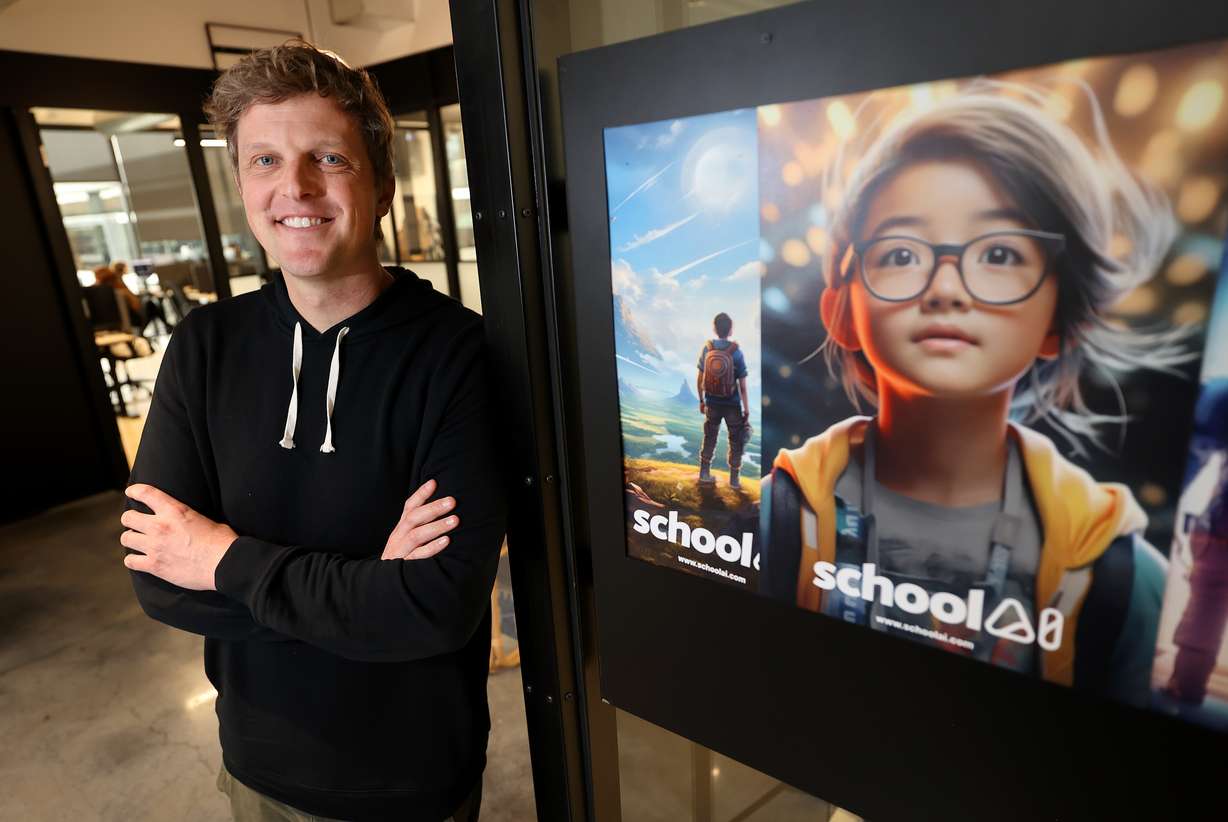
For Caleb Hicks, founder and CEO of the Lehi-based SchoolAI, this isn't a theoretical debate. It's a solution to the impossible math of being a teacher.
"As a teacher, the math is broken," Hicks says, recalling his time managing 320 students. "You have the 'loud' students who demand your attention and the 'challenged' ones who require it. The remaining 80% — the invisible middle — often slip through the cracks. You simply cannot see every student every day."
A balanced approach
Solving that impossible math requires more than just better software; it requires a policy framework that refuses to trade human agency for raw efficiency. Rep. Doug Fiefia, a former Google insider turned legislative architect, is the man ensuring that Utah's educational AI doesn't lose its soul.
"When you think about AI, you usually think about efficiency — doing things quicker, better, faster," Fiefia, R-Herriman, told KSL. "But we can't lose sight of who it's actually serving. Humans have to be at the center of every decision. We want AI to thrive and solve the world's toughest problems, but it must not replace the human."
Fiefia's philosophy is built on a foundation of "light as a disinfectant." His flagship legislation, HB286 (the AI Transparency Act), requires the largest "frontier" developers to publish their safety protocols for the public to see. For schools, this means transparency is the only way to build the trust necessary to keep these tools in the hands of kids.
Evidence, not anxiety
Hicks' mission to solve that math has turned Utah into a global pilot site. Currently, SchoolAI is used in over 80% of the state's districts. New research published by SchoolAI in January 2026 provides the first data-backed shield against the anxiety of AI-driven cheating.
Analyzing more than 23,000 teacher-created AI lessons, the study found that rather than replacing student thinking, AI is being used to deepen it. According to the data, 73% of AI-supported experiences required "conceptual understanding," while 58% specifically asked students to evaluate ideas or make judgments.
In Utah classrooms, AI assistants like 'Dot' act as infinitely patient tutors that never give away the answer. Instead, they ask, "How would you have solved this differently?" It is a shift from "answering" to "initiating" — the exact "future-proof" skill identified earlier in this series.
'Mission Control' for mentorship
The "Pro-Human" model shortens the feedback loop from days to seconds. Using a "Mission Control" dashboard, teachers see real-time transcripts of every AI-human interaction. If a student starts "wheel-spinning" — repeating errors without progress — the system alerts the teacher immediately.
"AI allows me to be in 30 places at once," says one Oak Canyon Junior High teacher. "It doesn't replace my instruction; it tells me who needs my human intervention right now. It allows me to focus on the 80% who used to be invisible."
'ER doctor' risk
However, the pivot isn't without its warnings. As noted by state leaders, putting humans exclusively at high-stakes inflection points can lead to a new kind of fatigue. "We have to be careful that we aren't just creating a new kind of burnout," Kevin Williams warned.
Fiefia echoes this concern, noting that the legislative hammer must be heavy enough to deter negligence but precise enough to encourage innovation. HB286 introduces penalties of up to $3 million for frontier companies that intentionally exploit minors or ignore their own safety protocols.
We want AI to thrive and solve the world's toughest problems, but it must not replace the human.
–Utah Rep. Doug Fiefia, R-Herriman
"This bill completely carves out small businesses and universities. We aren't here to punish experimentation," the lawmaker clarified. "But penalties have to matter. Large companies treat small fines as a cost of doing business. We are making sure they don't make a 'business decision' to push out an unsafe product early just to beat a competitor."
In education, this means ensuring that teachers aren't just reacting to data alerts, but are still finding the unscripted, "un-automated" moments that define the student-teacher bond. Utah's HB286 could ensure these tools remain "human-in-the-loop," prohibiting AI from being the sole arbiter of a student's grade. The AI is the sidekick; the teacher remains the hero.
The verdict
As Utah gets into the 2026 legislative session, the message is clear: Banning AI in schools is a failure to prepare students for a world where curiosity is the ultimate currency.
The educational 'Learning Pillar' remains the anchor of the state's $100M AI investment. If the classrooms of the Silicon Slopes can prove that AI makes students more curious and teachers more connected, it provides a blueprint for every other industry facing automation.
The ultimate goal isn't just efficiency — it's human-enhancing technology. In the classrooms of 2026, the "pro-human pivot" is no longer a policy paper. It is a student asking a deeper question, a teacher catching a struggling child before they fall, and a state betting that the best way to handle the future is to engineer more room for the human spirit.
Read more:

Artificial Intelligence in Utah
For more news about Artificial Intelligence and its development and advancement in society, visit this section on KSL.com.
Related stories
Most recent Artificial Intelligence stories
Related topics
 Brooke Nally