'%3e%3cpath%20d='M34.1406%205.85938C30.3906%202.10547%2025.3047%200%2020%200C14.6953%200%209.60938%202.10547%205.85938%205.85938C2.10938%209.61328%200%2014.6953%200%2020C0%2025.3047%202.10547%2030.3906%205.85938%2034.1406C9.61328%2037.8906%2014.6953%2040%2020%2040C25.3047%2040%2030.3906%2037.8945%2034.1406%2034.1406C37.8906%2030.3906%2040%2025.3047%2040%2020C40%2014.6953%2037.8945%209.60938%2034.1406%205.85938ZM37.0117%2023.543H31.1602V13.5391H27.6328V19.9414C28.1211%2020.6914%2028.3711%2021.582%2028.3711%2022.5625V22.625C28.3711%2023.668%2028.1172%2024.6055%2027.6328%2025.4297V26.6094H36.082C33.4883%2032.9375%2027.2891%2037.3789%2020.0039%2037.3789C10.3711%2037.3789%202.62109%2029.6289%202.62109%2020C2.62109%2010.3711%2010.3711%202.62109%2020%202.62109C29.6289%202.62109%2037.3789%2010.3711%2037.3789%2020C37.3789%2021.1484%2037.2617%2022.2656%2037.0508%2023.3477C37.0391%2023.4141%2037.0234%2023.4766%2037.0117%2023.543Z'%20fill='white'/%3e%3cpath%20d='M22.3086%2018.5352C20.4336%2018.125%2019.9531%2017.8398%2019.9766%2017.1836V17.1406C19.9766%2016.6992%2020.3477%2016.2148%2021.4023%2016.2148C22.582%2016.2148%2023.8867%2016.6797%2025.0781%2017.4766L26.8516%2015.0195C25.4453%2013.8906%2023.707%2013.3398%2021.5547%2013.3398C18.5195%2013.3398%2016.4375%2015%2016.4063%2017.4766V17.5352C16.3633%2020.2617%2018.5859%2020.9805%2021.293%2021.6016C23.0391%2021.9766%2023.5703%2022.3164%2023.5703%2022.9609L23.5469%2022.9766C23.5469%2023.3906%2023.2578%2023.7031%2022.7852%2023.8359C22.5742%2023.9062%2022.1289%2023.9727%2021.5156%2023.9727C20.7617%2023.9727%2019.7539%2023.8633%2018.6328%2023.4844C18.0898%2023.2891%2017.4727%2023.0039%2016.8047%2022.6133L20.1406%2026.625C20.2813%2026.6602%2021.0977%2026.8516%2021.7734%2026.8516C25.0039%2026.8516%2027.0859%2025.2461%2027.1094%2022.6328V22.5703C27.1602%2020.1133%2025.2148%2019.1719%2022.3086%2018.5352Z'%20fill='white'/%3e%3cpath%20d='M5.24219%2013.5664V26.6133H8.75391V23.7578L10.2969%2021.9531L14.2031%2026.6133H18.3867L12.3555%2019.5195L17.4023%2013.5664H13.4531L8.75391%2019.0586V13.5664H5.24219Z'%20fill='white'/%3e%3c/g%3e%3cdefs%3e%3cclipPath%20id='clip0_97_2430'%3e%3crect%20width='40'%20height='40'%20fill='white'/%3e%3c/clipPath%3e%3c/defs%3e%3c/svg%3e)


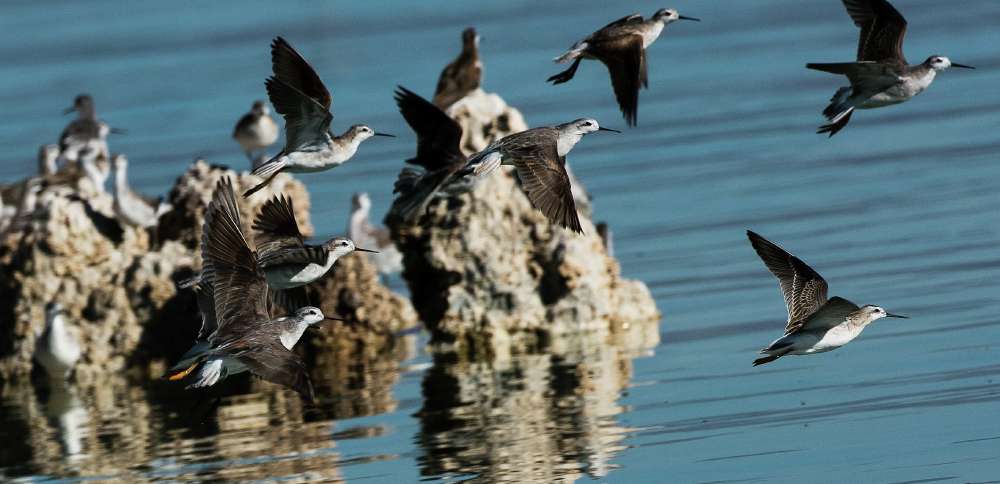
- The Wilson's phalarope advances toward endangered species protection after a first-round review process.
- The U.S. Fish and Wildlife Service cites habitat decline due to freshwater diversion.
- Utah leaders have opposed the measure in the past, fearing federal action on Utah's water.
Editor's note: This article is published through the Great Salt Lake Collaborative, a solutions journalism initiative that partners news, education and media organizations to help inform people about the plight of the Great Salt Lake.
SALT LAKE CITY — A bird species that relies heavily on the Great Salt Lake and other Western saline lakes took a step toward receiving new protections on Friday in a case that advocates believe could address the lake's water decline.
The Wilson's phalarope was among 10 species that advanced past the 90-day review process, which triggers a status review of the species to determine whether protective actions are necessary, the U.S. Fish and Wildlife Service announced.
"We find that the petition presents substantial scientific or commercial information indicating that listing the Wilson's phalarope as a threatened or endangered species may be warranted," the agency wrote in its decision, pointing to "freshwater diversion" leading to declines in habitat resources in Utah, California and Oregon.
The measure launches a 12-month petition findings process, which will determine whether "actions are warranted in accordance" with the Endangered Species Act of 1973, officials added.
Its decision marks an early win for the environmental and conservation groups that backed the measure, and a blow to state leaders who opposed the measure when the proposal was introduced nearly two years ago.
"Wilson's phalarope is sounding the alarm bell about the Great Salt Lake's decline. I'm thrilled these little birds are one step closer to the protection they so desperately need, and I'm hopeful this leads to real action to save the Great Salt Lake," said Deeda Seed, senior Utah campaigner for the Center for Biological Diversity, in a statement after the decision was released.
The Center for Biological Diversity filed a 119-page petition that called for protections for the Wilson's phalarope back in 2024, amid a population decline.
Wilson's phalarope regularly migrate as far north as Canada in the summer, and can be found across most of South America in the winter. The species also relies heavily on the Great Salt Lake, as well as Mono Lake in California or Lake Abert in Oregon, during the annual migration.
Combined, approximately 40% to 60% of the species' global population visits the three saline lakes every year, but all three lakes have dealt with decline fostered by drought and overconsumption of the lakes' water supplies, said Ryan Carle, science director of the conservation group Oikonos, at the time the petition was unveiled.
Approximately 250,000 phalaropes were annually reported at the Great Salt Lake, at least half of historic levels before the Great Salt Lake's decline, he added at the time.
The groups behind the measure said it could spark "federal action" to get more water to the Great Salt Lake, which is why Utah leaders opposed the measure. Gov. Spencer Cox said Utah would "push back" against any possible listing when the proposal was introduced because of that.
Debates over the listing as a possible measure to protect the Great Salt Lake play a role in "The Lake," a documentary about the Great Salt Lake that premiered at the Sundance Film Festival a day before the U.S. Fish and Wildlife Service made its announcement.
While it's a positive sign, there's still plenty of steps to go, said Ben Abbott, an associate professor of ecology at BYU, a proponent of the petition and one of the researchers featured in the film. He says protections may not guarantee more water for the drying Great Salt Lake, but it could lead to more possibilities for that to happen.
"The timing feels more than coincidental to come out the day after the film," he said after the film was screened again in Salt Lake City on Friday. "It doesn't mean that the petition's going to prevail or fail, but I think it's a great sign that an important part of the federal government is still functioning and can hopefully provide resources to the table."