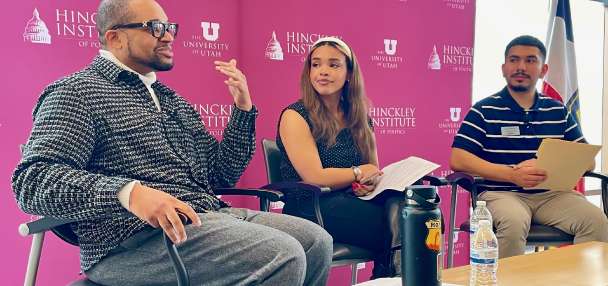
- Gov. Spencer Cox emphasized literacy's importance at a Utah symposium, highlighting AI concerns and policy.
- Cox called for expanded resources, early interventions and third grade retention to boost literacy.
- Kirsten Baesler, assistant secretary for the Office of Elementary and Secondary Education in the U.S. Department of Education, stressed literacy's role in workforce, economy and national governance, urging community involvement.
OGDEN — Utah Gov. Spencer Cox remembers meeting with "a very prominent individual" who divined that parents will soon no longer have to read to their kids. Artificial intelligence will do it for them.
That prediction, said Cox during Tuesday's literacy and reading symposium event in Ogden, "made me sick to my stomach."
That "AI alarm" only compounded Cox's concerns about the costs being exacted by plunging literacy rates — and boosted his commitment to finding policy and cultural solutions.
The governor was joined Tuesday at the symposium by first lady Abby Cox, Utah Lt. Gov. Deidre Henderson and a hall full of educators, lawmakers, bestselling authors, business leaders and reading advocates.
Also participating was Kirsten Baesler, assistant secretary for the Office of Elementary and Secondary Education in the U.S. Department of Education.

The symposium offered several reading-based panel discussions and speeches — ranging from policy ideas, early literacy, family, libraries and community engagement.
But each participant tackled a common purpose: Strengthening literacy and getting more kids — and more adults — reading.
Cox: 'Every single kid can learn to read'
Tuesday's symposium was held a day after a Gardner Policy Institute report revealed that almost half of Utah's third graders are not reading at minimum proficiencies — coupled with research attesting that almost all kids can learn to read with proper early intervention and instruction.
In his keynote armchair discussion with Baesler, Cox addressed queries about why literacy and reading are one of his guiding priorities.
"We care deeply about this — we've worked on it for several years," said the governor.
Cox pointed to the literacy initiative found in 2022's Senate Bill 127 "that's now being fully implemented — and good things are starting to come from that." But it's time, he said, to place even larger emphasis on literacy as a policy.
Cox said his own personal study on the science of literacy assured him that "every single kid can learn to read, regardless of their demographic situation. Regardless of their family situation."
The question now facing Utah policymakers, he added, is how many resources they are willing to put toward supporting literacy? Simply reaching the minimum reading threshold in Utah schools isn't enough.
"We can do better than that … if we're committed."
Considering third grade retention and calling for resources

Beyond the emerging AI challenges to literacy, Cox acknowledged cultural realities. Literacy, he said, "is a crisis for adults" found across American demographics.
"We've got to change something."
The 2026 Utah legislative session is fast approaching, and Cox hopes lawmakers expand on SB127.
He's also learning from other states such as Mississippi, where they practice third grade retention. If a child is not reading on grade level by third grade, they stay back for another year of instruction.
"I think there's a way we can do it that treats kids and families with dignity and respect and makes it easy for them — but we need that pressure," said Cox. "It's not that we want to hold kids back, it's that we want them reading at third grade level so we don't have to hold them back."
Additionally, he said, Utah schools need more resources.
"We need to spend more of the budget on resources. We need more paraprofessionals in our classrooms. … We need those interventions earlier. We need individual reading plans for those in the special education field."
Cox also pointed to attendance issues facing "every school district."
"We've got to figure out how to help with chronic absenteeism."
Literacy: More than an educational issue

A career educator with broad experience as an administrator, teacher and library media specialist, Baesler emphasized during her keynote discussion that literacy is not simply an education issue.
"This is a workforce issue. This is an economic issue. And if Utah or any of the other 49 states are going to thrive to their fullest potential, they're going to need to have their students reading on grade level," she said.
America's educational system, Baesler added, was not created to craft scholars. "It was to ensure that we were a nation of citizens that could govern ourselves. That is truly one of the biggest reasons why we need to focus (on literacy)."
Teachers and educational systems alone can't solve literacy shortcomings, she said.
"It's going to take our families. … Our communities are going to need to be involved. Our policymakers. Our executive branch.
"We can't do it alone, but we can do it together. … Reading is the beginning of all other learning."
Baesler also championed professional development requiring teachers to receive training on the science of reading. States should also invest in proper curriculum while equipping teachers with instructional strategies.
Meanwhile, she said, the DOE is gathering best practices across the states to share with others.
Returning education to the states

Cox noted there's no "silver bullet" to solving literacy challenges.
"There's no one thing we can do to fix it," he said. "It's all things — and the data shows that one thing we need more are volunteers in the classroom; more kids to read to kids."
The governor noted that many Utah high school students are already helping younger kids improve their reading skills by volunteering in early-elementary classes. The high schoolers are reading with kids — and their own reading skills are improving.
Baesler said her department's priority is to return education to the states — including Utah.
"We now have to free up the funding that we already sent to you with funding flexibility so you can be creative within your communities and decide — with your school boards, with your legislators, with your community members, with your philanthropic partners — what is the best way to do this," she said.
Literacy, added Cox, offers students and adults understandings of "the great ethics of history" — ensuring the nation's survival for the next 250 years.
"That's what this is all about," he said. "It's not about just a kid getting a good job or Utah having the No. 1 economy. It's whether or not our nation survives the next generation."

Most recent Education stories
Related topics
 Jason Swensen