Estimated read time: 3-4 minutes
- Utah's population grew by over 44,000 from July 2024 to July 2025.
- Natural change surpassed net migration as the main growth driver for Utah for the first time this decade.
- Utah County led numeric growth, while Tooele and Iron counties topped percentage growth.
SALT LAKE CITY — Utah is still growing, but state demographers say its growth continues to moderate as the number of people moving in is starting to slow down.
The Beehive State gained a little more than 44,000 people between July 1, 2024, and July 1 of this year, the Utah Population Committee reported on Wednesday. It represents a year-over-year population growth of 1.3%, bringing the state's estimated population to 3.55 million.
This year's growth is slightly less than the 50,000 people Utah gained between mid-2023 and mid-2024, largely because of net migration — the number of people moving into the state versus the number of people leaving — wasn't as robust over the past year as it has since the COVID-19 pandemic.
Net migration accounted for 43% of the state's growth, which is the lowest percentage in four years. Natural change — a measure of babies born over reported deaths — anchored growth for the first time during the 2020s, reverting back to a trend that had made Utah one of the country's fastest-growing states for years before this decade.
"Our 2025 estimates reveal a moderation in Utah's population growth," said Emily Harris, senior demographer at the University of Utah Kem C. Gardner Policy Institute, which chairs the committee, and the report's lead author.
While the report doesn't detail what could be behind the migration slowdown, institute leaders previously pointed to the rising cost of housing, including high interest rates, as a possible factor.
"A significant shift occurred this year, with natural change contributing the majority of new Utahns, making it the primary driver of growth for the first time this decade," Harris added. "This represents a return to Utah's historical growth patterns seen before the recent period of high levels of net migration."
Where is Utah's growth?
Utah's overall population yielded some surprises, but where growth is happening wasn't much of a surprise. Utah County led the state in numeric growth, gaining nearly 16,000 new residents. Although it's close to 6,000 fewer residents than the committee's 2024 report, it's almost double that of any other county in the state.
Salt Lake County placed second, adding over 8,000 residents. Combined, the state's two most populous counties accounted for over half of the state's growth, while the Wasatch Front as a whole accounted for two-thirds of it, as Davis and Weber counties were fourth and eighth in numeric growth.
Yet, all four Wasatch Front counties wound up with net migration rates lower than the state, according to the report, which could lean toward the cost theory.
Meanwhile, Washington (4,751 new residents) ended up third in growth, showcasing southwestern Utah's ongoing growth. Tooele County (2,466), considered one of the Wasatch Front's "ring counties," rounded out the top five.
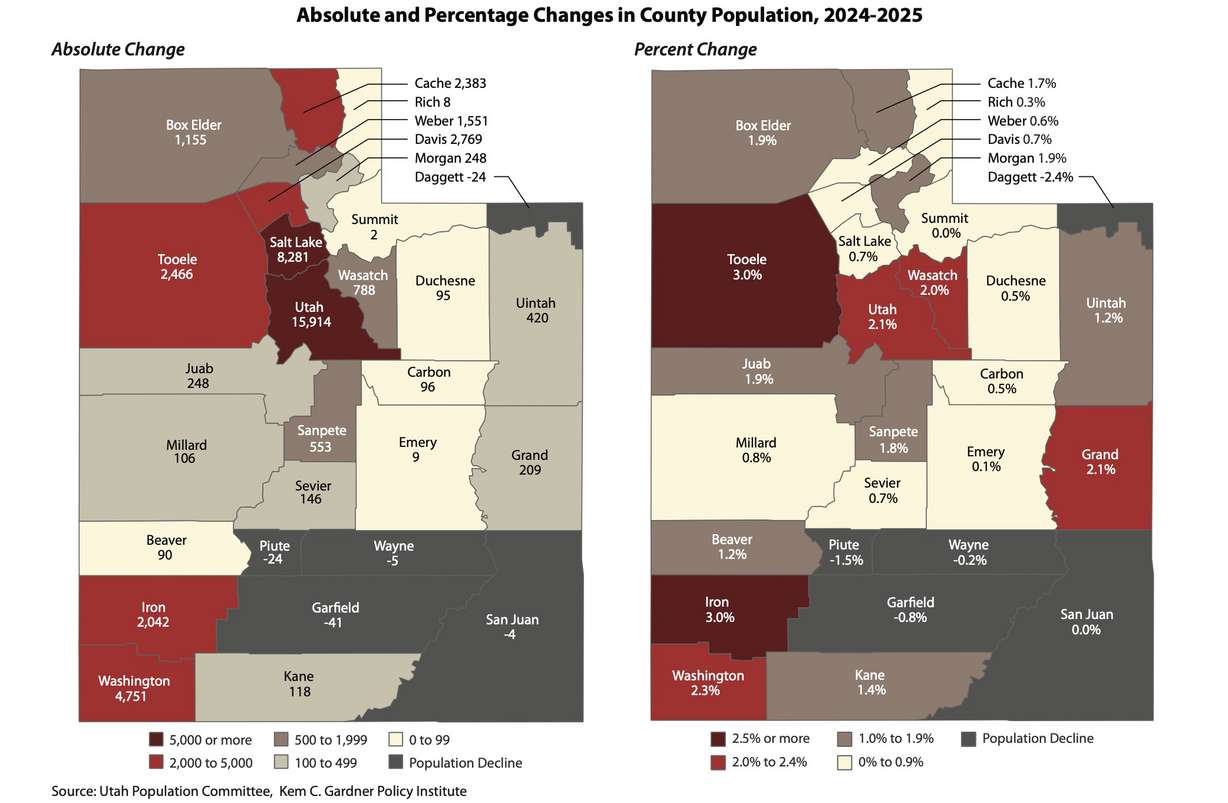
Southwest Utah and those ring counties did, however, lead all the counties in another growth category. Tooele and Iron counties (each at 3%) topped the state in terms of year-over-year percentage growth, showcasing how those areas are quickly growing.
Washington County (2.3%), Grand and Utah counties (each 2.1%) rounded out the top five in percentage growth.
Only five counties lost population, but the numbers weren't too significant. Most of the population loss occured in south-central and southeast Utah, led by Garfield County's 41-person decline. Piute was next, tying with Daggett County in northeast Utah. Wayne and San Juan counties rounded out the bottom five.
Daggett County experienced the highest net loss, losing an estimated 2.4% of its population.
The committee's annual report also doesn't indicate which cities gained or lost residents, which sometimes bucks county trends. For instance, Salt Lake City led the state in growth between mid-2023 and mid-2024, outpacing four Utah County cities that also placed in the top five.
It also doesn't show how Utah's trends relate to those of other states. The U.S. Census Bureau, which uses similar but different metrics to estimate populations between decennial censuses, is expected to release its 2025 population estimates for all states in January. That should indicate how Utah's growth patterns compare with the rest of the country.