

Estimated read time: 5-6 minutes
- Sim Gill, Salt Lake County District Attorney, seeks a fifth term amid ICE concerns.
- Gill emphasizes constitutional limits on federal power, addressing ICE agents' alleged rights violations.
- Opponent Kent Davis focuses on criminal recidivism, criticizing Gill's diversion programs' effectiveness.
SALT LAKE CITY — The prosecutor overseeing Utah's largest county led a national conversation this summer on bringing charges against federal immigration officers who violate state laws as U.S. Immigration and Customs Enforcement arrests soar across the country.
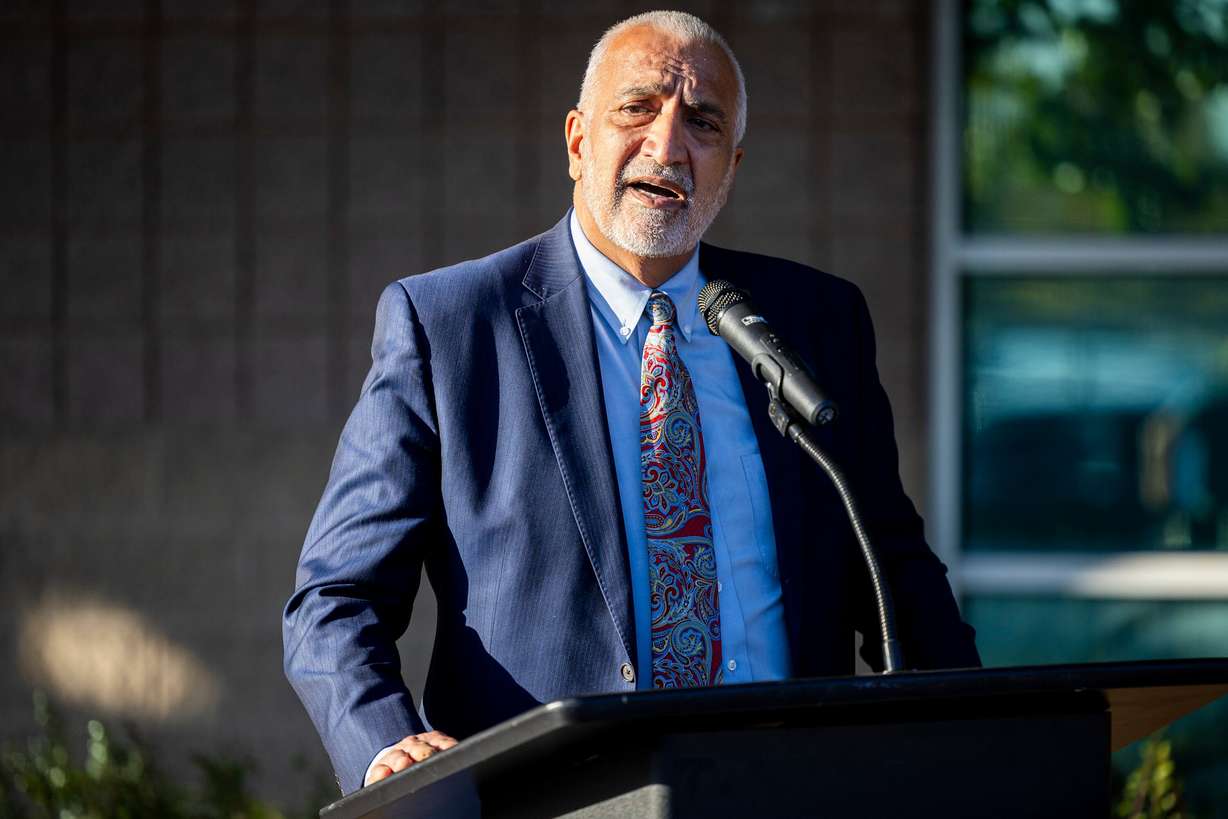
Salt Lake County District Attorney Sim Gill, a first-generation immigrant from India, delivered a presentation to the Major County Prosecutors Council in July with legal guidance on how to hold ICE agents accountable for alleged infringements of citizens' rights.
This is a key issue for the reform-oriented attorney running for a fifth term. While his Republican opponent, Kent Davis, has framed the race in terms of restoring trust in the rule of law, Gill believes that one way to do this is upholding constitutional limits on federal power.
"Here's the bottom line: ICE does not get to violate rights of our citizens," Gill told the Deseret News. "We're still living in America, which is ruled by the Constitution and the law, and I am committed to that."
Gill's workshop answered questions about when immunity applies to federal agents carrying out administrative functions. States cannot impede legitimate exercises of federal authority, he outlined. This depends on whether an officer has acted on an objectively reasonable basis.
After the deaths of protesters Renee Good and Alex Pretti, who were shot by federal agents just weeks apart in Minneapolis, nine progressive prosecutors formed the Fight Against Federal Overreach to support prosecution of immigration officers who may have violated state law.
The elected prosecutor in Minneapolis, Mary Moriarty, a member of the organization, filed charges against two agents earlier this year.
Gill is not a member of the coalition, but he said he plans to continue discussions on the topic with a collection of county prosecutors during their January meeting. Gill's concern about the impact of ICE operations on his jurisdiction has only increased since the July seminar.
ICE arrests surge in Utah
Utah ICE apprehensions spiked to a record 613 in June, following a brief decline since a December high of 511, according to totals published by the Deportation Data Project, which calculates state-by-state arrests based on government responses to public information requests.
The number of Utah arrests conducted by the Trump administration in July, 548, is roughly five times the average monthly figure under President Joe Biden. Nationwide, the number of monthly arrests has rocketed from 8,603 in December 2024 to 49,571 in July 2026.
Around half of July arrests were of immigrants with no criminal charges. In Utah, where a dozen police agencies have 287(g) agreements with ICE to facilitate the deportation of immigrants in the country illegally who broke additional laws, the ratio was closer to one-third.
While public deportation data only extends through July, there are signs the rate continues to speed up. ICE deportation and transfer flights from Salt Lake City have nearly tripled since June, the Human Rights First tracker found, with more than three flights occurring weekly.
Gill does not seek to obstruct President Donald Trump's deportation of immigrants in the country illegally, he said. But he fears that surging ICE activity creates a chilling effect among immigrant residents, including citizens, who are now afraid to come forward with criminal complaints.
"My fundamental concern is the safety of my community," Gill said. "Our goal is not to interfere with anyone, but nor turn a blind eye to a blatant violation of constitutional rights of all our citizens."
In a statement to the Deseret News, Davis said ICE agents should be treated equally under Utah law. The district attorney has no place in civil immigration enforcement, he said, expressing a similar focus on ensuring victims report crimes regardless of their status.
Differences between the two candidates hinge on how best to address criminal recidivism in the county.
Do DAs address homelessness?

As Gill's deputy district attorney from 2017 to 2021, Davis has focused his attacks on the inner workings of the office, not on partisan disagreements over whether Gill is "soft on crime." But a recent audit, which Davis said inspired his bid, suggests the two may be linked.
In December 2025, state legislative auditors released a report finding around half of the felony cases declined by Gill's office lacked a detailed explanation for the dismissal. A similar pattern was observed among plea deal agreements where charges were reduced.
The biggest takeaway from the audit for Davis was that the diversion programs created by Gill as alternatives to incarceration do not keep track of criminal recidivism for participants who later reoffend. This can contribute to a "revolving door" of criminal activity, according to Davis.
"I want written standards, documented decisions and regularly published performance metrics," Davis said.
The criticism is outweighed by outcomes under his watch, according to Gill. His dedication to reforming the criminal justice system without compromising safety is vindicated, he said, by Salt Lake crime falling to the lowest level in a decade, though some violent crime is up.
These results blow through the false binary between building alternatives to prison and being "tough on crime," Gill said, pointing out that his office has a higher than average filing rate and claiming that violent offenders are never referred for pre-filing diversion.
During his 16 years in office, Gill has led out on finding solutions to the persistent problem posed by "high utilizers," individuals who are often chronically homeless and who take up the majority of police resources, according to Salt Lake City Mayor Erin Mendenhall.
"He's been, not only key, but instrumental in rethinking the approach," Mendenhall told the Deseret News.
In stark contrast to the characterizations found in the audit, Mendenhall said Gill has been more "hands-on" with dangerous felons than other prosecutors, even as he helps the city to brainstorm ways to coordinate services to help those with underlying disorders.