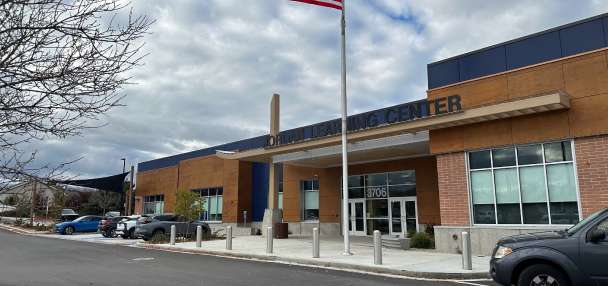

- Utahns have until 8 p.m. Tuesday to return ballots via drop box or vote in person on Election Day.
- Lt. Gov. Deidre Henderson issued an emergency order allowing some voters in San Juan County impacted by severe flooding to vote electronically.
- Utah's four congressional seats are up for grabs, and voters will weigh in on two proposed constitutional changes.
SALT LAKE CITY — Election Day is upon us.
For the first time since 2014, Utah has no statewide candidates on the ballot — constitutional state offices like governor and attorney general are held every four years coinciding with the presidential elections, and the next election for U.S. Senate isn't until 2028 — but voters will weigh in on races for the U.S. House, control of the state Legislature, county offices and a pair of proposed constitutional amendments.
Although it's too late to return ballots through the mail, Utahns have until 8 p.m. on Tuesday to return mailed ballots at a drop box or vote in person. As of Monday morning, 27% of Utah voters have cast ballots.
Here's what you should know as Americans head to the polls:
Floods prompt emergency voting measures
Severe flooding in southeastern Utah led Lt. Gov. Deidre Henderson to issue an emergency declaration Monday, allowing some voters in San Juan County to cast their votes electronically.
San Juan County voters who cannot "reasonably travel" to a drop box or in-person polling location, including residents of Aneth, Bluff, Dennehotso, Halchita, Mexican Hat, Mexican Water, Navajo Mountain, Oljeto and Red Mesa, will receive an email Tuesday morning asking if they have an email address tied to their voting record.
"We want every eligible voter in San Juan County to be able to cast a ballot if they have not done so already," Henderson said in a statement. "We are grateful for the local election officials and poll workers. They will still be on hand at all previously scheduled in-person polling locations through 8 p.m. on Election Day."
Affordability concerns
Midterm elections are often seen as a referendum on the president and the governing party, and that's shaping up to be the case this year as Americans express frustration about the economy.
President Donald Trump campaigned in 2024 on bringing down prices, but the Iran war and Trump's tariffs have contributed to continued inflation.
Candidates up and down the ballot are appealing to Utahns' wallets. Democrats in several races are trying to tie their GOP opponents to the president's actions, blaming Trump for the economic frustrations many voters feel.
Republicans, meanwhile, point to tax cuts extended through the so-called One Big Beautiful Bill as efforts to make life more affordable for voters.
Races to watch
All four of Utah's congressional districts are up for grabs, with three Republicans running for reelection: Reps. Blake Moore, Celeste Maloy and Mike Kennedy. Rep. Burgess Owens, the only other current member of Utah's House delegation, is not seeking reelection after a court-imposed map replaced one of Utah's safe conservative districts with one that favors Democrats.
Former Democratic Rep. Ben McAdams is now seeking a return to Congress in that district, Utah's 1st Congressional District, where he is running against Republican Riley Owen, Libertarian Jesse West, unaffiliated candidate Elias Montgomery and write-in candidate Bobby Darvish.
The remaining three races are all expected to lean toward Republicans, though some political analysts suspect a potential blue wave across the country could lead to slightly narrower margins for the GOP.
Republican Rep. Blake Moore is running for Utah's 2nd Congressional District, along with Democrat Peter Crosby, Independent American candidate Carlton Bowen, Libertarian Daniel Cottam and unaffiliated candidate Robert Moesinger.
The 3rd Congressional District features Rep. Celeste Maloy, a Republican, Democrat Kent Udell, Constitution Party candidate Cassie Easley, Libertarian Michael Stoddard and a pair of independent candidates: Adonis Hooslyn and Ayden Scott.
Finally, the 4th Congressional District race pits Rep. Mike Kennedy against Democrat Jonny Larsen, Libertarian Taylor Wright and unaffiliated candidate Steven Burt.
Republicans are almost certain to retain control of the Utah Legislature, but several down-ballot races could impact the margins of control of the state House of Representatives.
- House District 10: Former Rep. Rosemary Lesser, a Democrat, is hoping to return to her old seat in Weber County after being defeated by Republican Rep. Jill Koford, R-Ogden. With Koford seeking a seat in the state Senate, Lesser faces Republican Jim Alvey, a public relations professional.
- House District 26: Rep. Matt MacPherson, R-West Valley City, is being challenged by Democrat Michael Finch in a race on the west side of Salt Lake County.
- House District 27: Rep. Anthony Loubet, R-Kearns, won this seat in 2022 by only 67 votes. He improved on that total two years ago earning nearly 56% of the vote, but it remains one of the most competitive state legislative districts. Liz Oates, a Magna native, is hoping to unseat Loubet.
Voters weigh in on constitutional changes
While there are no candidates running statewide, voters across Utah will have the chance to weigh in on two proposed changes to the state Constitution.
The first, Amendment A, would remove the requirement that lawmakers advertise future amendment proposals in newspapers in each county in advance of the election. Instead, a new law would simply require them to post the text of amendments on state websites for voters to read.
That has been relatively noncontroversial, but Amendment B has attracted strong feelings and millions of dollars both for and against. Amendment B would require citizen-led initiatives that raise taxes to pass with at least 60% support, raising the bar from the 50% currently required.
A recent poll from Noble Predictive Insights found 56% of likely Utah voters oppose the measure, while 34% support and another 10% aren't sure.