
- Representatives from Utah Civic Compact, which puts a focus on automatic license plate readers, addressed the issue at a gathering in Washington Terrace.
- Doing away with readers may not be in the cards, but setting clearer guidelines on use of the data they generate may be possible.
- The issue will likely be a big focus of the 2027 Utah Legislature.
WASHINGTON TERRACE, Weber County — Many may view automatic license plate readers with a measure of distaste.
But a representative from a non-profit organization that puts a focus on investigating their implementation in Utah says getting rid of them altogether may not be in the cards.
"I know there's the temptation to feel that since it's so intrusive, the technology just needs to be gotten rid of completely," Clark Dice, communications director with the Utah Civic Compact, said. "Unfortunately, the terrain doesn't look like that's going to be what the future looks like."
Rather, the issue needs to be handled with "nuance," he told a crowd Tuesday at a town hall meeting on automatic license plate readers, or ALPRs, organized by Indivisible Ogden. He expects the issue, already drawing the attention of lawmakers, will be a big focus in the coming session of the Utah Legislature.
"We're going to have to have a conversation of what are we willing to accept from this new technology," he said. "Who owns the data? Who controls the data? How is it protected? And what does law enforcement need to do before they start tracking your movements?"
Law enforcement officials stress the importance of ALPRs, cameras placed along roads that read the license plate numbers of passing cars, in tracking criminals and fighting crime. Critics, though, see them as an invasion of privacy, and they are an increasing focus of debate across Utah and around the country. In light of the controversy, Indivisible Ogden, a progressive organization, organized the meeting at the Pleasant View Branch library in Washington Terrace, and Dice and others from Utah Civic Compact addressed the group and their reservations with ALPRs.
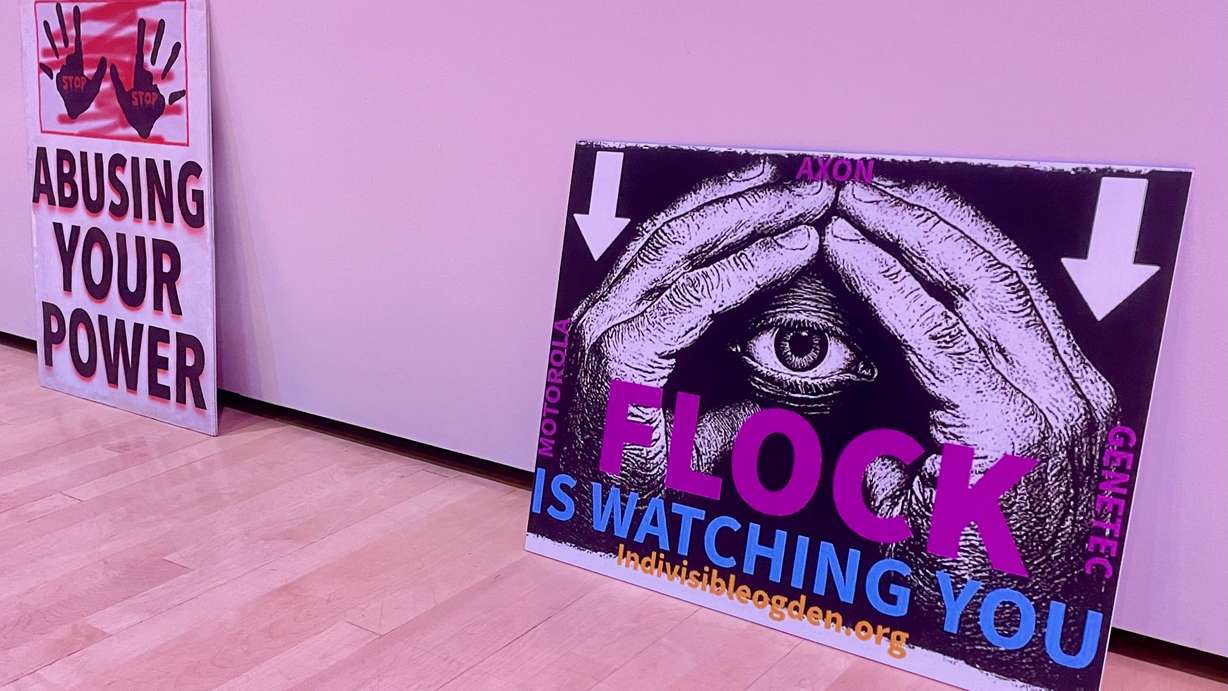
"It's not just about the camera. It's about your movements. It's about how your behavior is being cataloged and tracked," Dice said. "It has significant chilling effects on behavior. ... I worry about the person who feels self-conscious about going to the AA meeting because they're afraid that someone's going to notice their patterns to the meeting. I worry about the person who has to take time off of work because they have a mental health crisis or addiction recovery, and they go to a treatment center."
Law enforcement agencies may restrict how license-plate data is used, but he said the guidelines can vary from law enforcement agency to law enforcement agency, underscoring what he sees as the importance of standardizing the regulations.
"We've been trying to influence the legislators for the next legislative session, so we can pass some laws that will put some safeguards on this technology," Dice said.
Connor Radcliffe, president of the compact, estimates there are at least 1,000 ALPR cameras spread around Utah, but pinning down a precise number has been difficult.
At any rate, he noted figures provided to the organization by the Weber County Sheriff's Office that indicate that data culled by the county's 10 cameras was searched more than 5 million times dating to early 2022. The Weber County Sheriff's Office was the only entity to voluntarily provide the data the compact sought from around the state and Dice suspects it could be just a sampling of what is happening at other law enforcement agencies.
Radcliffe said one of the big takeaways from the Weber County numbers was that data, by and large, is used by out-of-state law enforcement agencies. The cameras, manufactured by Flock Systems, a major ALPR manufacturer, are part of a nationwide network.
But Jarom Gillins, director of policy for the Utah Civic Compact, said that network has some "undefined constraints," making it hard to understand exactly how data is distributed. Beyond that, he hinted at concerns about how Flock itself could potentially market data gathered by its cameras to the private sector.
"We are concerned about the government overreach, but what I'm concerned about more than that is that a private company is collecting data on all of us using government contracts to pay for the installation of the cameras," Gillins said.