'%3e%3cpath%20d='M34.1406%205.85938C30.3906%202.10547%2025.3047%200%2020%200C14.6953%200%209.60938%202.10547%205.85938%205.85938C2.10938%209.61328%200%2014.6953%200%2020C0%2025.3047%202.10547%2030.3906%205.85938%2034.1406C9.61328%2037.8906%2014.6953%2040%2020%2040C25.3047%2040%2030.3906%2037.8945%2034.1406%2034.1406C37.8906%2030.3906%2040%2025.3047%2040%2020C40%2014.6953%2037.8945%209.60938%2034.1406%205.85938ZM37.0117%2023.543H31.1602V13.5391H27.6328V19.9414C28.1211%2020.6914%2028.3711%2021.582%2028.3711%2022.5625V22.625C28.3711%2023.668%2028.1172%2024.6055%2027.6328%2025.4297V26.6094H36.082C33.4883%2032.9375%2027.2891%2037.3789%2020.0039%2037.3789C10.3711%2037.3789%202.62109%2029.6289%202.62109%2020C2.62109%2010.3711%2010.3711%202.62109%2020%202.62109C29.6289%202.62109%2037.3789%2010.3711%2037.3789%2020C37.3789%2021.1484%2037.2617%2022.2656%2037.0508%2023.3477C37.0391%2023.4141%2037.0234%2023.4766%2037.0117%2023.543Z'%20fill='white'/%3e%3cpath%20d='M22.3086%2018.5352C20.4336%2018.125%2019.9531%2017.8398%2019.9766%2017.1836V17.1406C19.9766%2016.6992%2020.3477%2016.2148%2021.4023%2016.2148C22.582%2016.2148%2023.8867%2016.6797%2025.0781%2017.4766L26.8516%2015.0195C25.4453%2013.8906%2023.707%2013.3398%2021.5547%2013.3398C18.5195%2013.3398%2016.4375%2015%2016.4063%2017.4766V17.5352C16.3633%2020.2617%2018.5859%2020.9805%2021.293%2021.6016C23.0391%2021.9766%2023.5703%2022.3164%2023.5703%2022.9609L23.5469%2022.9766C23.5469%2023.3906%2023.2578%2023.7031%2022.7852%2023.8359C22.5742%2023.9062%2022.1289%2023.9727%2021.5156%2023.9727C20.7617%2023.9727%2019.7539%2023.8633%2018.6328%2023.4844C18.0898%2023.2891%2017.4727%2023.0039%2016.8047%2022.6133L20.1406%2026.625C20.2813%2026.6602%2021.0977%2026.8516%2021.7734%2026.8516C25.0039%2026.8516%2027.0859%2025.2461%2027.1094%2022.6328V22.5703C27.1602%2020.1133%2025.2148%2019.1719%2022.3086%2018.5352Z'%20fill='white'/%3e%3cpath%20d='M5.24219%2013.5664V26.6133H8.75391V23.7578L10.2969%2021.9531L14.2031%2026.6133H18.3867L12.3555%2019.5195L17.4023%2013.5664H13.4531L8.75391%2019.0586V13.5664H5.24219Z'%20fill='white'/%3e%3c/g%3e%3cdefs%3e%3cclipPath%20id='clip0_97_2430'%3e%3crect%20width='40'%20height='40'%20fill='white'/%3e%3c/clipPath%3e%3c/defs%3e%3c/svg%3e)


- Utah's reservoirs are nearing 50% capacity amid drought conditions.
- Gov. Spencer Cox credits water restrictions for keeping it at 52% in August, while hoping for a strong snowpack next winter.
- Cox emphasizes cooperation among Colorado River states for sustainable water management solutions.
SALT LAKE CITY — Utah's reservoir system is nearing 50% capacity faster than its median average, but Utah Gov. Spencer Cox said that might be a "win" all things considered.
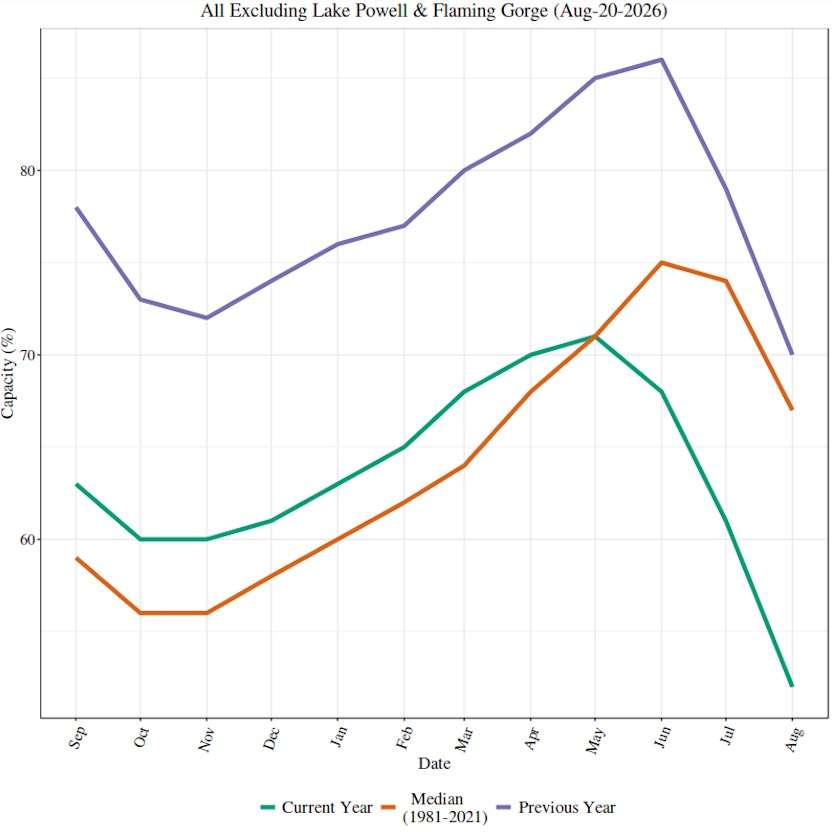
The statewide reservoir system — excluding Lake Powell and Flaming Gorge — tumbled to 52% on Thursday, per Utah Division of Water Resources data. The system fell to 70% last year, while the state's median average for August is 67%.
It follows Utah's record-low snowpack, which led to some of the worst spring runoff conditions ever reported. Snowpack accounts for nearly 95% of the state's water supply; Cox said it might be surprising that it's even 52% right now.
"If you had told me that we were going to have the snowpack that we had last year and that we'd have reservoirs at 50%, that's a win. That's about where we were hoping we'd be as we get toward the end of the growing season," he said Thursday during his monthly briefing with Utah reporters.
The governor credits water restrictions for that, saying he's let his grass die at his home in Sanpete County while his family farm cut back operations more than anyone in his family can ever remember.
Some of this year's decline is also tied to construction projects that called for reservoirs to release some of their water supply.
But all areas of Utah remain in drought, including more than 93% of the state in severe or extreme drought. Only a small sliver of the state, located in northwestern Utah, is in an exceptional drought, the worst drought category, per the U.S. Drought Monitor.
This summer's monsoonal moisture has been helpful toward recovery. Statewide soil moisture levels remain above normal for late summer, even though experts at the Natural Resources Conservation Service caution that some areas of the state have benefited more than others.
Strong soil moisture levels before the next snowpack can help improve snowmelt efficiency over the ensuing spring.
All eyes are now on the "super El Niño" developing over the Pacific Ocean, which could deliver a wet winter.
However, El Niño events typically bring warmer storms into the western U.S. in the winter, KSL meteorologist Matt Johnson points out. It's much too early to know if projected above-normal temperatures will be anywhere as warm as the past winter, which broke records and factored in the low snowpack.
Cox is hopeful that it will deliver a strong snowpack.
"If we have another bad year, that means even more restrictions next year," he said. "But I feel really good about where we are."
Colorado River
The governor also weighed in on the Bureau of Reclamation's post-2026 plan for Lake Powell and Lake Mead, which was unveiled in late July. He noted that none of the Colorado River states are happy about it, but he believes it could improve negotiations, with it potentially being the baseline for a future agreement.
Lake Powell hit a new record low last week, also following the poor snowpack.
The states aren't giving up on Lake Powell, Cox said, adding that every state needs to make sacrifices in order to make the system work. He hopes all releases from Flaming Gorge count as the Upper Basin's contributions for the system, with assurances that all releases are restored in the future.
"We have to make the system work," he said. "We recognize that we're part of that system."