'%3e%3cpath%20d='M34.1406%205.85938C30.3906%202.10547%2025.3047%200%2020%200C14.6953%200%209.60938%202.10547%205.85938%205.85938C2.10938%209.61328%200%2014.6953%200%2020C0%2025.3047%202.10547%2030.3906%205.85938%2034.1406C9.61328%2037.8906%2014.6953%2040%2020%2040C25.3047%2040%2030.3906%2037.8945%2034.1406%2034.1406C37.8906%2030.3906%2040%2025.3047%2040%2020C40%2014.6953%2037.8945%209.60938%2034.1406%205.85938ZM37.0117%2023.543H31.1602V13.5391H27.6328V19.9414C28.1211%2020.6914%2028.3711%2021.582%2028.3711%2022.5625V22.625C28.3711%2023.668%2028.1172%2024.6055%2027.6328%2025.4297V26.6094H36.082C33.4883%2032.9375%2027.2891%2037.3789%2020.0039%2037.3789C10.3711%2037.3789%202.62109%2029.6289%202.62109%2020C2.62109%2010.3711%2010.3711%202.62109%2020%202.62109C29.6289%202.62109%2037.3789%2010.3711%2037.3789%2020C37.3789%2021.1484%2037.2617%2022.2656%2037.0508%2023.3477C37.0391%2023.4141%2037.0234%2023.4766%2037.0117%2023.543Z'%20fill='white'/%3e%3cpath%20d='M22.3086%2018.5352C20.4336%2018.125%2019.9531%2017.8398%2019.9766%2017.1836V17.1406C19.9766%2016.6992%2020.3477%2016.2148%2021.4023%2016.2148C22.582%2016.2148%2023.8867%2016.6797%2025.0781%2017.4766L26.8516%2015.0195C25.4453%2013.8906%2023.707%2013.3398%2021.5547%2013.3398C18.5195%2013.3398%2016.4375%2015%2016.4063%2017.4766V17.5352C16.3633%2020.2617%2018.5859%2020.9805%2021.293%2021.6016C23.0391%2021.9766%2023.5703%2022.3164%2023.5703%2022.9609L23.5469%2022.9766C23.5469%2023.3906%2023.2578%2023.7031%2022.7852%2023.8359C22.5742%2023.9062%2022.1289%2023.9727%2021.5156%2023.9727C20.7617%2023.9727%2019.7539%2023.8633%2018.6328%2023.4844C18.0898%2023.2891%2017.4727%2023.0039%2016.8047%2022.6133L20.1406%2026.625C20.2813%2026.6602%2021.0977%2026.8516%2021.7734%2026.8516C25.0039%2026.8516%2027.0859%2025.2461%2027.1094%2022.6328V22.5703C27.1602%2020.1133%2025.2148%2019.1719%2022.3086%2018.5352Z'%20fill='white'/%3e%3cpath%20d='M5.24219%2013.5664V26.6133H8.75391V23.7578L10.2969%2021.9531L14.2031%2026.6133H18.3867L12.3555%2019.5195L17.4023%2013.5664H13.4531L8.75391%2019.0586V13.5664H5.24219Z'%20fill='white'/%3e%3c/g%3e%3cdefs%3e%3cclipPath%20id='clip0_97_2430'%3e%3crect%20width='40'%20height='40'%20fill='white'/%3e%3c/clipPath%3e%3c/defs%3e%3c/svg%3e)


- President Trump signed an order reducing Bears Ears and Grand Staircase-Escalante national monuments.
- The new sizes are almost a tenth of their original sizes, much smaller than their reduced sizes in 2017.
- Republicans celebrated the order; Democrats criticized the decision, the latest in a back-and-forth battle.
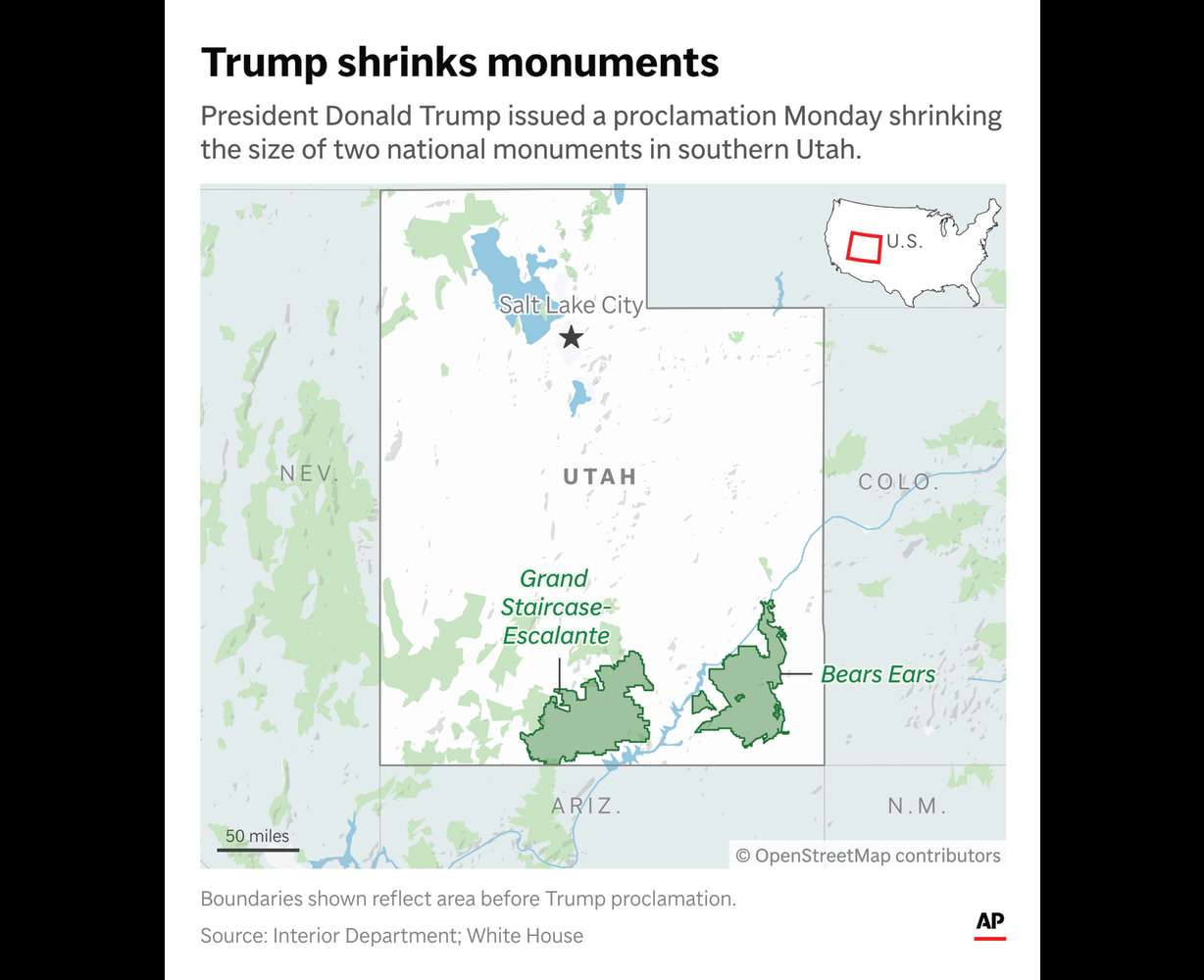
SALT LAKE CITY — President Donald Trump has once again ordered the sizes of two monuments in southern Utah to be reduced, but his new order will shrink them beyond his first order nearly a decade ago.
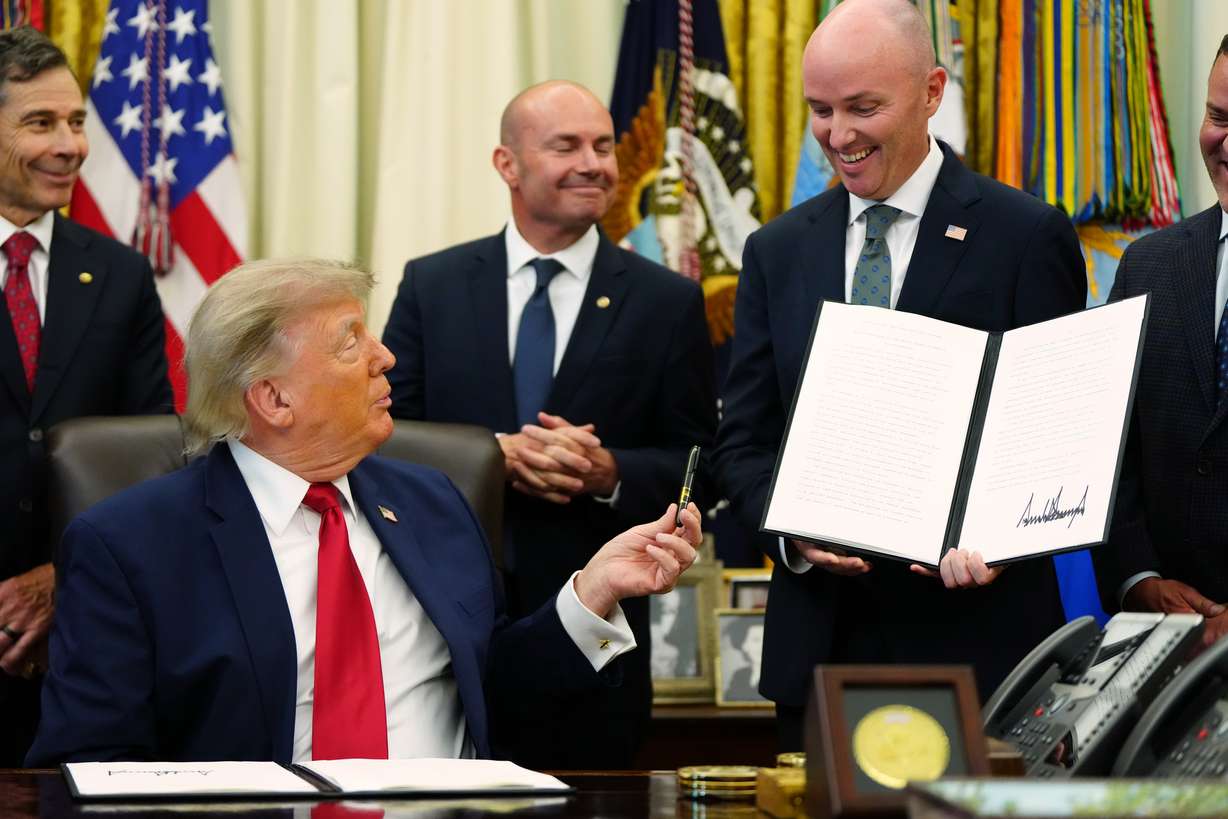
Trump signed an executive order on Monday reducing the sizes of Bears Ears and Grand Staircase-Escalante national monuments to about 121,000 acres and 182,000 acres, respectively. The combined total is approximately a quarter of the previous sizes he shrank them down to in 2017, and a tenth of their original sizes.
In all, almost 3 million acres "are going to be well taken care of now," the president said as he signed both orders.
"We've done something that I think was very desperately needed. It was very unfair to the people of Utah, and now fairness has been brought back," he said.
Gov. Spencer Cox and members of Utah's congressional delegation, who attended the signing ceremony at the White House, applauded as Trump signed both orders. They argued that the new size is the smallest possible while protecting important objects within both monuments, something that the president wrote in his orders.
"This is a big day for Utah. ... We need to rightsize these monuments," Cox said. "This does not remove the other protections that already exist in those areas. (It's) just making the monuments more manageable."
Conservation groups and Utah's Democratic delegation were less thrilled. Ben McAdams, the Democratic candidate in the new and more left-leaning 1st Congressional District, asserted that the move will open the door for special interest groups looking to mine or drill on land that was previously protected.
"I'll stand with the tribal nations, sportsmen and women, local businesses, Utahns and Americans nationwide who believe these lands should stay in public hands. ... These lands belong to the families who hunt them, hike them, camp on them, make a living because of them and hope to pass them on to their kids," he said in a statement.
Andrew Adams, KSLA political football gets kicked again
Both national monuments have become political footballs over the past decade.
Presidents Bill Clinton and Barack Obama, both Democrats, designated Grand Staircase-Escalante and Bears Ears national monuments between 1996 and 2016. Combined, they covered more than 3.2 million acres of land in Utah. Trump, a Republican, signed an order in 2017 shrinking the overall size of the two to nearly 1.23 million acres, but that order was reversed by President Joe Biden, a Democrat, in 2021.
How the Antiquities Act of 1906 is applied has been central to their arguments.
Trump's latest orders call for Grand Staircase-Escalante National Monument to be split into Escalante and Kaiparowits Horizon units, and Bears Ears National Monument into the Shash Jáa Unit and the Indian Creek units, calling it "the smallest area compatible with the proper care and management of the objects to be protected."
Utah's Republican leaders have long argued that the monuments are too large and don't fit the original scope of the law. Kate MacGregor, deputy secretary of the Interior, pointed out that the first monument was only 1,300 acres, far less than either Grand Staircase-Escalante and Bears Ears national monuments.
"President Clinton, President Obama and President Biden have increased acreage in the state of Utah and locked those acres up," she said, noting that it makes it difficult for people to access.
The Antiquities Act authorizes a president to "declare by public proclamation historic landmarks, historic and prehistoric structures and other objects of historic or scientific interest" within land owned or controlled by the U.S. government at their "discretion." That's left the law up to interpretation.
While the first few monuments were a little over 1,000 acres, officials for the Center for Western Priorities point out that President Theodore Roosevelt, the president at the time the law was created, also designated over 800,000 acres of public land for Grand Canyon National Monument in 1908. Congress would later designate it a national park.
Proponents of the original Grand Staircase-Escalante and Bears Ears boundaries argue that the sizes helped secure cherished places that were vulnerable to defacement, looters and development.
"These places have been entrusted to us by generations past, and we have a duty to protect them for generations to come," said Brian King, chair of the Utah Democratic Party.
Another legal fight looming?
The timing of Trump's latest order wasn't too surprising. Multiple environmental and conservation organizations, who have been opposed to shrinking the size of the monuments, said Friday that a new order reducing the sizes of the monuments was imminent.
Groups like Sierra Club, The Wilderness Society and Center for Western Priorities vowed to protect what they referred to as "iconic, irreplaceable natural places." They said they would also back Native American tribes that have long overseen the land while its protection status changes again.
Their voices were louder after the exact measure was revealed.
"These two landscapes deserve to be protected for current and future generations of Utahns and Americans, not opened to exploitation," said Scott Braden, executive director for the Southern Utah Wilderness Alliance.
Past decisions on the monuments ignited lawsuits, which local legal experts expected would be rekindled once the monuments were addressed again.
Another change would likely spark "immediate litigation" again, John Ruple, a research professor of law at the University of Utah's S.J. Quinney College of Law and director of the Wallace Stegner Center Law and Policy, told KSL in 2024, shortly after Trump won the election to return to the Oval Office.
He expected Utah would likely turn from opposing presidential decisions under Biden to defending them under Trump, while conservation groups would do the opposite, saying "it's safe to assume the state of Utah will continue to be engaged in costly and lengthy litigation."
Ruple also suggested Congress might be the best place to settle the debate once and for all, which is something both sides also referenced on Monday. Sen. John Curtis, a R-Utah, said a bill could "bring stakeholders together, work through disagreements and enact lasting solutions."
House Minority Leader Angela Romero, D-Salt-Lake City, of the Utah Legislature agrees, although it's unclear how or when such an agreement could come together.
"This back-and-forth with every administration has to stop," she said. "These lands deserve the protections that come with national monument status."