- Reps. Celeste Maloy and Blake Moore face primary challenges after the GOP convention.
- Moore lost to Karianne Lisonbee, receiving 33.7% against her 61.5% delegate vote.
- Maloy narrowly beat Phil Lyman 50.95% to 49.04%, sending both to a primary.
OREM — Two members of Congress, Reps. Celeste Maloy and Blake Moore, will face primary challengers following a lengthy Republican nominating convention on Saturday.
Both incumbents had already qualified for the ballot by collecting signatures, but were unable to avoid facing a primary after Moore was blown out during the convention by state Rep. Karianne Lisonbee and Maloy won a narrow race against former state lawmaker Phil Lyman.
In the 2nd Congressional District, Moore received 33.7% of the vote compared to 61.5% for Lisonbee. A third candidate was eliminated. In the 3rd Congressional District, Maloy narrowly bested Lyman 50.95% to 49.04% after two rounds of voting, but she did not clear the required threshold to become the GOP nominee outright.
Meanwhile, another incumbent congressman, Rep. Mike Kennedy, received more than 78% of the Republican delegate vote to receive the party's nomination in the 4th Congressional District, despite Kennedy facing multiple challengers.
This is the first Republican convention since 3rd District Judge Dianna Gibson adopted a new congressional map, scrambling the typical seats and giving Democrats a strong advantage in the 1st Congressional District. No incumbent Republican member of Congress is running in it. Instead, delegates nominated Riley Owen to run for the seat, although he had already gathered signatures to get on the ballot.
Judge Gibson was frequently criticized from the convention stage, as several candidates criticized her ruling amid an ongoing court fight over Utah's anti-gerrymandering law known as Proposition 4. Over the last few months, Republicans have frequently vented their frustration with Gibson and the courts more broadly.
During the convention, delegates voted on a handful of state legislative and school board races in the morning, then heard from congressional candidates in the afternoon, but only after the typical arguments over party rules and bylaws.
Rather than using electronic voting like recent years, delegates voted via paper ballots. It took well over two hours to tally just the first round of votes.
"Some of us drove 300 miles to get here and have 300 miles to drive home, so we would like to know the results," one woman said into the microphone about 80 minutes after vote counting first began.
Owen advances in 1st District
Riley Owen, a Navy reservist who worked for several months in the White House during President Donald Trump's first term, called the race an "uphill battle" for Republicans.
"To win this race, we must unify our Republican base behind a nominee who can keep this district red and rooted in the conservative principles that seven generations of my family and so many generations of yours have built here in Utah," Owen said.
Owen railed against the lack of a balanced budget and criticized the legislative and judicial branches of government ceding their constitutional powers to the executive.
Dave Robinson, former volunteer spokesman for the Salt Lake County Republican Party, told delegates he believes the seat can be won by a Republican. He spent part of his speech criticizing illegal immigration and expressing support for the SAVE Act, an election bill championed by Sen. Mike Lee, R-Utah.
Robinson also defended the defamation lawsuits he filed against several GOP officials after he was accused of sexual harassment and bullying by several women.
"Dave Robinson was accused of things that if it were true, I would be in prison," Robinson said, referring to himself in the third person. "And he was accused of these things by people in our own party."
Stone Fonua, a perennial candidate who has run for multiple offices in multiple parties over the years, spent his speech urging love and even sang the Latter-day Saint hymn "Love at Home."
"Love and peace is my mission," Fonua said.
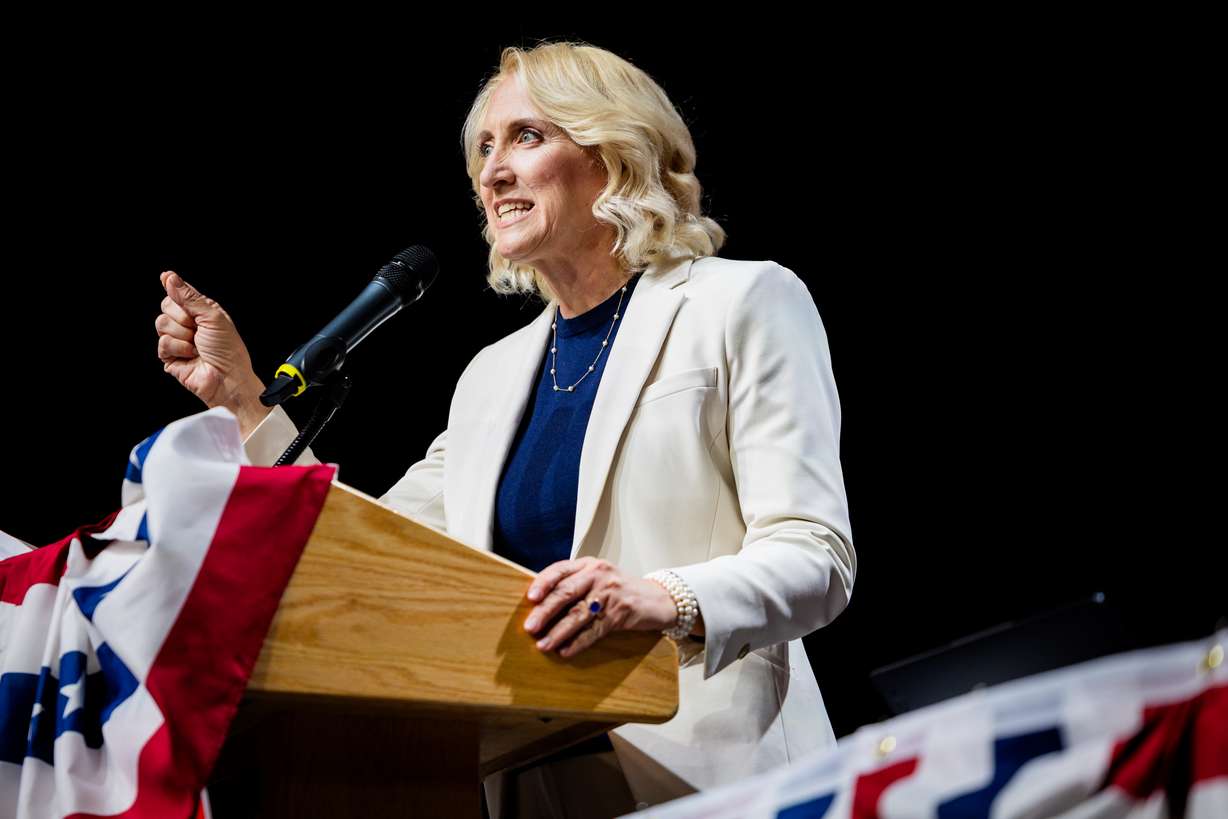
Lisonbee trounces Moore in delegate vote
As Rep. Blake Moore came out to address the delegates, he was met with a mixture of applause and boos. While Moore is endorsed by President Trump and holds a high leadership position in the U.S. House of Representatives majority caucus, he has faced criticism from some Republicans, particularly over his involvement in passing Proposition 4 in 2018.
Moore argued he kept his promise to help make the Trump tax cuts permanent, and he touted his role in helping create "Trump" investment accounts for children. He also said he's committed to Hill Air Force Base.
"Nothing is more critical to northern Utah's economy," Moore said. "As the first ever Utahn elected to leadership, I'm in the best position to continue supporting the base. We cannot restart this process now."
But Karianne Lisonbee, a state lawmaker, sharply criticized Moore, accusing him of working with Democrats "to turn a reliably red Utah congressional seat deep blue," and noting he does not live in the district he's running in.
Lisonbee cited the rising national debt and unfunded social security obligations as examples of a lack of leadership under Moore's tenure.
"Fraud and corruption have seeped into our institutions," Lisonbee said. "Government is too big, costs too much, and has gone far beyond its purpose."
A third candidate, Colton Hatch, also ran for the seat. He called immigration "the most important issue we face." He also criticized military action in foreign countries, abortion, and the COVID-19 vaccine as he urged delegates to support him instead of the other two GOP candidates.
"Trading Jack for Jill will not take over Capitol Hill," Hatch said.
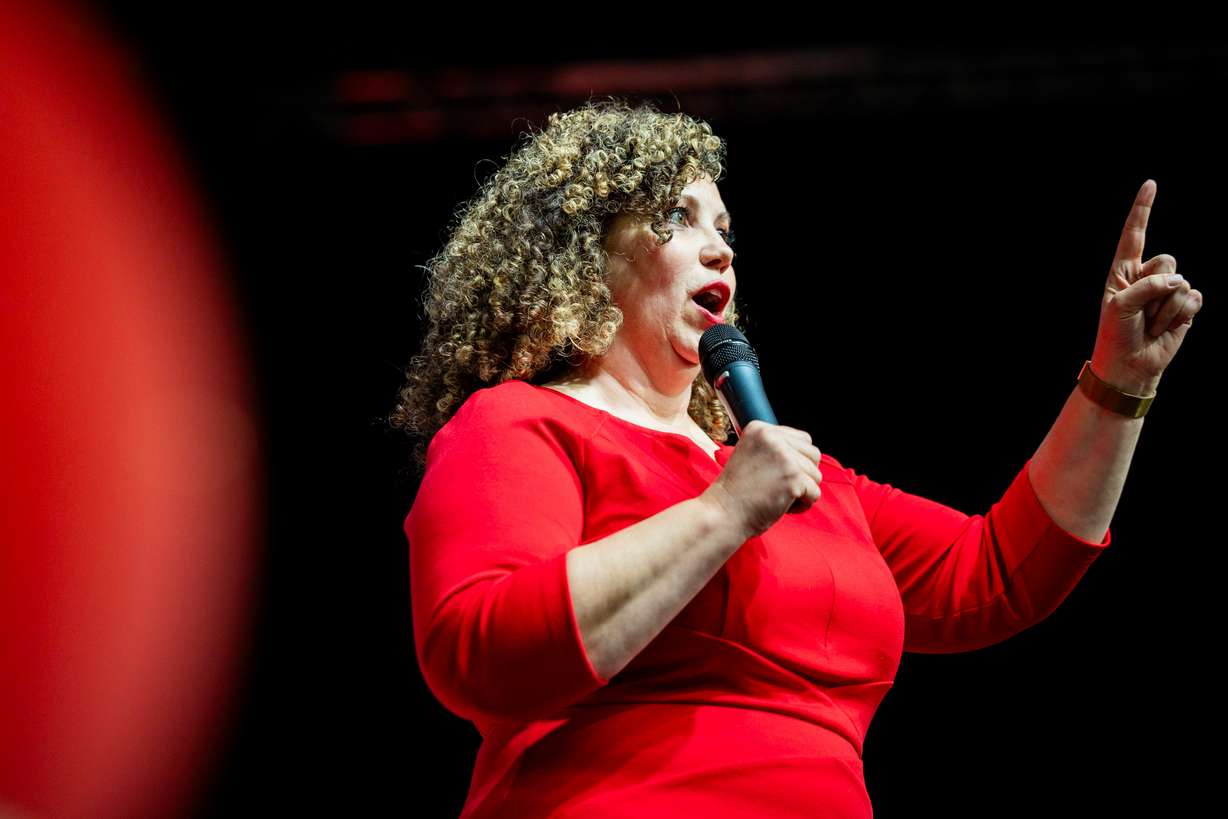
Close race between Maloy, Lyman
Rep. Celeste Maloy, who currently represents the 2nd District, started her pitch for the 3rd District by acknowledging there are good reasons for voters to be frustrated: the rising national debt, global instability and that "people who have violated our trust aren't always held accountable as quickly as we would like."
Since first being elected in 2023, the representative said she has sought to channel the "spirit of pilgrims" that helped during the nation's founding.
"All I'm asking today is that you give me a chance to keep doing that — to bring that Utah spirit and to do things on the federal level that are good for Utah," she said.
Phil Lyman, a former state lawmaker who is challenging Maloy, took the stage to loud applause from the delegates and proceeded to lean in on immigration, transgender issues and calling for a full release of files related to the late sex offender Jeffrey Epstein.
"Our problem in Utah is not a lack of trust, it's that we trust people who are not trustworthy," Lyman said.
He said crossing the border illegally is enough to warrant deportation and referred to an "invasion" of migrants coming into the country.
A third candidate, Tyler Murset, said he created an app allowing all constituents to weigh in on each vote in Congress and pledged to follow whatever a majority of his voters want.
"We entrust our representatives to act in our best interest, but it always seems that they're acting in someone else's interest," he said.
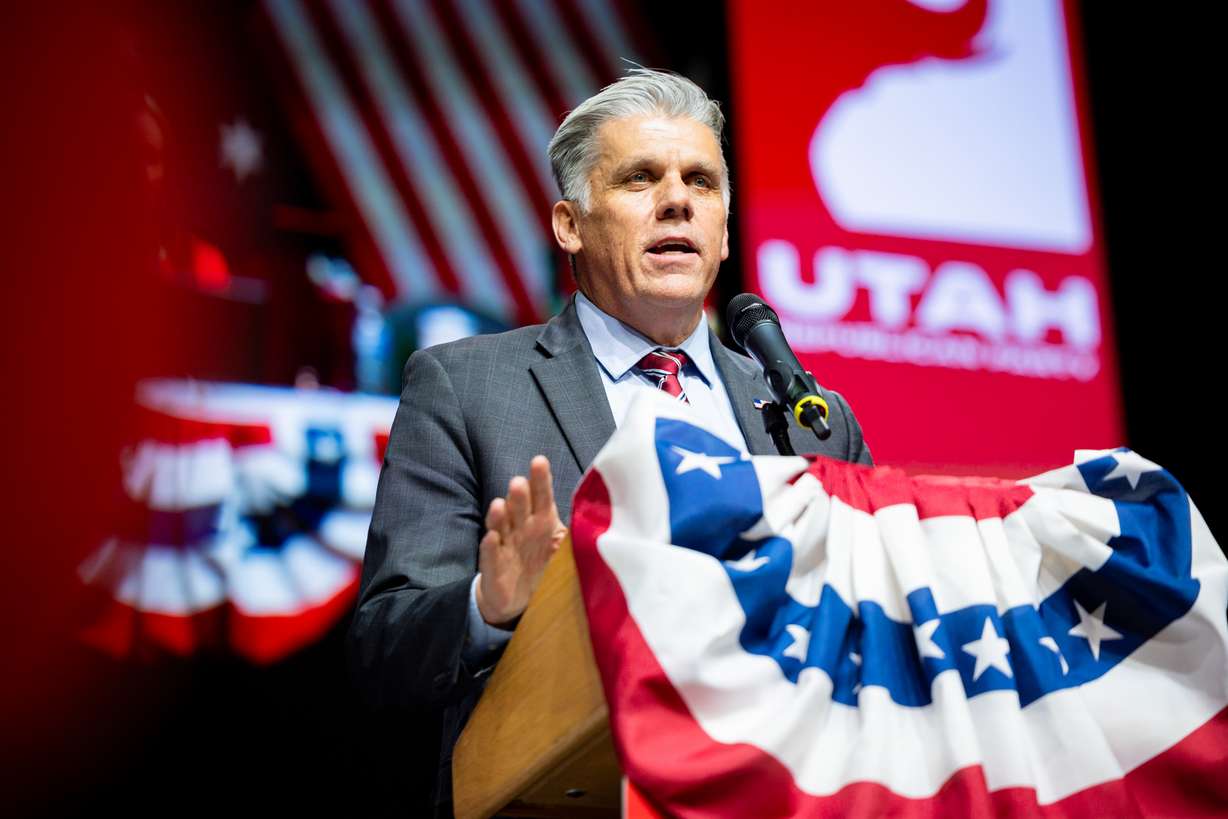
Kennedy cruises to nomination
Rep. Mike Kennedy, who currently represents the 3rd District, put his faith in the delegates and decided not to gather signatures in his first reelection campaign. He does not live in the 4th District.
Kennedy's speech Saturday leaned into his support for the caucus and convention process. He touted his support in the Legislature to repeal the law allowing candidates to qualify for the primary by gathering signatures.
Several challengers also chose to compete at the convention only, including Seth Stewart, Isaiah Hardman, Scott Hatfield and Tyrone Jensen.
Stewart criticized a court ruling that has blocked Utah's near-total abortion ban from taking effect.
Hardman, on the other hand, said he was disappointed by what the GOP majority in Congress has accomplished since Trump took office last year.
Hatfield called for stronger family values, while Jensen touched on several hot-button topics like drag shows and LGBTQ issues.
All his challengers similarly opted not to gather signatures, but Kennedy came out on top after the delegate vote and will advance to the November general election.