- Rep. Mike Kennedy advocates Utah's AI "sandbox" policy for federal adoption.
- Utah's AI office drafts regulations based on industry feedback and pilot programs.
- Trump's AI framework faces congressional challenges; Utah's model offers potential compromise.
SALT LAKE CITY — Utah Rep. Mike Kennedy wants to export the state's pioneering approach to artificial intelligence to Washington, D.C., in a bid to break a bipartisan stalemate over an AI framework proposed by President Donald Trump.
The president called on Congress in March to pass legislation to replace state laws that he said stunted innovation. But a lack of consumer protection provisions appears to have put a congressional majority out of reach.
The Trump administration attempted unsuccessfully last year to insert an AI moratorium into budget discussions. In the meantime it has begun reaching out to states to kill proposals that could violate a December executive order.
Utah became the first target of this presidential pressure campaign in February when the White House sent a memo to legislative leaders declaring a bill "unfixable" that required AI developers to disclose risk assessments.
But Kennedy thinks Utah can fix the federal deadlock on AI by replicating the state's business-friendly policy lab at the national level, creating regulatory certainty for companies while recommending guardrails for consumers.

What is Utah's AI approach?
Kennedy got the idea from a meeting he hosted last week between Utah's federal delegation and state officials, including Utah Gov. Spencer Cox, state Senate President Stuart Adams and House Speaker Mike Schultz.
In 2023, Utah became the first state to create an office of AI policy with authority to draft liability mitigation agreements with AI firms. After a pilot period, the office then proposes regulations based on industry feedback.
This process led to new laws in 2025 that established rules for the use of mental health chatbots, expanded prohibitions on AI abuse of personal identity and established AI disclosure requirements for certain businesses.
The office recently approved an agreement with a company exploring AI prescriptions for common medications, which attracted an influx of businesses wanting to operate in Utah, Senate Majority Leader Kirk Cullimore said.
"I think health care is ripe for disruption right now," Cullimore, R-Sandy, told the Deseret News. "And if we can get some coordination on that, I think what we're doing in the AI Policy Lab at the state level could be even more effective."
The message from these companies, according to Cullimore — the lawmaker behind the office — was that applying this regulatory "sandbox" model to the U.S. government would allow AI to safely revolutionize industries.
Utah's delegation signaled they were committed to make that happen, said Cullimore, who attended the meeting on April 2.
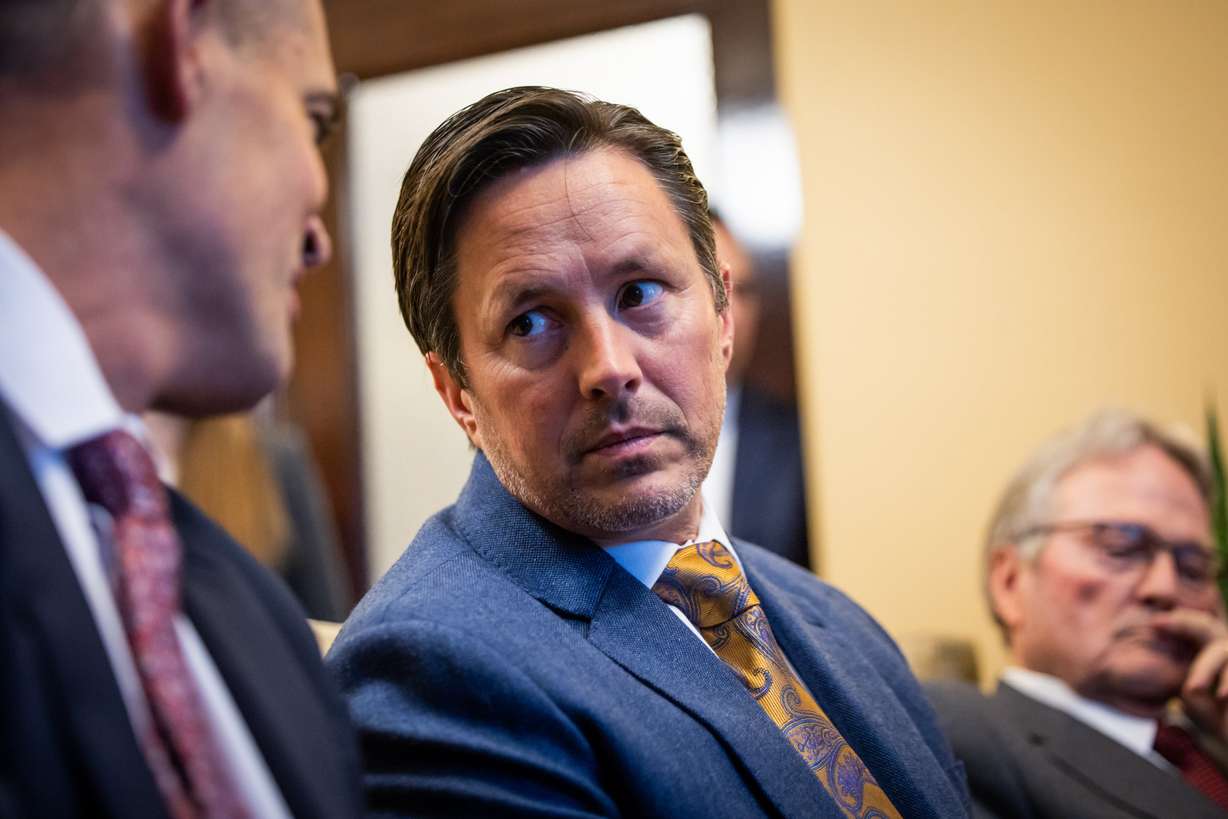
As Trump tries to push AI policy through a fractured Congress, Kennedy told the Deseret News that Utah's "healthy approach" of regulation that is "helpfully directive" and "not destructive" could point to common ground.
"If I can represent that to the administration, they might just lift the template that already is working and put it into whatever this federal policy ends up being, and lo and behold, Utah is driving the process in a functional way," Kennedy said.
Trump's AI framework
Trump's AI framework asks Congress to preempt state AI laws — except for those narrowly tailored to protecting children — to establish a "minimally burdensome national standard," instead of a patchwork of policies.
This fits with Trump's broader vision that a lighter regulatory touch is critical to ensure that AI innovation reaches its full potential, according to John Villasenor, who co-directs the Institute for Technology, Law & Policy at UCLA.
"The big concern is that when you have potentially dozens of different state-level frameworks that are all slightly different, and perhaps contradictory, the compliance burden just becomes really, really bad," Villasenor told the Deseret News.

But the laissez-faire, nationwide standard industry giants are clamoring for has hit the reality of modern-day Congress.
After receiving the approval of House Republican leadership, Trump's framework has made little headway with top Democratic policymakers, many of whom criticized the plan's lack of accountability for AI firms, Politico reported.
Trump's push appears driven by business interests, especially after the administration targeted Utah's law focused on child protection plans and catastrophic risk assessments, said Peter Wildeford, the head of policy at AI Policy Network.
"Even if you like a national framework, you don't want to be replacing state laws with something that's much weaker than what the states, including Republican states, have decided is best for their citizens," Wildeford told the Deseret News.
A federal version of Utah's sandbox policy could be a potential compromise that aligns state laws with the Trump administration's framework in a way that encourages AI innovation but not at the expense of consumer protection, Wildeford said.
A federal sandbox?
In September, Senate Commerce Committee Chair Ted Cruz introduced the SANDBOX Act, which would empower the Office of Science and Technology Policy to temporarily waive "outdated" regulations to allow AI developers to launch new technologies.
"Which I do think is a reflection of sort of the sandbox perspective that Utah's brought to the AI conversation," said Chris Koopman, CEO of the Utah-based Abundance Institute. "This is definitely a Utah model."
Negotiations over Trump's framework are still in early stages, Koopman said. The bill drafting process hasn't stalled because it hasn't started yet. It will likely move forward this summer, according to Koopman, who hopes Utah's approach will appear in the final product.
While Utah was an early adopter of sandbox policies, AI proposals failed to progress through the Legislature this year.
The first proposal, HB286, withered under White House threats, and the second, HB438, which would have imposed penalties for AI chatbots that engage in harmful conversations with minors, met overwhelming opposition from industry representatives.
But this is just another example of the Utah Way, Koopman said, with lawmakers finding a balance between public policy and economic dynamism in the state.