'%3e%3cpath%20d='M34.1406%205.85938C30.3906%202.10547%2025.3047%200%2020%200C14.6953%200%209.60938%202.10547%205.85938%205.85938C2.10938%209.61328%200%2014.6953%200%2020C0%2025.3047%202.10547%2030.3906%205.85938%2034.1406C9.61328%2037.8906%2014.6953%2040%2020%2040C25.3047%2040%2030.3906%2037.8945%2034.1406%2034.1406C37.8906%2030.3906%2040%2025.3047%2040%2020C40%2014.6953%2037.8945%209.60938%2034.1406%205.85938ZM37.0117%2023.543H31.1602V13.5391H27.6328V19.9414C28.1211%2020.6914%2028.3711%2021.582%2028.3711%2022.5625V22.625C28.3711%2023.668%2028.1172%2024.6055%2027.6328%2025.4297V26.6094H36.082C33.4883%2032.9375%2027.2891%2037.3789%2020.0039%2037.3789C10.3711%2037.3789%202.62109%2029.6289%202.62109%2020C2.62109%2010.3711%2010.3711%202.62109%2020%202.62109C29.6289%202.62109%2037.3789%2010.3711%2037.3789%2020C37.3789%2021.1484%2037.2617%2022.2656%2037.0508%2023.3477C37.0391%2023.4141%2037.0234%2023.4766%2037.0117%2023.543Z'%20fill='white'/%3e%3cpath%20d='M22.3086%2018.5352C20.4336%2018.125%2019.9531%2017.8398%2019.9766%2017.1836V17.1406C19.9766%2016.6992%2020.3477%2016.2148%2021.4023%2016.2148C22.582%2016.2148%2023.8867%2016.6797%2025.0781%2017.4766L26.8516%2015.0195C25.4453%2013.8906%2023.707%2013.3398%2021.5547%2013.3398C18.5195%2013.3398%2016.4375%2015%2016.4063%2017.4766V17.5352C16.3633%2020.2617%2018.5859%2020.9805%2021.293%2021.6016C23.0391%2021.9766%2023.5703%2022.3164%2023.5703%2022.9609L23.5469%2022.9766C23.5469%2023.3906%2023.2578%2023.7031%2022.7852%2023.8359C22.5742%2023.9062%2022.1289%2023.9727%2021.5156%2023.9727C20.7617%2023.9727%2019.7539%2023.8633%2018.6328%2023.4844C18.0898%2023.2891%2017.4727%2023.0039%2016.8047%2022.6133L20.1406%2026.625C20.2813%2026.6602%2021.0977%2026.8516%2021.7734%2026.8516C25.0039%2026.8516%2027.0859%2025.2461%2027.1094%2022.6328V22.5703C27.1602%2020.1133%2025.2148%2019.1719%2022.3086%2018.5352Z'%20fill='white'/%3e%3cpath%20d='M5.24219%2013.5664V26.6133H8.75391V23.7578L10.2969%2021.9531L14.2031%2026.6133H18.3867L12.3555%2019.5195L17.4023%2013.5664H13.4531L8.75391%2019.0586V13.5664H5.24219Z'%20fill='white'/%3e%3c/g%3e%3cdefs%3e%3cclipPath%20id='clip0_97_2430'%3e%3crect%20width='40'%20height='40'%20fill='white'/%3e%3c/clipPath%3e%3c/defs%3e%3c/svg%3e)




- A Utah law firm is pursuing a $56 million lawsuit against the U.S. government on behalf of a Venezuelan man.
- The man was part of a contingent of immigrants sent to a Salvadoran prison last year by U.S. immigration officials, where he suffered abuse.
- The man was detained after entering the country with four family members, now in Utah.
SALT LAKE CITY — Lawyers at a Utah law firm are laying the groundwork for a $56 million lawsuit against President Donald Trump and federal immigration authorities on behalf of a Venezuelan man sent last year to a notorious Salvadoran prison by U.S. authorities.
The man has no criminal record in the U.S. or in Venezuela and came to the U.S. legally, his attorneys say.
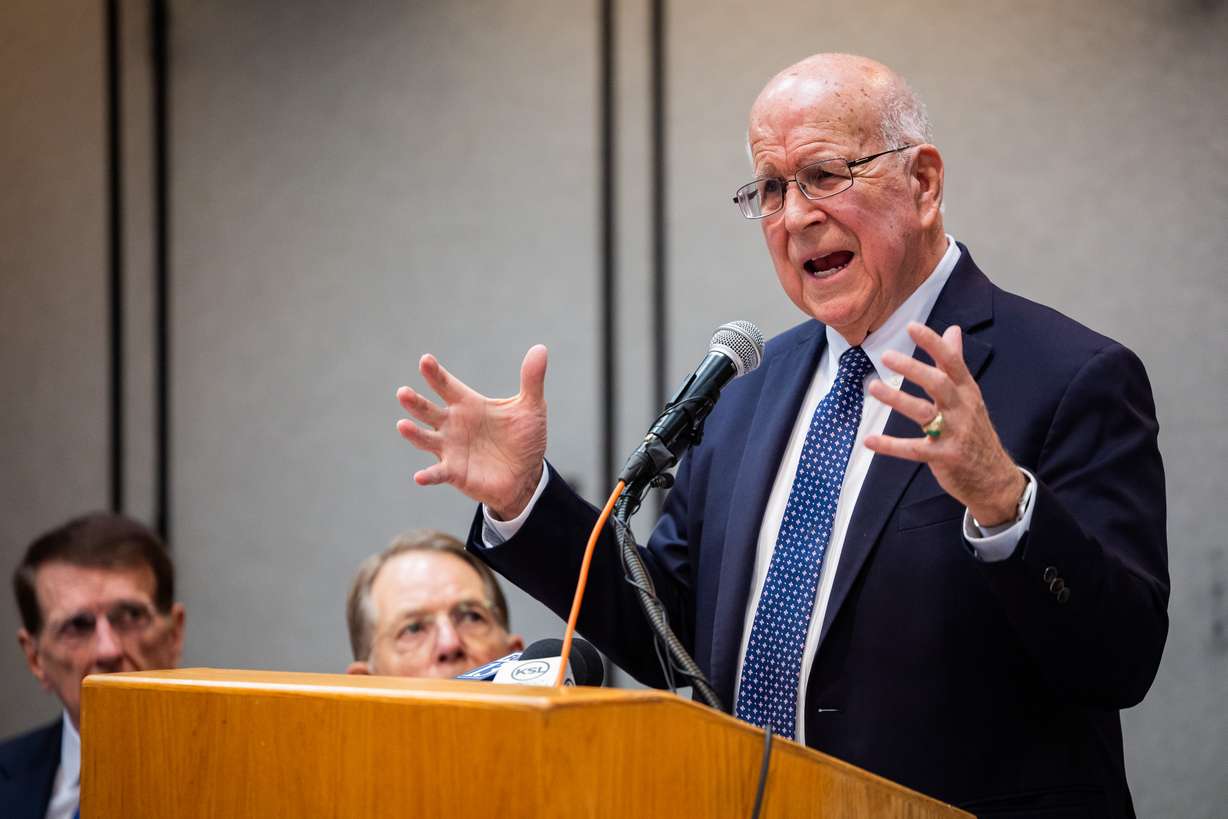
Lawyers from Parker and McConkie on Tuesday said they had filed a notice of claim on behalf of a client they identify as Johnny Hernandez, a pseudonym, stemming from the personal injuries they say he suffered due to the actions of U.S. immigration officials. Filing a notice of claim is a preliminary step required before suing the government.
"He came to the United States legally. I emphasize that, legally. He came to escape threats and political persecution of the Maduro government because his family were at odds with the totalitarian practices of their own government," said Jim McConkie, one of the attorneys pursuing the case, alluding to Nicolás Maduro, the president of Venezuela until his ouster by U.S. forces in January.
"He has no criminal record here or anywhere else in Venezuela or any other part of the world."
McConkie said Hernandez becomes only the second immigrant sent by U.S. officials to the Terrorism Confinement Center in El Salvador, known as CECOT, to pursue legal action against the federal government. Neiyerver Adrián Leon Rengel, also from Venezuela, is pursuing a $1.3 million lawsuit against the government stemming from the mistreatment he says he received at the Salvadoran, according to CBS News.
Hernandez, 20, who has four family members, also from Venezuela, who are living in Utah, suffered "catastrophic injuries" at CECOT at the hands of prison guards there, according to his lawyers. Hernandez was detained by U.S. officials in San Diego, California, soon after his Aug. 22, 2024, entry into the country with the four other family members and eventually sent to CECOT in March 2025, part of the first contingent of immigrants U.S. officials sent to the Salvadoran prison.
That transfer of immigrants to El Salvador — part of Trump's crackdown on illegal immigration — sparked controversy and outrage from critics, in part because administration officials brushed aside judicial orders to halt the flights carrying the people. Trump officials maintained that those sent were criminal immigrants, but others questioned his characterization.
"The Trump administration knowingly and unlawfully locked up an innocent person for four months in a concentration camp-like prison where he suffered torture, shooting, beatings and solitary confinement," said McConkie. "When the U.S. government knowingly and purposefully violates the law by detaining and deporting innocent individuals on false charges and is not held responsible, the individual rights of not just legal immigrants but all Americans are placed in jeopardy."
Hernandez and around 250 other Venezuelans sent, like him, by U.S. officials to CECOT were released on July 18, 2025, and he was returned to Venezuela, where he now lives. He continues to suffer from injuries sustained at CECOT, including a shoulder wound caused by a rubber bullet, anxiety, depression and more, according to the notice of claim.

"The U.S. government knew or should have known that the transfer of (Hernandez) to CECOT in El Salvador would subject him to a high risk, if not the certainty of the severe torture and abuse that he has actually suffered," reads the notice of claim.
He is still recovering from the "unspeakable horrors" he experienced in El Salvador, according to attorney Brent Ward, also involved in the case.
Read more:

Voces de Utah
Looking for more news from Utah's Latino community? Visit our Voces de Utah section for more stories, events and features.Parker and McConkie filed the notice against Trump, the Department of Homeland Security, Immigration and Customs Enforcement, the U.S. State Department, the U.S. Justice Department and the varied agencies' agents and employees. The government has six months to respond, but McConkie doubts federal officials will have any response.
"Absent a satisfactory response within six months, our client will file a lawsuit against the government in federal court," reads a statement from the lawyers.
In a statement, the Department of Homeland Security sidestepped questions related to potential U.S. responsibility for conditions faced by immigrants the U.S. government sent to CECOT.
"For your questions on conditions and treatment at CECOT, we refer you to the El Salvador government as they are not U.S. citizens and were not under U.S. jurisdiction," the statement says. The department also offered a broad defense of the Trump administration crackdown on illegal immigration as key to U.S. security and expressed confidence in the ability of U.S. law enforcement officials' ability to identify gang members.
"President Trump will not allow foreign terrorist enemies to operate in our country and endanger Americans. He will always put the safety of the American people first," the statement said.
McConkie said the sum sought, $56 million, is meant to help compensate Hernandez for what he went through and to send a message.
Large judgments "are important because it places a cost on the aggressor and requires them to take some responsibility, enough responsibility that they will be discouraged from being involved in the similar conduct in the future," he said.
Referencing the number of immigrants sent to CECOT along with Hernandez, he said "there should be 252 $56 million lawsuits against the United States of America for this kind of conduct."
Hernandez had crossed legally into the United States with his four other family members on Aug. 22, 2024, at the San Ysidro Port of Entry in San Diego, according to his notice of claim. He was detained because a border guard erroneously thought he was a member of the Tren de Aragua gang, though he isn't, while the other four members of his family were able to proceed. They entered legally under a humanitarian parole program then in effect.
Hernandez was held for around six months at a immigration detention facility in San Diego, though his family had no idea where he was. He received no legal assistance and never received documentation explaining why he was being held, according to his notice of claim. In early March 2025, he was shuttled with many other Venezuelan nationals detained at the San Diego facility to several U.S. airports, then to El Salvador and the CECOT prison by way of Honduras.
All along, Hernandez had said he wanted to stay in the United States so he could pursue his immigration case.

In El Salvador, Hernandez and the other prisoners with him were beaten by Salvadoran police inside the airplane, shortly after arriving. During their four months at the Salvadoran prison, they suffered regular beatings and mistreatment by guards.
"He was routinely taken to an area of the prison out of view of surveillance cameras. There, he was viciously hit, kicked and beat by male guards as many times and for as long as they wanted. He was also taken from his cell and brought standing with his hands tied to be abused by female guards, who took turns punching the prisoners in the stomach for as long as they wanted," reads the notice of claim. "Terrible abuse, including but not limited to physical, psychological and emotional abuse, continued regularly during four months of confinement."
During some sort of uprising in the prison, Hernandez suffered a wound to his shoulder caused by a rubber bullet fired by guards. Guards refused to provide treatment and would penetrate the wound with their fingers. Cellmates ultimately helped remove the rubber bullet.
"He continues to suffer from physical and psychological injuries inflicted at CECOT, including but not limited to permanent impairment from the wound to the shoulder, contusions, scars, post traumatic stress disorder (PTSD), anxiety and depression," reads the claim.
McConkie and the others involved in Hernandez's case also used the opportunity of Tuesday's press conference to blast ICE plans to build an immigration detention facility in Salt Lake City that could house up to 10,000 people. They say U.S. officials are using CECOT as a model for the Utah prison and others planned around the country.