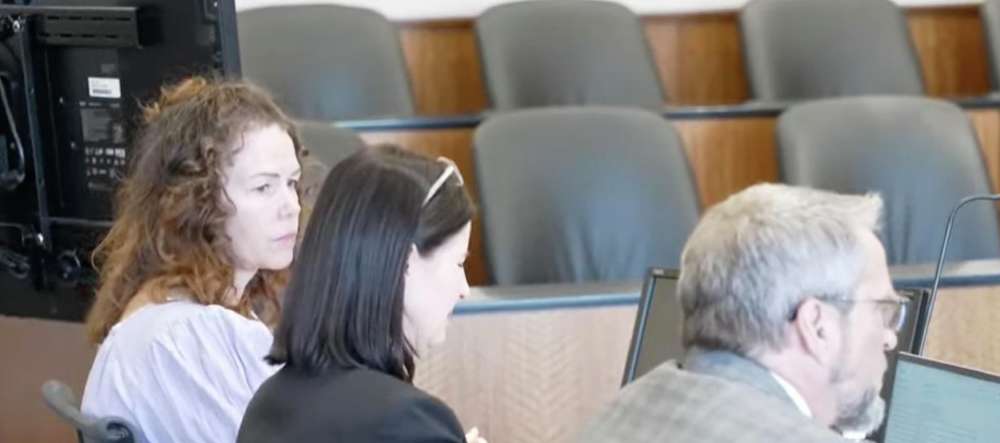
- Meggan Sundwall, a nurse, is on trial on charges accusing her of killing a friend who claimed to have terminal cancer.
- Prosecutors argue Sundwall administered insulin to benefit from a life insurance policy, which the friend claimed existed but did not.
- Sundwall's attorneys claim there is not enough proof that the death wasn't suicide.
PROVO — Jurors will be tasked with deciding whether Meggan Sundwall encouraged her friend to commit suicide or actually killed the friend with a fatal insulin overdose in a trial that began on Wednesday.
Deputy Utah County attorney July Thomas said Sundwall, a nurse living in Santaquin, "had a plan" to go to her friend's house and inject her with insulin until the friend died. She said texts between the two friends outlined the plan. Sundwall was incentivized because the friend repeatedly told her she was the beneficiary of a life insurance policy.
Thomas said in opening statements that Kacee Lyn Terry, 38, of Highland, told lies that grew. She said her family believed that she had cancer right up until she was hospitalized in a diabetic coma shortly before she was taken off life support and died. Terry ordered saline to the home and had a port where she would administer it, claiming it was a chemotherapy drug.
Terry sent Sundwall texts saying "tell me that I'm not dying," and portrayed that she was in pain from cancer and wanted to be free from the pain. Thomas said that was a frequent topic of conversation for the two women.
"I believe you will find that Kacee neither wanted nor intended to die on Aug. 12," she told the jury, "even though she pretended she did want to in an increasingly desperate attempt to keep Meggan's attention and affection. The evidence tends to establish that Kacee thought she could handle Meggan, but she didn't count on Meggan's determination."
Sundwall told her friend things like "there is nothing left for you here" and "you have to let go, it is past time." Terry would, in turn, pretend to be doctors and nurses texting Sundwall to say she was nearing death and in hospice.
According to Thomas, Terry pretended to be suicidal and interested in ending the pain — but it was pain that did not exist. She said after Sundwall spoke about ways she could end her life, and provided insulin to her while they were roommates and asked if she planned to use it. Thomas said Sundwall offered to help.
Terry told her sister she thought Sundwall was trying to kill her, and the family helped her move out of Sundwall's home and into Terry's grandparents' home, Thomas said.
She said Terry's lies "continued to grow and grow ... (and) became so outlandish that it appears to be a cry for help."
Thomas said Terry claimed she had used four and nine bottles of insulin, hundreds of times over what Sundwall said would kill her, and Sundwall did not call her out.
Ultimately, Terry agreed that Sundwall could help her end her life on Aug. 11, 2024, but Terry postponed until the next day. She said family members saw Sundwall arrive at the home on Aug. 12, 2024, and when they returned to check on Terry after multiple missed calls, she was found "lying on her bed struggling to breathe, unconscious or in a coma and Meggan sitting there watching," Thomas said.
She said no one called 911, not Sundwall or her parents, who arrived after hearing Terry was dying. Thomas said a glucose monitor showed checks of Terry's blood sugar 19 times over 10 hours. The numbers go from normal to a level where she would have been unconscious, and then she was tested 10 more times.
"For at least seven solid hours, Meggan was there watching Kacee descend from confusion to unconsciousness to a coma," Thomas said.
She said Sundwall was in financial distress after losing a job and a car. She said a message Sundwall sent said, "If you dying would get me out of this mess and darkness I am in, I would take it." Thomas also said that 283 messages were deleted from Sundwall's phone.
"Meggan wanted Kacee to die to relieve her from the stress of her financial situation, and that plan worked," she said.
Scott Williams, Sundwall's attorney, said the "largest question" is whether Terry needed Sundwall and could not have killed herself. He said evidence does not prove there was more insulin administered after she would have been in a coma.
He said Terry had admitted for years that she was suicidal, but that it had been escalating. She had claimed to be using opioids and was stealing from her grandparents, Williams said.
"She certainly ramped up her supposed misery level," he said, adding that a psychologist will testify about the dynamic between the two friends and why Sundwall would accept anything her friend was saying and show up unconditionally.
"You're going to see that Kacee is begging her to help her," Williams said.
He said the police had confirmation bias and missed DNA tests on key items.
Sundwall is charged with aggravated murder, a first-degree felony, and obstruction of justice, a second-degree felony.
This story may be updated.