
- Utah aims to become a key U.S. hub for critical minerals production.
- Legislation by Sen. Ann Millner, R-Ogden, seeks federal support and expedited permitting for mining.
- Environmental concerns arise, but the Department of Environmental Quality supports growth while protecting the environment.
SALT LAKE CITY — A study last year revealed that just over a third of Americans knew much about critical minerals.
But almost all who were surveyed likely rely upon critical minerals.
Reading this article on a cellphone or a laptop? If so, then at this moment you're utilizing devices that depend upon critical minerals such as lithium and cobalt.
And critical minerals are also vital to the country's economic and national security. They're foundational elements found in hypersonic weapons, fighter jets and a long list of other 21st century military technologies.
Now a pair of measures introduced during the 2026 Utah legislative session aim to position the Beehive State as a primary U.S. hub for critical mineral production, processing and research.
Sen. Ann Millner, R-Ogden, is sponsoring both measures: SB254 — "Critical Minerals Amendments," and SCR9 — a resolution calling for federal support of Utah's critical minerals industry.
Millner believes Utah is well-poised to be a front-runner in America's essential critical minerals industry because of the state's critical minerals abundance — and its existing academic expertise in the field.
"We believe that we have about 50 of 60 critical minerals that we need for the defense of this country, (and) for technology and innovation in the state of Utah," said Millner during her presentation of SB254 to the Senate Natural Resources, Agricultural and Environment Committee.
"We don't know that they're all mineable, but, in terms of economic feasibility, we need to figure that out."
It's not enough to simply pull critical minerals from Utah ground, she added. They need to be processed. "And our goal is to capture 20% to 25% of the U.S. domestic demand."
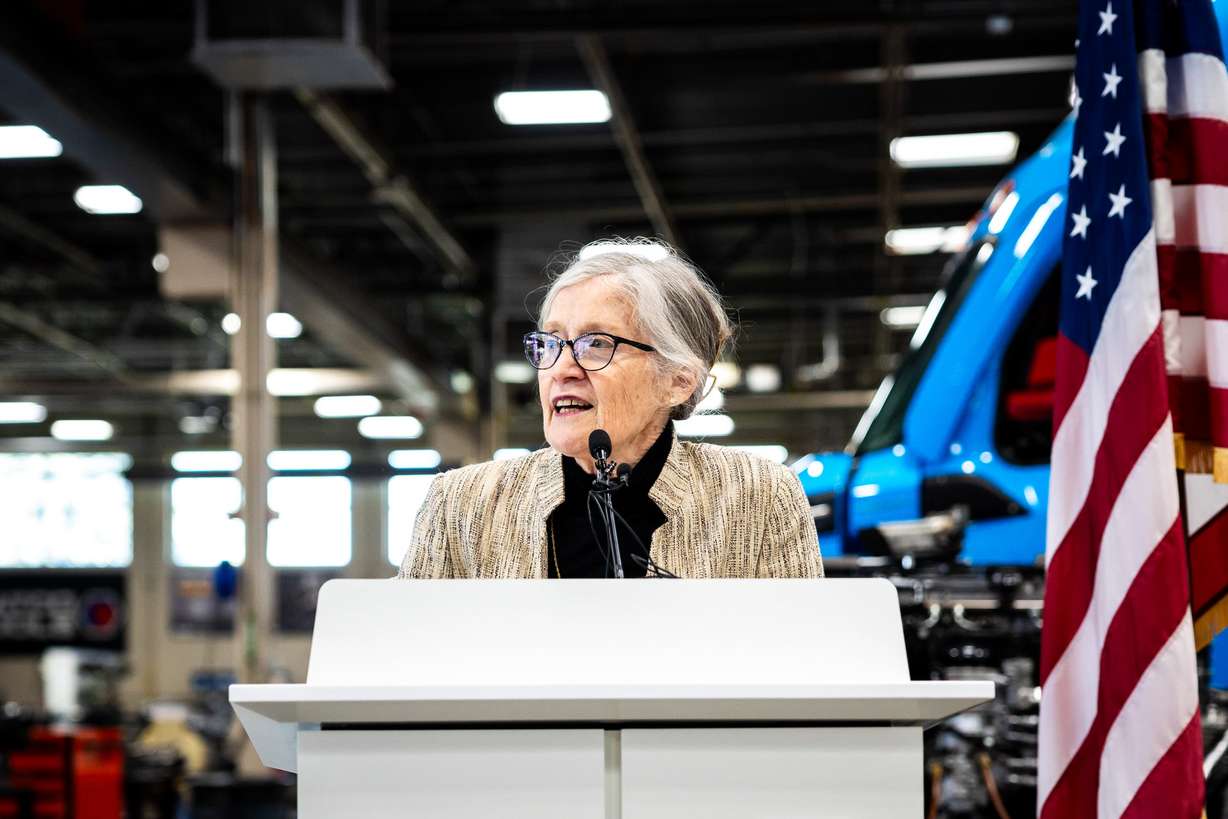
Critical minerals are a high-urgency industry that will help shape the country's future, Millner testified.
"We need to make sure we have access to these minerals — and our cheap source of these minerals from China has now been threatened significantly."
That's an alarm others have sounded.
Last October, China announced that it will require foreign companies to get approval from the Chinese government to export magnets containing even trace amounts of rare-earth materials that originated from China or were produced with Chinese technology, The Associated Press reported.
The Trump administration said this gives China broad power over the global economy by controlling the tech supply chain.
SB254, said Millner, voices a response toward the U.S. becoming a "critical minerals independent" nation — while also offering the state a local economic boon.
What's the 'MINES Center?'
Millner said her critical minerals bill — which has already received Senate floor approval and now awaits a House vote — initiates several things.
First, it develops a state strategy.
"If we want to help develop this (critical minerals) industry, we need to get focused on what a state strategy would be," she said.
"So we're going to set up a Critical Minerals Council — and we're going to ask them to work on a strategic plan."
Timely permitting, argued Millner, is a key element of any critical mineral strategy.
"We want to be the state where permitting is expedited. We'll be doing it with all the necessary requirements and not cutting down on our quality — but (also) making sure we're doing it as quickly as we can."
Second, the bill calls for the development of critical mineral zones.
"We know that where there are some deposits — we don't know maybe where there are other potential deposits," said Millner. "Helping us do what we need to do in order to develop and facilitate critical mineral zone development is extremely important because we want to expand mining — and we want to bring much more processing."
SB254 also calls for the creation of a "Minerals for Industrial, National, and Economic Security Center" — or MINES Center.
The purpose of MINES, said Millner, would "allow us to be able to support industry in the early innovation around this project."
The University of Utah, as noted in the bill, would play a prominent role in the state's critical minerals strategy and development. Utah's flagship university is one of only 14 accredited mining engineering programs in the nation.
And the school is on board with the project and is open to providing researchers and students, said Millner.
Such relationships with local academia would help build talent pools and processing capabilities.
Coordinating the initiative would also include mining experts, along with the state's economic development office.
"We bring everybody in," said Millner.
Related:
Can Utah solve Trump's critical minerals dilemma?
The top power brokers in the Utah Legislature announced one of their aims for the legislative session is to make Utah the No. 1 destination for critical mineral extraction."We're trying to put our university expertise, our state expertise and the expertise brought by our mining industry in the state to the table.
"And then our trade folks, who can help us work through how … to make this a viable project."
SB254 calls for significant state funding — $21 million — to cover operating and capital costs for 2027.
A portion of those dollars would be used to develop the facility and purchase equipment needed by industry to facilitate innovation and product testing.
Environmental worries: Concerns and responses
Responding to the bill, Sen. Nate Blouin, D-Salt Lake, said the proposed council is made up exclusively of representatives from industry and economic growth — "nothing from conservation; not even the Department of Environmental Quality."
Blouin questioned why such communities are excluded "in a state that is already widely acknowledged as one of the most friendly jurisdictions in the world, which we tout all the time."
He also wondered about safety risks presented by the mining activities, adding, "This seems like a dangerous direction to go in."
Millner said the intent is to keep the council at "a manageable number" — but added that the DEQ would be involved.
"DEQ has been in these conversations with us and thinks that this is a reasonable approach to how we go forward."
That comment was verified by Ted Sonnenburg from Utah's DEQ.
"We believe that this bill will assist our efforts to support growth while still being protective of the environment," he said.
Sen. Keven Stratton, R-Orem, responded he was confident in the varied processes implemented by SB254.
He added he was enthused about Utah's critical minerals' potential.
"I have had a real concern with our lack, in the state of Utah and in our nation, in drawing upon and protecting ourselves and being self-reliant in the space of critical minerals."

During public comment, Magna resident Mackenzie Miller expressed concern about the state moving too quickly with critical mining efforts, asking for due diligence in environmental processes.
"I don't know how we can make permitting faster — and still account for the environmental impacts," he said.
Millner concluded by saying her legislation is a catalyst for Utah becoming a "major exporter of processed minerals that meet the critical mineral needs of this country — which is extremely important to all of our future."
Utah's critical minerals ecosystem: Soliciting federal support
Millner also sponsored SCR9 — a resolution notifying Congress, including Utah's congressional delegation, that the Beehive State "is a place that is part of the solution to how we meet our critical minerals needs in this country."
The resolution adds that the MINES Center could be a national "critical minerals center of excellence."
"Utah can succeed at this in a way that no one else can," said Millner. "But we also would like to have federal support as (the federal government) is seeking solutions to national security issues and supply chains for critical minerals."
During Millner's resolution presentation to her Senate colleagues, Utah Mining Association President Brian Somers voiced support of state legislative calls for federal support.
Some of the most essential critical minerals, he said, can be extracted in Utah. But federal support is needed.
The critical mineral resolution "calls on the federal government to support Utah's efforts — and to allow us to unleash the amazing mineral endowment in our amazing mining industry that we have here."

Most recent Utah Legislature stories
Related topics
 Jason Swensen





