- Gov. Spencer Cox discussed immigration, Trump, and his faith at a Politico event.
- Cox denied plans for a 2028 presidential run, focusing on family and ideas.
- Cox criticized Trump's divisiveness and stressed unity, reflecting on past political violence.
Washington, D.C. — Utah Gov. Spencer Cox sat for an interview Thursday morning at a live Politico event as governors from across the country convene for an annual gathering of the National Governors Association.
Cox spoke about his differences in opinion with President Donald Trump and divisiveness in the country, as well as the concept of being an American under heightened immigration scrutiny, and how his membership in The Church of Jesus Christ of Latter-day Saints affects his views.
He also addressed whether he has presidential ambitions, and shared his views on the idea of "heritage Americans."
The conversation comes after Trump refused to invite two Democratic governors to the White House for what is traditionally a meeting of all sitting governors with the president.
Cox reaffirms he's not running, but still has passion
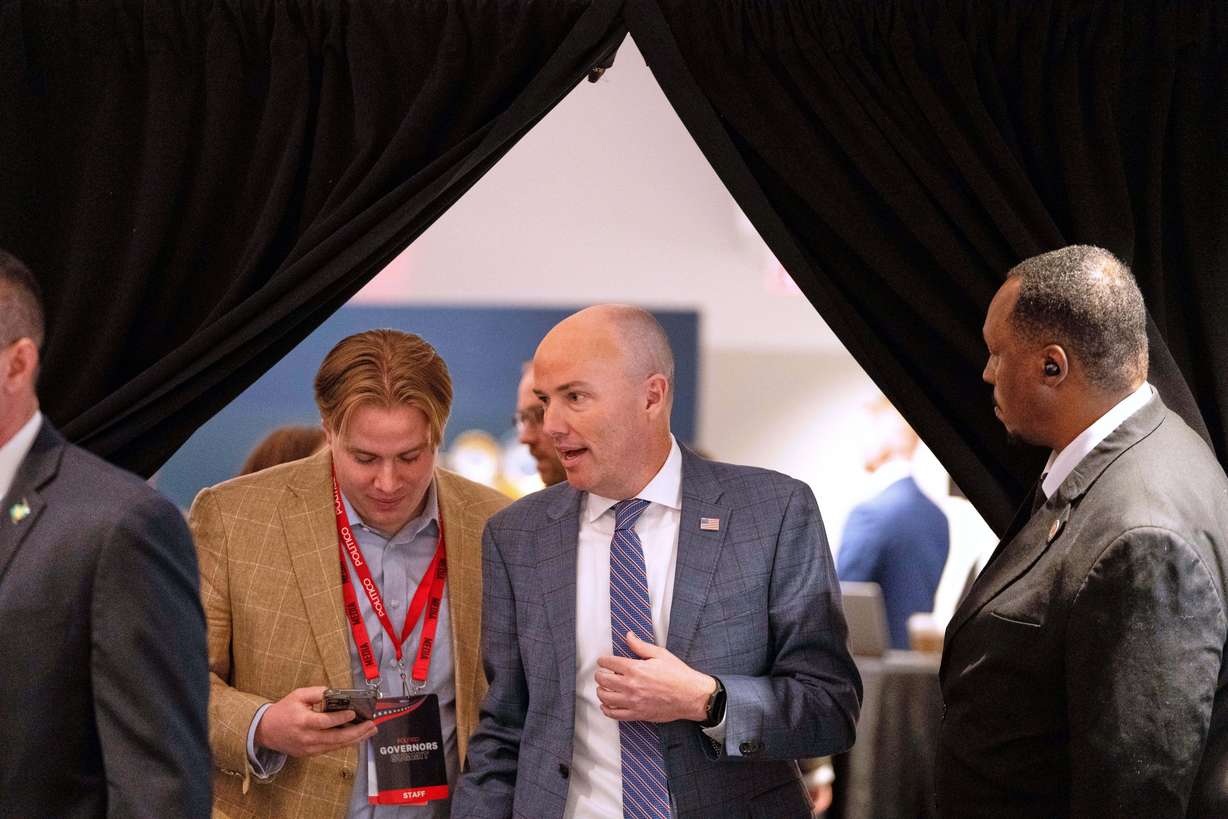
Cox was one of several speakers early Thursday at a Governors Summit hosted by Politico in honor of the NGA's annual meeting in Washington, D.C.
He spoke about some of his favorite issues, including reducing social media use in society and eliminating sports gambling, and the targeting of young men across the country.
Cox was asked by Politico's Jonathan Martin about what his plans are after he finishes his second term as Utah's governor. He strongly denied that he would make a 2028 presidential bid.
"I'm not running, just want to make that very clear. I know that's what people who are running say, so it's very confusing to people, but it's also what people who aren't running say," Cox said. "And so, let me just assure you that I'm one of the people that are not running who say it."
He also said he does not plan to run for a Senate seat.
Martin noted that Cox rose to the national stage thanks to his Disagree Better initiative, which he started in 2023 as NGA chair and now continues as a nonprofit. Martin questioned the governor about how he will continue this work after he leaves office. It's rumored that Cox could go on to further his efforts at a national-level organization or at a university, but the governor wouldn't say what he wants to do after leaving office.
"I don't know. I get three years to be governor. That's all that matters to me. I really try not to think about it, because once you take your eye off the ball, it's hard to get your eye back on the arena of ideas," he said. "Look, yeah, I care about this stuff deeply, and I want to spend more time with my family."
"But I hope that there will be a place for ideas, and I hope to be able to share mine."
Cox asked about Trump and national unity
Cox was also thrust into the national spotlight last year after conservative activist Charlie Kirk was shot and killed at Utah Valley University. Cox called for Americans to turn down the political temperature and for an end to political violence.
He was asked Thursday about his comments to Trump after his 2024 assassination attempt in Butler, Pennsylvania.
The governor wrote to then-candidate Trump to say he had the ability in that moment to unite and save the country for the better. Martin asked Cox on Thursday if he believes since retaking the White House that this is something Trump has achieved.
"It's certainly aspirational and hopeful in the conversation that we had, and he and I have had these conversations. I'm grateful to have a relationship with him that ... I can push back," Cox replied. "And look, specifically during the Charlie Kirk shooting, I think it was a dark time, it was a tragic time. He and I disagreed on some things and he knows that, again, he would tell you if he were sitting here right next to me. In fact, he said it in Charlie Kirk's memorial.
"He said, 'Charlie would be mad at me because he wanted me to forgive my enemies, and I hate my enemies.' And so he and I differ on that, he knows that. I know that I still believe that he is a very unique person, a very unique candidate, very unique president, someone who, if he put his mind to it, could do more to unify. He's not putting his mind to it. He said very clearly that's not who he is," Cox continued.
Cox went on to say that he believes that people should forgive their enemies, saying it's part of his faith but also something he struggles with. He admitted that he knows it's not something human beings do easily.
"I would love more unity, but that doesn't mean we should agree on everything," he said.
Martin then clarified, asking the governor, "You wouldn't sit here with a straight face and say that President Trump is trying to unify?"
"No, no, and he wouldn't say that either," Cox said.
During his remarks, Cox also pushed back against the Trump administration's approach to gambling and artificial intelligence. He said the administration trying to tell states what to do in that regard is "preposterous."
"I'm concerned about these new technologies and what they're doing to our kids," he said. "It's one thing if we're fighting China and you're developing your model. But once you start selling sexualized chatbots to kids in my state, now I have a problem with that, and I'm going to get involved."
Martin asked the Utah governor about conversations on the political right about "heritage Americans" and the ongoing debate over immigration, and asked Cox what he thought it means to be — or not to be — an American.
"I don't care if you've been here since the 1600s, as the Coxes who immigrated from Great Britain to the Massachusetts colony and eventually immigrated to Utah," Cox said, "or if you just got here a week ago, that being an American is more about an idea than how long you've been here."
Cox noted that the country is celebrating its 250th birthday this year and invoked the history of the Latter-day Saints.
"In Utah, we believe that very, very strongly as people who were kicked out of our homes and kind of had to leave the United States a little bit ago to what was then the Mexican territory to be able to practice our faith. We know what it's like to be discriminated against and we want to make sure that doesn't happen to other people," he said.