- The University of Utah significantly impacts Utah's economy and society, employing 44,801 people.
- In 2024, the university supported $10.3 billion in GDP and $18.1 billion in sales.
- Nearly three-quarters of U. graduates are employed in-state five years after graduation.
SALT LAKE CITY — As Utah's flagship institution and second-largest university in the state, the University of Utah is a significant contributor to the state both economically and socially.
A new study from the Kem C. Gardner Policy Institute released Wednesday shows exactly how, painting the picture of how the U.'s economic contributions and societal impact through avenues like education, research, and health care help shape Utah and beyond.
"The University of Utah is driving Utah's future through education, research and engagement that strengthen our economy, benefit our communities, and prepare students for lifelong success," U. President Taylor Randall said in a statement. "New data from the Kem C. Gardner Policy Institute reinforces that this approach is working, advancing a model of higher education with real, measurable impact that improves the lives and health of Utahns."
Here's a breakdown of how.
Employment
The University of Utah's physical presence extends far beyond its Salt Lake campus to 37 cities and 15 counties in Utah.
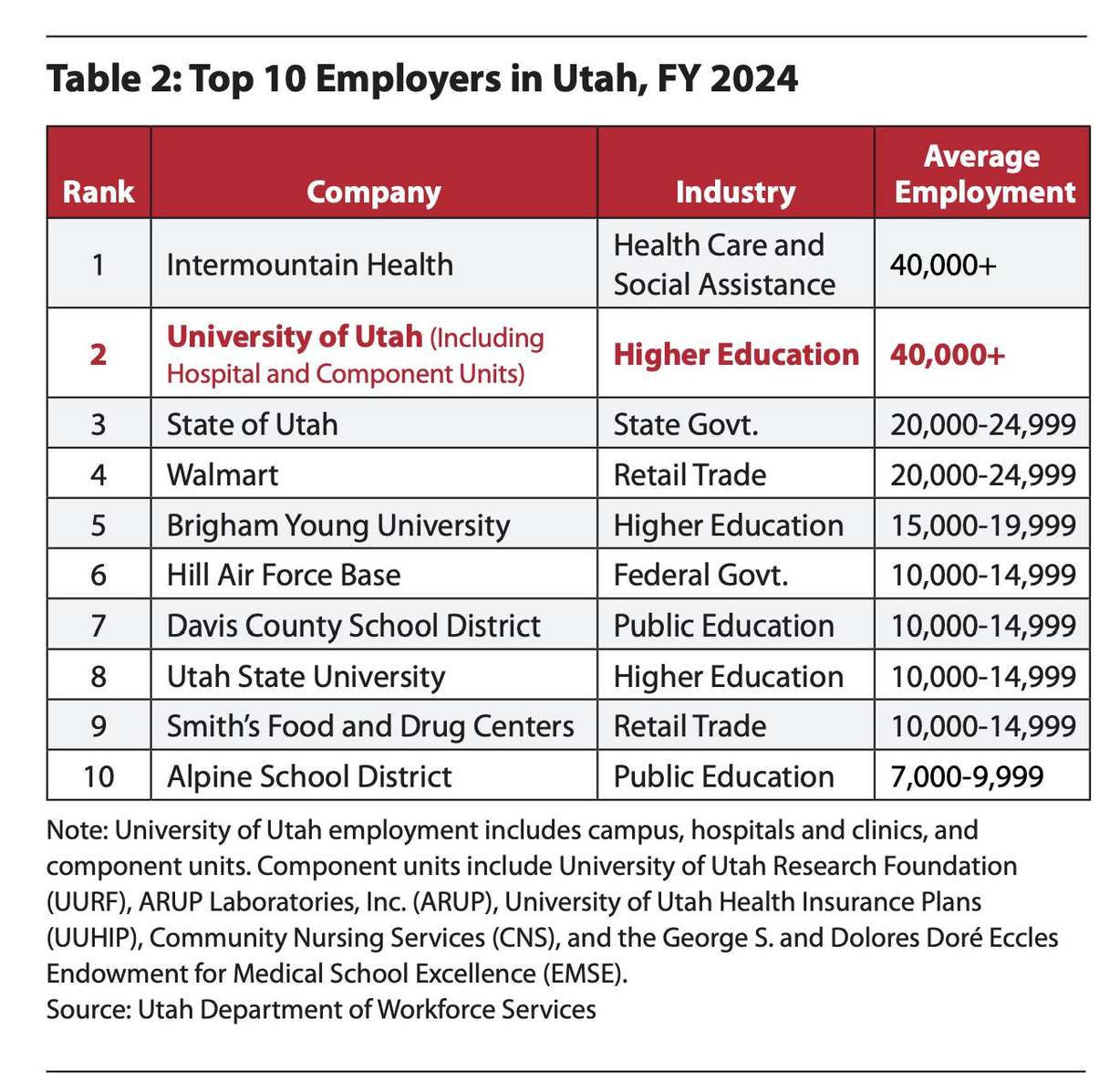
Unsurprisingly, the U. directly employed 44,801 individuals across its campus, health system, and component units in 2024, making it the second largest employer in the state, trailing only Intermountain Health.
Additionally, the U. supports nearly 100,000 jobs across the state, representing 4.1% of jobs statewide.
Economic activity
In 2024, the U. supported $7.6 billion in earnings, $10.3 billion in GDP, and $18.1 billion in total sales. Statewide, this accounts for about 4.9% of total earnings, 3.7% of GDP and 3.6% of total sales.
The U. has also engaged in many significant construction projects over the last five years, including several student housing projects, the Spencer Fox Eccles School of Medicine, the William Steward Building for Applied Sciences, and the Kathryn F. Kirk Center for Comprehensive Cancer Care and Women's Cancers at Huntsman Cancer Institute.
These projects and capital spending further drive economic contributions to the state, with the report showing the U.'s average annual spending on capital and construction totaled $747 million, with $116 million spent on capital investments and $631 million spent on construction.
This spending supports 5,590 jobs, $406 million in earnings, $739 million in GDP, and $1,246 million in output.
Education and research
Like any higher education institution, two of the most important measures for the U.'s impact on the state can be found in how well it's educating students and the quality of research happening at the university.
During the 2023-24 academic year, the U. enrolled over 35,000 students across more than 300 degree and certificate programs and awarded over 9,000 degrees and certificates.
This is pivotal to the state's workforce, with nearly three-quarters of U. graduates employed in-state five years after graduation, according to the report.
"These alumni provide a skilled workforce and support economic growth through spending on goods and services and increased tax contributions. On average, Utah residents with higher educational attainment earn higher wages, resulting in increased consumption and larger tax contributions than those with lower educational attainment," said the report.
As a nationally recognized R1 institution and member of the Association of American Universities, Randall has consistently expressed his desire for the U. to be a top-10 public institution.
The University of Utah expended more than $700 million on research-related activities in 2024, with approximately two-thirds of funding from federal sources, bringing new resources into Utah while advancing innovation, workforce training, and discovery.
Societal benefits
Along with his goal of positioning the U. among the world's most prestigious universities, Randall has also often touted the U.'s role in driving "unsurpassed societal impact."
The report said institutions such as the Natural History Museum, Red Butte Gardens, Pioneer Theatre Company, and others contribute to the state's cultural identity.
Additionally, 30 athletes with ties to the U. will step onto a world stage when they compete in the 2026 Winter Olympics — making the U. the top-ranked U.S. higher education institution in terms of athletic representation at this year's Milano Cortina Games.
Of course, the societal impacts extend beyond sports and culture. In the research vein, the Food and Drug Administration in June 2025 approved an antiviral drug for HIV prevention based on the findings of U. biochemist Wesley Sundquist.
Sundquist's lab at the U. laid the foundation for the development of a highly effective, long-lasting prophylactic — or preventive measure — against HIV, the virus that causes AIDS.
The resulting drug — lenacapavir — was developed by California-based pharmaceutical company Gilead Sciences and has since been named the "Breakthrough of the Year" by Science, a top scientific journal.
Health
The University of Utah Health system also represents a major component of the school's economic contribution.
"As Utah's only academic medical center, the health system serves patients from across the state and region, supporting employment, training much of the state's health care workforce, and improving health outcomes," said the report.
The U. enrolled 6,360 students in health-related degree and certificate programs in 2023-24 and graduated 1,376 health professionals, helping meet statewide demand for skilled clinicians, according to the report.
"Health care is the fastest-growing industry in both Utah and the nation, with demand expected to increase as the population ages. As a result, the University of Utah's role in preparing the health care workforce will remain critical," the report states.
The full report is available online.