- Utah Sen. Nate Blouin proposes a bill to match a $200 million fundraising effort for the Great Salt Lake.
- The bill would reallocate funds from long-term projects to support lake restoration efforts.
- Conservation groups and youth support the bill, but state officials remain unsure about its future.
Editor's note: This article is published through the Great Salt Lake Collaborative, a solutions journalism initiative that partners news, education and media organizations to help inform people about the plight of the Great Salt Lake.
SALT LAKE CITY — Utah's philanthropic community came together last year to pledge $200 million toward efforts to get water back to the Great Salt Lake so it's healthy in time for when Utah hosts the 2034 Winter Olympics.
A new bill proposed in the Utah Legislature would match that by reallocating funds collected for long-term water projects, as the lake's levels continue to fall.
SB250, sponsored by Sen. Nate Blouin, D-Salt Lake City, calls for $198.5 million to be added to the state's Great Salt Lake account, which would be used for water agreements and leases, and other ways to get water to the Great Salt Lake. Another $1.5 million would go toward the Office of the Great Salt Lake Commissioner for administrative expenses.
Some of it would come from the state's general fund, but most of it would come from a large chunk of an account dedicated to the proposed Bear River Development project and other long-range water projects, said Blouin, as he introduced the bill on Tuesday.
"I think this would make a gigantic impact on the situation that we are in," he said.
His bill is similar to one that former Rep. Joel Briscoe, D-Salt Lake City, ran in 2023. That bill failed to gain any traction during a much happier time for the Great Salt Lake. Although the lake set an all-time low the previous year, Utah was in the midst of record-high snowpack, which gave the lake a welcome boost.
That year also reduced water demand, helping the lake rise more in 2024. However, Blouin is rekindling the effort as the lake faces a much more dire situation. Its southern arm currently sits almost 3½ feet below its highest point two years ago, with little confidence it will gain much more ground, as the basin is on pace to set a record-low snowpack.
The bill has the backing of several conservation groups, including the Utah Rivers Council and Center for Biological Diversity, as well as youth groups that helped craft the bill's language. Many have criticized the Bear River project, which has now been pushed back to the 2050s or later, because it would divert more water before it reaches the Great Salt Lake.
"The bill ... tells the Utah State Legislature that they must match philanthropic donations with state dollars," said Sophia Smith, an 18-year-old University of Utah student who was among the youth groups that helped craft the bill.
She skipped class to support the measure because of what the lake's future means to her. If the lake doesn't improve, she said, future generations may experience similar or worse environmental and economic impacts than the challenges that low lake levels currently present.
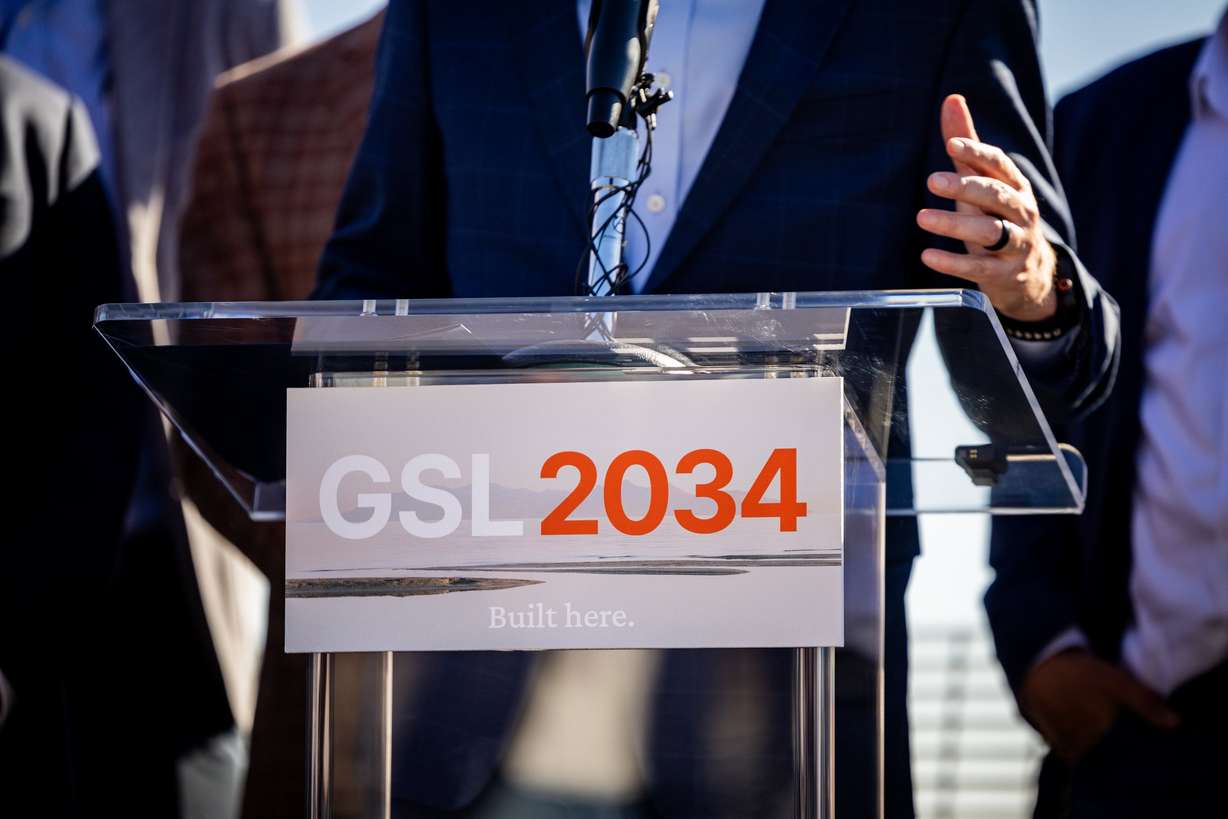
Blouin unveiled it a few weeks after Gov. Spencer Cox, who announced the GSL 2034 initiative, reiterated that the state's goal is to return the lake to its minimum healthy level of 4,198 feet above sea level by the 2034 Winter Olympics.
However, the proposal is not among the bills Utah's top Great Salt Lake official is tracking in this year's legislative session.
"I would say that there are probably other efforts to get more money for leasing and other things that I would expect would have more likelihood of passing, but I guess that remains to be seen," said Brian Steed, Utah's Great Salt Lake commissioner, in response to SB250 on Wednesday.
His office is tracking a few other bills that it believes can improve the lake's future.
HB348 and HB410, each sponsored by Rep. Jill Koford, R-Ogden, would bolster processes in getting more water to the lake and the Colorado River, said Hannah Freeze, the lake's deputy commissioner. They would help explore new leasing opportunities, make it easier for farmers and ranchers to send water downstream and improve efforts to ensure water reaches its intended destination.
"(It would be) a huge win for us, especially working with our farmers and ranchers when we have to make decisions —sometimes game-time decisions or based on the weather," she said. "We need to be able to have the flexibility and make quick decisions."
A few other bills address overall water conservation. Blouin is hopeful that SB250 will be one of the next efforts, but he isn't sure that the lake's current situation will change much of the discussion around it.
"I don't think (the state) is taking this seriously," he said. "I think we're seeing these aspirational 2034 goals that don't have teeth behind them. ... We certainly have to reshape the narrative, I think."