- Utah and six other states travel to Washington, D.C., in their pursuit of a new Colorado River agreement.
- Failure to agree may lead to costly litigation and water curtailments in Utah.
- Current agreement expires Sept. 30; states face deadlines for a new plan.
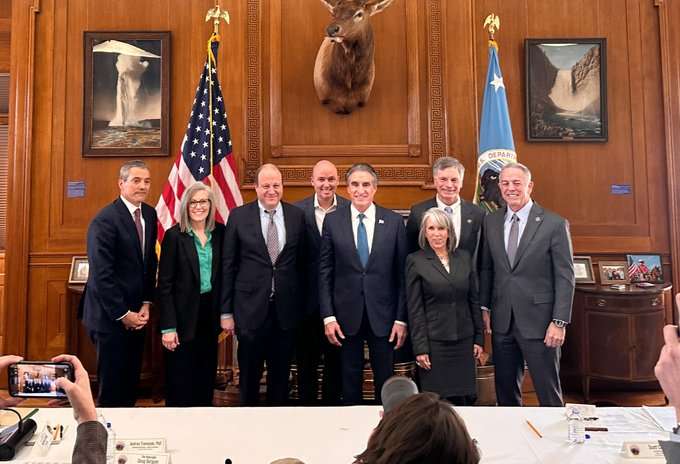
SALT LAKE CITY — Gov. Spencer Cox said he remains hopeful after he and Utah's top Colorado River officials traveled to the nation's capital Friday to meet with six other states as they continue hashing out a new agreement on how to use the river.
Leaders from Arizona, California, Colorado, Nevada, New Mexico and Wyoming also traveled to Washington, D.C., so they could meet with Interior Secretary Doug Burgum. It followed several other recent meetings among the group, including some in Salt Lake City, which failed to break the impasse.
The meeting sparked "constructive conversation" about the situation, Cox said afterward, but there is no agreement yet.
"I leave today hopeful that we'll avoid the path of litigation. No one wins going down that path," he posted on social media. "I still have faith that an agreement can be reached. Our chief negotiators now have their marching orders: Make a deal, and make it soon."
Burgum and other governors also left the meeting feeling optimistic.
"This is one of the toughest challenges facing the West, but (the Department of Interior) remains hopeful that, by working together, the seven basin states can help deliver a durable path forward," Burgum said in a statement.
The current agreement regarding how Lake Powell and Lake Mead are managed expires on Sept. 30, and the seven states have spent over two years negotiating over a new deal to no avail. The states blew past one key deadline in November, and they have until Feb. 14 to reach a definitive framework solution, paving the way for a consensus agreement and formal review under the National Environmental Policy Act.
The states also have until early March to submit formal comments on the federal alternative that was released a few weeks ago. A new plan will be instituted on Oct. 1, whether it's one that the states agree to or the federal plan.
Failing to reach an agreement would not be in Utah's interest, said Amy Haas, executive director of the Colorado River Authority of Utah, as she painted a picture of what could happen after that to state lawmakers earlier in the day.
It would likely force the Bureau of Reclamation to select a plan to govern the river, which would likely ignite "unprecedented litigation before the U.S. Supreme Court," she warned during a Natural Resources, Agriculture, and Environmental Quality Appropriations Subcommittee meeting. Most fights over the river have been between two states, and even those are costly and time-consuming.
"This would be litigation involving seven states and likely the federal government," she said, adding that such a situation could last decades to resolve and potentially cost hundreds of millions of dollars, while the state is forced into water curtailments.
"We would see forced cuts to junior water users, such as the Central Utah Water Conservancy District, which would directly impact the Wasatch Front," she added. "We estimate, in terms of agricultural losses, $500 million annually in eastern Utah alone."
Such a scenario could result in significant drops in property values and create job losses, all while stalling growth along the Wasatch Front. All of these, Haas points out, could result in even more litigation within the state, between Utah and water users who end up being forced to cut water.
All seven states agree that there's an issue with water shortages in the system, but they've been unable to agree on a way to solve it. Lower Basin states have called for mandatory reductions during dry years; Upper Basin states, including Utah, have argued that they're already pulling less water out of the system than their counterparts.
Arizona Gov. Katie Hobbs called Friday's meeting "productive," saying that she was "encouraged" that Upper Basin states like Utah had expressed "willingness to turn water conservation programs into firm commitments of water savings."
It's the latest saga in a long-standing feud over how to split up the river, which supplies water to over 40 million people, including approximately 60% of Utah's needs. Over two dozen Native American tribes and Mexico also receive a share of the river.
The drama is playing out while the Colorado River states are looking at a potentially rough spring. Lake Powell has already fallen back to 27% capacity, and inflows from this year's snowpack may end up being 60% of normal or worse — barring any improvements.
Federal officials began holding back releases from the reservoir in December, and they're considering more controlled releases from Flaming Gorge and Blue Mesa Reservoir upstream to keep Lake Powell above critically low levels, Haas said.
Reaching those levels could impact hydropower production, as well.
"It's going to affect a lot of people," said Rep. Carl Albrecht, R-Richfield, at the end of her presentation. "I don't know what we can do but ask the good Lord for moisture."