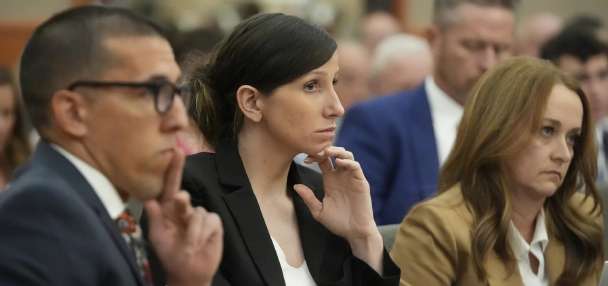
- Defendants in a $100 million supplement fraud scheme received prison and probation sentences.
- Participants used deceptive sales tactics false endorsements and laundered proceeds for luxury purchases.
- The final defendant's sentencing was postponed due to a separate federal tax evasion case.
SALT LAKE CITY — The investigation into a $100 million scheme involving fraudulent supplements has come to a close as the final defendants have been sentenced and some cases dismissed.
A federal grand jury in December 2022, indicted April Gren Bawden, of Salt Lake County; Chad Austin Bawden, of Salt Lake County; Phillip Gannuscia, of Salt Lake County and Puerto Rico; Makaio Lyman Crisler, of Utah County; Barbara Jo Jackson, of Utah County; Brent Goldburn Knudson, of Utah County; Richard Scott Nemrow, of Utah County; Dustin Garr, of Washington County; and Robert McKinley, of Spokane, Washington.
The defendants were accused of committing 18 crimes between January 2016 and April 2022, including conspiracy to commit wire fraud, conspiracy to commit bank fraud, conspiracy to commit money laundering, wire fraud, aggravated identity theft, and aiding and abetting money laundering, according to court documents. In March 2023, Jessica Bjarnson Gannuscia was added to the indictment for criminal contempt.
The case involved the sale of nutraceutical, CBD and dietary supplements through a number of websites and a call center operating in Utah, according to the indictment. Prosecutors say advertisements promised benefits such as weight loss and the treatment of seizures and cancers, included false claims about their effectiveness, and used false celebrity endorsements.
The defendants used "deceptive" sales tactics to mislead consumers about the price of products, the ability to return items or obtain refunds, and automatically enrolling them in recurring subscription payments without the customer's knowledge, the indictment states.
To facilitate "tens of thousands" of misleading online sales, the defendants were accused of setting up hundreds of "false storefront" websites, "sham" limited liability companies, and business checking accounts. They also allegedly set up hundreds of merchant processing accounts in the names of others, but which they controlled.
The defendants used the proceeds from the scheme to purchase luxury items, such as homes, cosmetic surgery, a Lamborghini Urus, a 2020 Porsche 911 convertible and a 2021 Nautique Paragon boat, according to court documents.
"In addition to the millions of dollars benefiting the defendants, more than $64 million of the scheme proceeds were transferred overseas," the indictment says.
More than three years later, the investigation is ending, with the final sentences handed down to the defendants this month.
The Bawdens were accused of controlling the call center that handled complaints from online customers and recruiting additional straw owners, as well. Both pleaded guilty in February 2025 to conspiracy to commit money laundering.
April Bawden was sentenced in October to three years of probation, consistent with her plea agreement.
Chad Bawden was sentenced to 12 months in prison, followed by two years of probation, due to his being "not only involved with the call center but was involved to some degree in all aspects of the scheme," a sentencing memorandum states.
Probation conditions state the Bawdens cannot be involved in any fiduciary capacity or enter into self-employment and must forfeit approximately $150,000.
Knudson, who allegedly managed the fraudulent merchant processing applications, pleaded guilty to conspiracy to commit wire fraud. He was also sentenced last week to three years of probation.
Crisler, accused of controlling some of the "sham" companies that used bank accounts to "layer" the proceeds by moving them around to conceal the origin of the funds, pleaded guilty to conspiracy to commit money laundering. He was sentenced to six months in prison followed by two years of probation. He also must forfeit $65,000, his boat and his boat trailer, according to court documents.
Gannuscia and Nemrow worked for the entity that fulfilled and managed the product sales in the scheme and used a special software to "distribute sales across multiple merchant accounts to further and conceal the scheme," the indictment said.
Gannuscia and Nemrow pleaded guilty to the conspiracy to commit money laundering in April 2025. Nemrow's case was terminated in August 2025 as he died a few weeks prior.
Gannuscia's sentencing was initially meant to occur in conjunction with a separate federal tax evasion case. But the "tax case has languished" with the trial postponed multiple times, so his sentencing for this case was supposed to be the same day as Knudson and Crisler until it was just recently continued to next month, according to court documents.
Jessica Bjarnson Gannuscia is his codefendant in the tax evasion case. She was initially charged with criminal contempt in relation to the supplement fraud case, but that charge was dismissed in March on the argument that she was "the sole remaining defendant without a pending resolution" and was facing more serious charges in the tax evasion case, a motion for dismissal states.
Jackson was accused of helping recruit "straw owners" to serve as named owners of merchant processing accounts that the defendants controlled. She initially submitted a guilty plea in August 2023 for one charge of conspiracy to commit wire fraud, but she withdrew her guilty plea in May this year and her charges were dismissed.
McKinley and Garr pleaded guilty in March to a misdemeanor charge of introducing misbranded drugs into interstate commerce that "failed to contain adequate directions for use," a plea agreement states. In exchange for pleading guilty to that charge, the rest of the fraud charges were dropped.
McKinley's alleged role in the case was assisting in the marketing of products, and Garr was accused of creating and controlling the software that aided individuals in concealing the scheme, the indictment says. McKinley and Garr were sentenced to a year of probation, plus significant forfeiture fines of $350,000 and $500,000, respectively.

Related stories
Most recent Police & Courts stories
Related topics
 Cassidy Wixom