- Senate Republicans blocked a resolution limiting President Donald Trump's military actions in Venezuela on Wednesday.
- Vice President JD Vance broke a 51-50 tie voting against the resolution.
- Concerns continue to grow over Trump's foreign policies and Congress's war powers role.
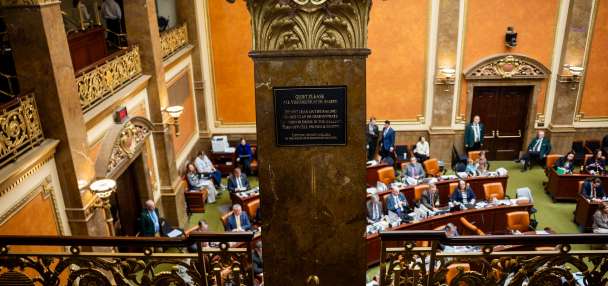
WASHINGTON — Senate Republicans blocked a resolution on Wednesday that would have barred President Donald Trump from further military action in Venezuela without Congress's authorization, after the Republican president put pressure on party members who had supported it.
The vote was 51-50 for a Republican point of order to dismiss the war powers resolution, as just three of Trump's Republicans voted with every Democrat in favor of moving ahead and Vice President JD Vance came to the Capitol to break the tie.
Opponents had argued that the resolution should not move ahead because the U.S. does not currently have troops on the ground in Venezuela, after U.S. forces swept into Caracas on Jan. 3 and captured Venezuelan President Nicolas Maduro.
"We're not currently conducting military operations there," Republican Senate Majority Leader John Thune of South Dakota said, as he opened the Senate on Wednesday. "Democrats are taking up this bill because their anti-Trump hysteria knows no bounds."
The Trump administration argues that Maduro's capture was a judicial operation to bring him to trial in the U.S. on drug charges, not a military operation.
Backers of the war powers resolution disagreed, noting that a large flotilla of ships is blockading Venezuela and has spent months firing on boats in the southern Caribbean and Pacific. Trump also has threatened further military action.
"An argument that the Venezuela campaign is not imminent hostilities within the meaning of the war powers resolution is a violation of every reasonable meaning of that term," Democratic Sen. Tim Kaine of Virginia, a lead sponsor of the resolution, said in a speech before the vote.
The close votes reflected concern in Congress, including from some Republicans, about Trump's foreign policy and growing support for the argument that Congress, not the president, should have the power to send troops to war, as spelled out in the Constitution.
Trump recently has said the U.S. will run Venezuela for years, told Iranians protesting against their government that "help is on the way" and threatened military action to take Greenland, a territory of NATO ally Denmark.
Measure advanced on Jan. 8
Wednesday's vote demonstrated Trump's hold over his party. It came less than a week after the Senate voted on Jan. 8 to advance the resolution. In that vote, five Republicans joined every Democrat in favor of moving forward, a rare rebuke of the party leader in the Republican-majority chamber.
Trump responded furiously, saying the five Republicans should never be elected to office again. The five were Rand Paul of Kentucky, Susan Collins of Maine, Josh Hawley of Missouri, Lisa Murkowski of Alaska and Todd Young of Indiana. Trump's party holds a 53-47 majority in the Senate.
Trump, Secretary of State Marco Rubio and other administration officials launched an intense campaign to encourage the Republicans to flip their positions and oppose the resolution, calling them repeatedly.
Hawley and Young did so on Wednesday.
Related:

Utah's 2 senators vote against resolution limiting Trump's actions in Venezuela
Utah's two U.S. senators voted against a resolution that would limit President Donald Trump from conducting further military action in Venezuela without the approval of Congress.In a statement, Young said he had received assurances from "senior national security officials" that there are no U.S. troops in Venezuela. "I've also received a commitment that if President Trump were to determine American forces are needed in major military operations in Venezuela, the administration will come to Congress in advance to ask for an authorization of force," he said.
Even if it passed the Senate, to become law the measure would have had to pass the Republican-led House of Representatives and garner two-thirds majorities in both the House and Senate to survive an expected Trump veto.
Trump's Republicans blocked two previous attempts to advance similar resolutions in the Senate last year.
After Maduro's capture, some lawmakers, including Democrats publicly and some Republicans behind the scenes, accused the administration of misleading Congress by having insisted they did not plan to force Venezuela to change its government.
In recent days, Trump has posted a meme online showing him as "Acting President of Venezuela" and told The New York Times the involvement in the South American country would last for years.