- The Utah Legislature condemned judges over a redistricting ruling creating a more Democratic congressional district.
- They also extended the deadline for congressional candidates to file as they plan to appeal that ruling.
- Lawmakers repealed an anti-bargaining law after unions gathered significant opposition signatures.
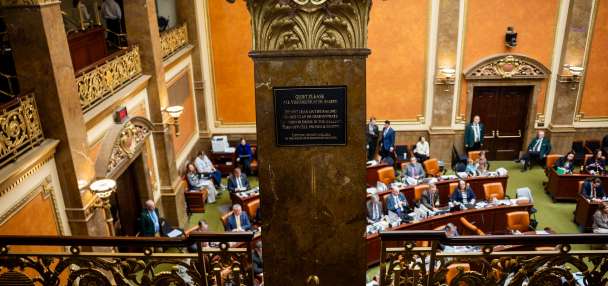
SALT LAKE CITY — The Utah Legislature strongly rebuked the state judiciary Tuesday, condemning the courts over a recent ruling on redistricting that threw out a congressional boundary map created by lawmakers in favor of one drawn by plaintiffs who accused the Republican majority of gerrymandering.
While Democrats urged restraint and said attacks on judges would hurt the justice system's credibility, Republican lawmakers said that the ruling usurped their powers to draw political maps outlined in the Utah Constitution and passed a resolution condemning the courts. To the extent that trust in the court has faltered, some Republicans say the judicial branch has only itself to blame.
"It is concerning ... to me that in protecting institutions that there are obvious and potentially glaring deficits now in the trust that we may hold other institutions to," said House Majority Leader Casey Snider, R-Paradise, the sponsor of the resolution. "How can we trust a judiciary that accuses us of gerrymandering and being biased when they create the most gerrymandered and extreme district that this state has ever seen?"
He was referring to Judge Dianna Gibson's Nov. 10 ruling selecting a new congressional map submitted by plaintiffs to remedy the new map adopted by lawmakers earlier this year, which she called an "extreme partisan outlier." The new map has one district that is anchored in Salt Lake County, which would lean Democratic.
Utah's congressional districts have all favored Republicans in recent election cycles, and the new Democratic district has already drawn a handful of well-known Democrats to compete, with more rumored to be considering it.
The ruling is the latest in a long-running legal drama over who gets to draw Utah's congressional maps and how.
Voters narrowly approved Proposition 4 in 2018, creating an independent redistricting commission to recommend maps to lawmakers and standards for redistricting that include banning the use of drawing districts to favor one party over the other. Lawmakers amended it in 2021, making the commission's role purely advisory and doing away with the redistricting criteria. Then they adopted a map of their own over several recommended by the commission.
That map, which was in place starting in 2022, split Salt Lake County among each of Utah's four congressional districts. Mormon Women for Ethical Government, the League of Women Voters of Utah and several individual plaintiffs later sued, saying the Legislature violated voters' rights to alter and reform their government when it replaced Proposition 4.
Brittany Tait, KSLTuesday's special legislative session saw lawmakers extend the deadline for congressional candidates to file election paperwork in order to give lawmakers more time to appeal Gibson's ruling. It also served as a forum for the public airing of grievances that many Republican lawmakers have been harboring toward their judicial counterparts.
Some said the recent ruling has threatened the future of representative government in Utah, while several called for prayers that the state's Supreme Court justices would intervene to stop the new maps from taking effect.
Democrats, however, argued that the map approved by the courts is based on neutral criteria.
"(Gibson) chose a map that followed neutral criteria, and it happens that it has a Democratic majority," said Rep. Doug Owens, D-Millcreek. "I want a neutral map. And the reality is that if you have a neutral map, it produces a Democratic-leaning district."
Lawmakers tweak election deadlines, repeal union bill
The resolution condemning judges doesn't have any real teeth, but lawmakers did approve several other bills to tweak how next year's midterm elections will play out in light of the ongoing legal challenges. Lawmakers have promised to appeal Gibson's ruling, so they extended the filing deadline for congressional races to March 13 to give time for that process to play out before candidates have to decide which district they are running in.
Congressional candidates typically need to collect 7,000 signatures from registered voters in their district in order to qualify directly to appear on a primary ballot. Another change will let candidates collect signatures from across the state, but only for those running for the U.S. House of Representatives, and for 2026 only.
That's because there is still some uncertainty about which maps will be in place when it comes time to file. GOP lawmakers are holding out hope that a higher court will approve their map, so they're hoping to give some leeway to candidates whose district boundaries could be in flux.
There was some consternation about letting candidates collect signatures statewide, but it's still unclear how the map might change in the future.
"Just an unknown," said Sen. Scott Sandall, R-Tremonton, during a Government Operations Interim Committee meeting Tuesday afternoon. "I have no anticipation other than we need time for the court appeals to proceed."
The Legislature also repealed a controversial law from earlier this year that would have banned public sector unions from collectively bargaining, after labor groups collected hundreds of thousands of signatures in an effort to have the law repealed. Rep. Jordan Teuscher, R-South Jordan, who was behind HB267, also sponsored the bill to repeal it. He said he still thinks it was good policy, though.
"We often talk about the Utah way ... and I think today is a strong example that, within the Utah way, we listen; we adjust, and we worked together to find areas of agreement," he said. "Repealing HB267 doesn't mean that we're abandoning the principles behind it. It means that we're choosing clarity over confusion, collaboration over conflict and long-term stability over short-term noise."
Labor groups had celebrated the planned repeal of the bill. They've also agreed to convene a working group to work with lawmakers on labor issues going forward.
Correction: An earlier version incorrectly said Rep. Nicholeen Peck suggested Judge Dianna Gibson picked the plaintiffs' proposed map to create a Democratic district. Peck said she was concerned that the ruling drew on what judges have done in other states.