- Utah's population is projected to surpass 5.5 million by 2065, a new University of Utah report shows.
- Utah County is expected to double its population, adding over 750,000 residents over the next 40 years.
- Fertility rates decline and net migration may plateau, affecting future growth rate trends.
SALT LAKE CITY — Utah remains on pace to add 2 million more people over the next 40 years, but the state's rate of growth may continue to slide over the next few decades, according to a new projection of statewide population trends.
The Beehive State's population, which recently surpassed 3.5 million, is projected to surpass 5.5 million by 2065, per the updated long-term planning projection released by the University of Utah Kem C. Gardner Policy Institute on Tuesday. It's the institute's first update to long-term projections since 2022, when experts estimated Utah's population could come close to 5.5 million by 2060.
Researchers project that Utah's population growth may quintuple the U.S. average over the next 40 years, as its employment growth triples the national average. It signals that Utah's economy should remain strong enough to add a population that researchers point out is the "approximate size of Idaho today."
However, they caution that slowing fertility rates, an ongoing trend that first emerged in 2008, will likely continue, which is why they've reduced the state's projected growth rates may not be as bullish as past projections. It's partly why Utah demographics may look different over the next few decades.
While the future is always uncertain, the projections — gathered through a dozen datasets from state, local and private sources, and reviewed by top industry professionals — are considered likely scenarios for Utah by 2065, said Mallory Bateman, director of demographic research at the Gardner Policy Institute, and one of the report's authors. It seeks to inform state and local governments, school districts and water managers so they can plan for what's expected in the coming years.
"Looking out 40 years is really tricky, but we do think that these are the most likely projections," she said. "They're based on a lot of good information, a lot of vetted information to (estimate) what the future holds for us."
Where growth is expected
Where growth is happening now is where future growth is anticipated to continue.
The report states:
- Utah County, which continues to lead the state in growth every year, is anticipated to double its population over the next 40 years, leading the way in numeric with an estimated addition of more than 750,000 people. Salt Lake County is second at over 370,000 people, followed by Davis (188,000) Washington (175,000) and Weber (113,000) counties.
- Utah County's projected 1.7% growth rate is second only to Wasatch County. Morgan, Tooele and Washington counties, each projected to grow by 1.5%, round out the top five.
- Growth is expected across all 29 Utah counties, but it's projected to be lowest across south-central and eastern Utah.
These are tied to housing projections, but researchers point out that some of the estimates are based on anticipated job growth. Salt Lake County is projected to add close to 600,000 new jobs by 2065, double any other county. Utah County is next at approximately 282,000 jobs, while Washington County and the rest of the Wasatch Front round out the top five.
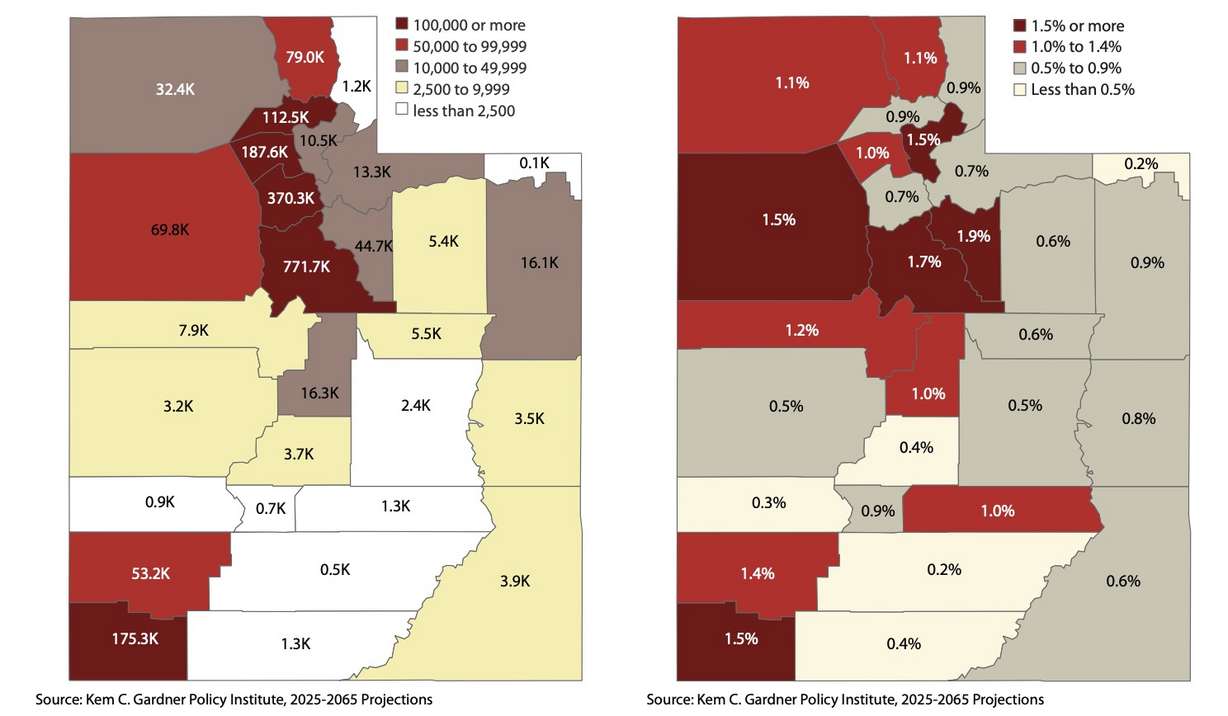
Yet, parts of northern and central Utah may end up with slightly higher job growth rates, largely because of anticipated employment opportunities tied to specific projects, Bateman said.
If the projections come to fruition, Salt Lake County would remain the state's most populated county with an estimated 1.6 million residents, but it would have a slim lead over Utah County at 1.5 million residents. Davis County could be the only other county exceeding 500,000 people.
The findings can help leaders prepare for growth in a way that preserves the state's current quality of life, said Jason Brown, CEO of the statewide growth planning nonprofit Envision Utah, after reading the report.
"I think it is fantastic that we have this window into the future," he said. "There's a lot of change coming, but we've dealt with change for a really long time and I think we can use this ... to build a great future."
A rate slowdown?
However, the report also finds that percentage growth — a category that Utah led the nation in after the 2020 Census — may decline over the next four decades, leading to slightly lower populations in the 2060s than projected in 2022.
Some of this decline is because Utah will be larger in population by 2065, meaning that its growth rates won't be as eye-popping as the past 40 years, Bateman points out.
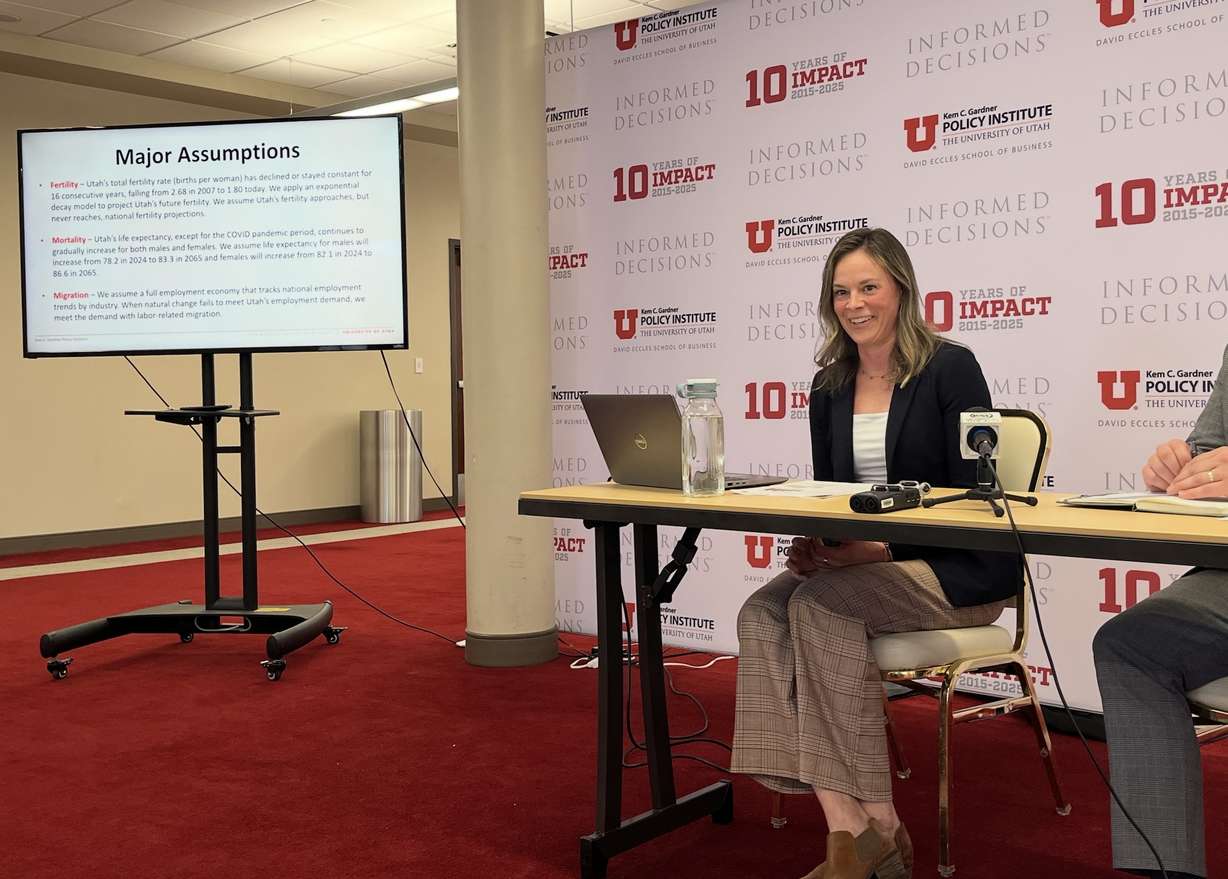
But in the 2022 report, Gardner Policy Institute researchers estimated that Utah could reach 5 million residents for the first time in 2051 before the state's population reaches 5.45 million by 2060. Tuesday's report extends projections out to 2065, but they now estimate Utah may reach a population of 5 million in 2054, and over 5.3 million by 2060, before reaching 5.55 million by 2065.
The adjustment was made after the U.S. Census Bureau released some fertility-related data from the 2020 census, after the 2022 report was compiled. That, combined with feedback from industry experts, resulted in a lower projected fertility rate, Bateman adds. Housing affordability and water availability may also factor into population growth, but researchers say that's harder to project.
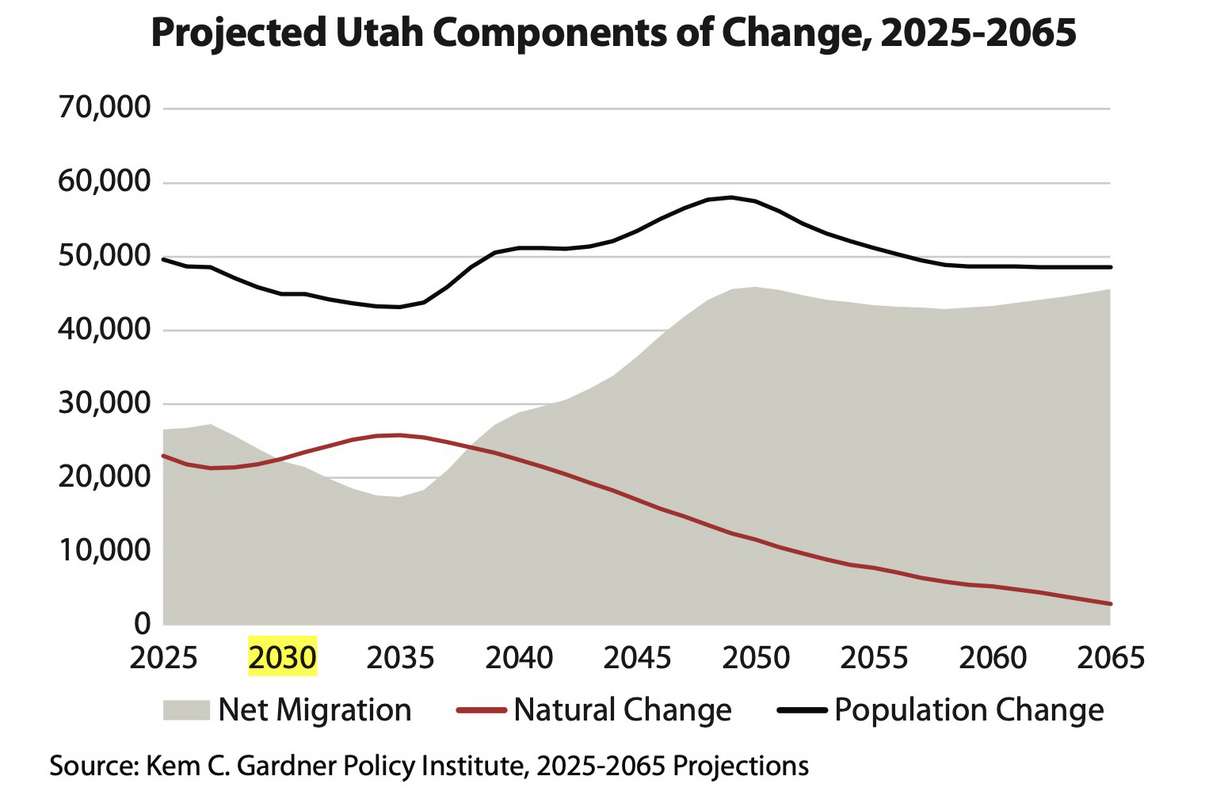
Net in-migration, a measurement of people moving into Utah compared to people moving out, has fueled growth over the last few years. That's expected to continue as a testament to Utah's economic outlook, the report states.
"Looking from 1985 to 2025, about two-thirds of our growth came from natural change (births over deaths), and we think that paradigm is really going to flip in the next 40 years," Bateman said.
Changing demographics
Utah may look vastly different by 2065 because of all of this. The institute projects that Utah's median age could rise from 32.8 to 45.3 by 2065, as the state's 65 or over population could increase from about 13% of the state's population to a quarter.
Health care industries are among the projected industries to grow over the next 40 years as a result, but tech, finance and state government jobs are also expected to grow. Transportation and federal civilian and military jobs, on the other hand, are projected to drop the most over the next four decades, following existing trends, the report's authors say.
Some industries, like utilities and farming, may see reductions because of shifting technology and efficiency that reduces labor needs, said Natalie Gochnour, director of the Gardner Policy Institute.
Yet, the authors caution that there's still plenty of room for change over the next 40 years. They point out that past population projections in the state have a 2.2% to 10.9% 20-year error rate because some things are difficult to anticipate, such as a global pandemic or economic slowdown.
That's also part of the planning process that Gochnour believes the state excels at, which can help ensure that its best attributes, like economic growth, quality of life and natural resources, can be maintained as it grows.
"Planning is really in Utah's DNA," she said. "These numbers inform the entire state."