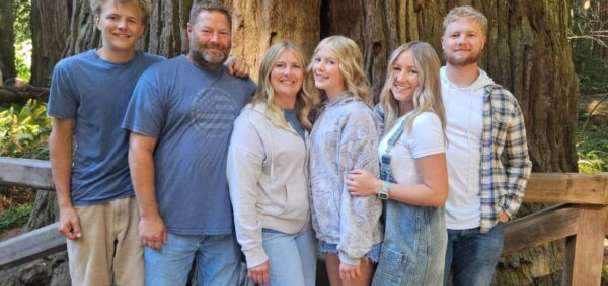
- Mark Maw underwent a less-invasive aortic procedure at Intermountain Health in Utah.
- The procedure, part of the ARISE II trial, uses a catheter to place a stent.
- Maw is the first in Utah to receive this pioneering treatment and is recovering well.
SALT LAKE CITY — Mark Maw learned he had a serious problem with his heart 17 years ago.
"(I was) really tired — no energy," he said. "(My heart doctor) said, 'Oh, you got a leaky heart valve.'"
Maw underwent open-heart surgery to repair it. Years later, doctors found an aneurysm on the aorta — the main artery carrying blood from the heart.
"He was like, what? A walking time bomb," said Mark's wife, Yvonne Maw. "If your aorta bursts, you have no chance."
Because of his age and medical history, traditional open-heart surgery carried serious risks.
"That's tough the first time around, tougher the second time around," said Dr. John Doty, cardiothoracic surgeon at Intermountain Health.
Surgeons at Intermountain Health offered Mark Maw something new — a less invasive way to repair the aorta, without opening his chest.
Doty and Dr. Evan Brownie, co-directors of Intermountain's aortic program, inserted a catheter through the groin to place a first-of-its-kind ascending stent graft, designed to seal off the weakened section of Mark Maw's aorta from the inside.
"If this can offer a solution that is safe, rapid and effective to get them out of that acute life-threatening condition, it's going to be one of the most revolutionary changes that we'll see in our lifetimes in the field of aortic surgery," said Brownie, vascular surgeon at Intermountain Health.
Mark Maw was the first patient in Utah to undergo this procedure.
"I told our grandkids, 'Grandpa's making history,'" Yvonne Maw said.
He's doing well post-surgery and is grateful for a second chance at life.
"I just didn't realize how lucky I am," Mark Maw said. "Take care of your heart, you know. Just take care of it."
The procedure is part of a national clinical trial called ARISE II. Intermountain Health is the only facility in Utah and one of a limited number nationwide chosen to test the device.

Photos
Related stories
Most recent Your Life - Your Health stories
Related topics
 Emma Benson