


- Utah Sen. John Curtis said he has questions about Jensen Huang's return as Nvidia CEO.
- He is one of several Republicans who appear skeptical of Huang's reinstatement after he resigned in light of an affair with an alleged Chinese spy.
- Former Utah Sen. Mitt Romney also questioned the U.S. policy around selling advanced chips to China.
SALT LAKE CITY — Utah Sen. John Curtis said he agreed with tech CEO Jensen Huang's initial decision to step down from Nvidia and appeared skeptical about Huang's sudden reinstatement this week.
Huang's surprise comeback as head of one of the world's most prominent chip manufacturers was met with bipartisan pushback. Huang initially left the company after it was revealed he had an affair with an alleged Chinese spy.
President Donald Trump took credit for Huang's return to Nvidia. But the move prompted skepticism from some in Washington, including Curtis.
"Nvidia's board says it relied on input from senior U.S. officials to conclude that bringing Jensen Huang back posed no national security risk," the Republican senator wrote on X. "I have some questions. Who in our government weighed in? What did they tell the board? And on what basis did the board conclude there was no risk?"
He added that Huang's initial decision to leave Nvidia after news of the affair broke was the right call.
"Just 11 days after Nvidia announced his departure, the board brought him back while its own independent investigation was still underway," Curtis continued. "Last week, the board said it didn't intend to reinstate him. I'd like to know what changed."
Meanwhile, Sen. Mike Lee, R-Utah, has been quiet on social media about Huang and the controversy surrounding his role at Nvidia. A spokesperson did not immediately respond Tuesday when asked if Lee had any comment on Huang's reinstatement at the tech company.
Arkansas Sen. Tom Cotton, a Republican who chairs the Senate Intelligence Committee, called for Congress to investigate the situation.
"I have warned the administration from the start about Communist China obtaining our most advanced chips through both smuggling and remote access," he wrote on social media. "The controversy with Nvidia and Megaspeed is just the tip of the iceberg, and it's not resolved because Jensen Huang has his job back."
Megaspeed is a Singapore-based company that is a customer of Nvidia. The alleged spy Huang had an affair with is a former executive for the company.
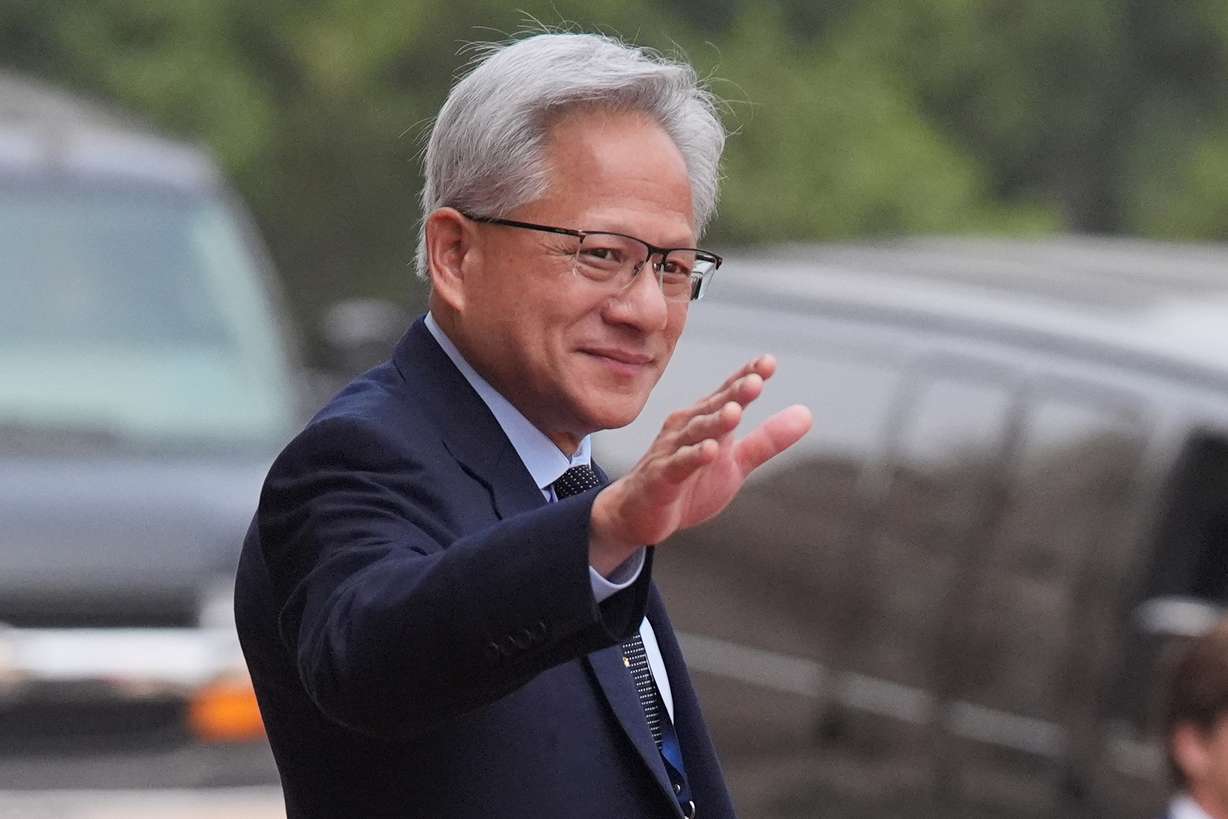
During a company-wide meeting Tuesday, Huang apologized to employees for making "some terrible mistakes," according to the New York Times, but he challenged the notion that he was back only because Trump pushed for it.
The president's involvement in the issue has raised questions about Nvidia's independence at a time when many are worried about a race with China to develop artificial general intelligence.
"In my opinion, by giving in to Trump, the board is endangering the company," Peter Cohan, associate professor of management practice at Babson College in Massachusetts, told the Associated Press. "That's because Huang has seen that he can do anything he wants, and he will get away with it."
Former Utah Sen. Mitt Romney also weighed in on the latest AI developments on Tuesday, referring to the reported sales of AI chips to China.
"Let me get this straight: we rushed AI along without regulating safeguards in order to stay ahead of China and at the same time, we sold China the very chips they'd need to get ahead of us," Romney wrote on X. "Smells of profit, corruption and perhaps worse."
The U.S. Department of Commerce has approved selling more than 800,000 advanced AI chips to Chinese companies this year, including companies with ties to the Chinese military, the New York Times reported last week. On Sunday, before Huang was renamed CEO, Treasury Secretary Scott Bessent called for answers about Nvidia's chip sales to China.
"We've been in touch with the temporary management, with the lead directors, with their lawyers, and we do need answers," he told CBS' "Face the Nation."