
Estimated read time: 5-6 minutes
- A new report offers insights on a June fire near the Utah-Colorado border that killed four firefighters.
- The federal report cites communication issues and extreme weather as contributing factors.
- Efforts aim to improve firefighter safety and honor the victims' service and sacrifice.
MOAB — A fire burning near the Utah-Colorado border in June spread across nearly 7 ½ miles in less than four hours during an "unfathomable" run before entrapping a group of wildland firefighters in the area, ultimately killing four and severely injuring another.
However, "strained communications infrastructure, fragmented airspace awareness" and other challenges also factored into the tragedy, according to a new federal report detailing the incident.
"No single decision or system failure fully explains the outcome. Instead, the events reveal the cumulative effects of known limitations operating under extraordinary tempo and conditions," the U.S. Wildland Fire Service and U.S. Forest Service wrote in a serious accident investigation report about the incident, which was released on Thursday.
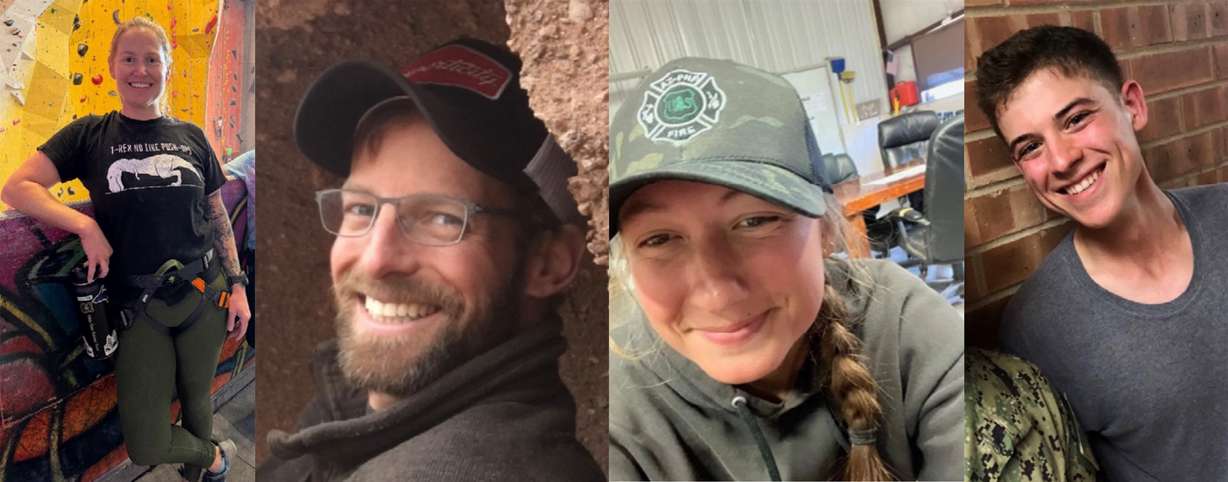
Emily Barker, 38, Nick Hutcherson, 27, and Sydney Watson, 26, all died from injuries when the fast-moving fire overtook them in western Colorado on June 27. Nathan Matthews, 43, died nearly a month later after being rescued from the fire.
A fifth firefighter is still recovering from burns and other injuries suffered in the incident. They have not been publicly identified.
The Knowles Fire, eventually renamed the Snyder Fire, was first discovered approximately 13 miles west of Grand Junction, Colorado, shortly before midnight on June 26. Lightning strikes had been reported in the area that night, sparking two fires that started on the Utah side of the border.
The primary fire burned about 60 acres by 8 a.m. on June 27, but shot up to 28,000 acres by the end of the day as the two fires merged. Most of the growth was reported shortly after noon, when wind and heat mixed with the dry conditions to create red flag conditions.
The area had experienced extremely low snowpack over the winter, largely from its warmest winter on record — an issue that also plagued Utah and most of the West. Its previous winter was one of the area's driest on record, too, with little monsoonal moisture during the in-between summer.
It left conditions extremely dry and prone to rapid fire growth, which suddenly happened that afternoon.
"The fires' tendency to spot over natural barriers that day was unlike anything the fire management organization had previously experienced," officials wrote in the 95-page report. "For some, it was the windiest day they had ever experienced on a fire, or, indeed, at all."
Five different fires were named at the time, burning near each other between Utah and Colorado.
'She was offering me her shelter'
Contact had been lost with one of the crews shortly before 3:30 p.m. that day.
Barker told colleagues that the smoke was heavy enough that it looked like sunset in the afternoon, but the crew knew the fire was approaching them not long after that.
"At some point we saw smoke that had a different shape, or texture, not like the smoke that had been present all afternoon," the surviving firefighter told investigators.
Barker was on the phone with her supervisor when she said she had to go because a "spot fire" had emerged. As the fire approached, she told the group to leave their gear as they sought an escape by helicopter.
She had been in communication with a nearby helicopter, telling them they could land at a designated site before suddenly telling them not to. "You can't land where we're at anymore," she said, before crews lost all communication with her.
On the ground, she instructed her team to pull out their emergency burnover shelters. By that point, the fire was only seconds away, the surviving firefighter said.
They recalled struggling to get their shelter to fully close when Barker offered them her shelter.
"I thought she was talking about radios, but she was offering me her shelter," the firefighter said, adding that the last thing they heard from her was instructions on how to use the shelter, which likely saved their life.
Everything after that was "fuzzy," like a dream the firefighter recalled, describing how they struggled to keep the shelter down as the fire raged over them and they received burns from heat.
Other personnel began calling the individual cellphone numbers of the crew, trying to get someone to pick up. Air crews finally reached Matthews via cellphone after approximately 25 minutes of silence, helping coordinate a rescue.
The standard handheld radios had "insufficient range from inside fire shelters. Handheld strobes and cell phones helped helicopters locate and rescue the two survivors amid heavy smoke conditions," the report noted.
The two were rescued from the site about 2 ½ hours after the burnover incident, when they learned that their three other colleagues had likely died.
Barker, Hutcherson and Watson were confirmed dead by a second helicopter crew. Matthews died from his injuries on July 24.
The surviving firefighter's condition was not released.
Key findings
The report, officials said, aims to learn from the incident so nothing like it ever happens again. It outlined several findings before the fatal burnover.
The top finding was that extreme weather and extremely low fuel moisture caused erratic fire behavior, but the report also highlighted issues with coordination and communication.
Many dispatchers were trainees, while staffing vacancies and other less-trained employees "contributed to communication issues" reported on June 27. Jumping between jurisdictional dispatches and older infrastructure didn't help, the report added.
"Aging radio infrastructure, network saturation, and a vacant telecommunications position produced unreliable radio coverage, missed weather broadcasts and forced heavy reliance on personal cell phones," the agencies wrote.
Not all crews were aware of where each other was by the time the fires grew out of control, and firefighters had been "inserted into small remote fires with reliance on being removed by a helicopter."
There was confusion as to where each helicopter was assigned to at points because of "overlapping frequency assignments and generic call-sign use."
U.S. Wildland Fire Service Chief Brian Fennessy said in a statement that they hope to examine these contributing factors to help improve firefighter safety.
"It is our duty to always remember their service and sacrifice," added Secretary of the Interior Doug Burgum. "To the close-knit community of firefighters across the country, we dedicate ourselves to apply the lessons of this report in their honor, and in the (service) of protecting all those who follow."