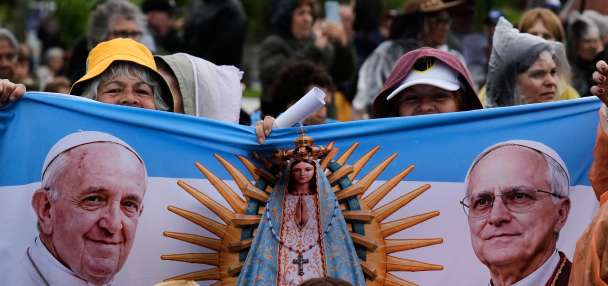
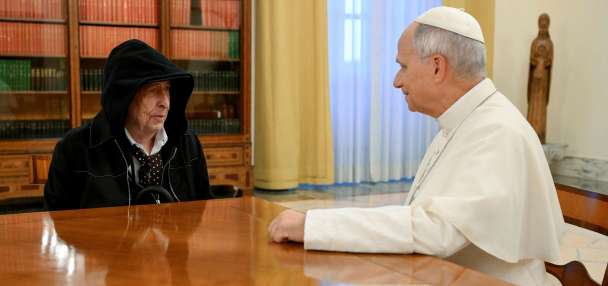
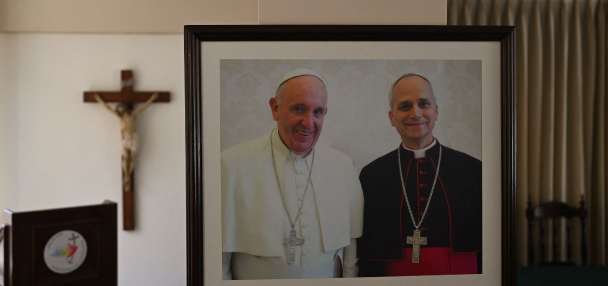
- Pope Leo XIV, formerly Robert Prevost, returns to Peru, his adopted homeland.
- Prevost's work in Peru shaped his path to papacy.
- His leadership during disasters and migrant crises highlights his dedication to Peruvians.
CHICLAYO, Peru — Riding on horseback to visit the most isolated Andean areas of his community, distributing food amid the COVID-19 pandemic, or wearing rubber boots in the water and mud of floods: this is how many Peruvians remember the man who is now Pope Leo XIV.
Robert Prevost was in the trenches and alongside his people during Peru's most difficult moments, and many of these memories will likely be front of mind among the public as they welcome the pope on his visit to his adopted homeland on Wednesday — a trip that will include visits to Lima, Cusco, Chiclayo and several other cities.
A young Prevost first arrived in the South American country as a missionary in 1985. The years that followed shaped his leadership style, which would later lead him to become the successor to the late Pope Francis.
His mission during the pandemic
"I think he was heroic in many ways; he risked becoming ill. We lost 11 priests and a bishop emeritus during that time," Father José Del Rosario recalls of the most difficult days of the pandemic.
Padre Robert, as he is known in Spanish in Peru, traveled more than 700 kilometers (435 miles) from Chiclayo to the Diocese of Callao, a province bordering the capital, Lima, where he served as apostolic administrator.
"He came every two weeks in his little car; he came alone in a simple pickup truck," explained Del Rosario, parish priest and rector of the Sanctuary of Our Lady of Mount Carmel of La Legua, who worked closely with the then-bishop.
Prevost distributed food and everything needed by a population that lived under lockdown for months, while also offering spiritual guidance during the crisis.
"He gave us a lot of hope and cared for our people, a man who was very close to the people … and also very humble," Del Rosario added.
Peru recorded more than 219,000 deaths, according to Johns Hopkins University figures, and one of the highest coronavirus mortality rates in the world. In Lima, and especially in the regions, terrifying scenes unfolded outside hospitals, with sick people collapsing in the street due to the shortage of oxygen, one of the key tools for treating the virus.
In Chiclayo, Bishop Prevost launched a fundraising campaign to purchase an oxygen plant. Together with Caritas Chiclayo, the bishop appealed to authorities and sectors of civil society and managed to raise more than US$380,000 for not just one but two oxygen plants.
On the front lines during natural disasters
Janinna Sesa, former director of Caritas Chiclayo, worked with the bishop for eight years, including during the pandemic, the flooding caused by the coastal El Niño in 2017, and Cyclone Yaku in 2023.
"We were always on the front lines, especially during disasters like the coastal El Niño phenomenon. He was the person who put on his boots and waded into the water; he helped people. He was very approachable and very kind," Sesa told CNN.
Before leaving for Rome in 2023, after the late Pope Francis appointed him prefect of the Dicastery for Bishops and president of the Pontifical Commission for Latin America, Bishop Prevost also led appeals for aid for the more than 10,000 people affected by flooding caused by Cyclone Yaku in the north of the country.
"I ask you to be generous; I ask you to open your hearts so that we can help one another and move forward, as we have done in other times of crisis," Prevost said in a video while standing in the water in the district of Illimo, in the Lambayeque region.
The Venezuelan migrant crisis
The assistance and response led by Prevost in the face of the massive arrival of Venezuelan migrants in 2018 was comprehensive and had a different vision from that of the country's other regions.
Peru received more than 1.6 million Venezuelans through November 2025, the second-highest number in the region after Colombia. More than 20,000 of them passed through Chiclayo, and more than 3,500 families settled in the region, according to figures from the Commission for Human Mobility and Human Trafficking of the Diocese of Chiclayo. Prevost also promoted this commission to assist migrants and combat human trafficking.
"The migration flow descended upon us, with thousands of migrants out on the streets, sleeping there, and the parishes serving as shelters," Sesa recalled.
Father Robert was concerned not only with providing food and collecting clothing, blankets, and medicine, but also with building the San Vicente de Paúl village, which took them in at Puerto Etén.
"His simplicity, the peace he conveys, that serenity Monsignor Prevost had when listening to people — I still see it in Pope Leo XIV…. He welcomed us with such warmth, with so much love," Lisbeth Díaz, a Venezuelan resident of Chiclayo and member of the Commission for Human Mobility and Human Trafficking, told CNN.
Prevost prioritized regularizing their legal status so they could work and integrate into society.
Promoting spaces for listening, and speaking
Prevost created spaces for dialogue and encouraged many people to raise their voices to denounce abuses during the internal conflict the country experienced beginning in the 1980s and to openly discuss the social reality during the authoritarian regime of the late President Alberto Fujimori in the 1990s.
At the Augustinian mission in Trujillo, the current pontiff and his seminarians traveled through towns and parishes in Andean areas, staging dramatizations that reflected the violence faced by peasants to encourage conversations that would help heal the trauma and pain they had suffered.
Prevost also participated in collecting signatures for the creation of the Truth and Reconciliation Commission (TRC), which investigated the violence between 1980 and 2000 and human rights abuses, particularly in rural Peru. Trujillo and the parishes led by the current pontiff collected the largest number of signatures.
A pope made in Peru
Leo XIV is a pope forged in Peru. The nearly two decades he spent in the land he adopted as his own profoundly shaped his ministry and set him on the path to the papacy. As a bishop, Prevost was a pastor close to his flock, and at the Vatican, one of his closest collaborators is the Reverend Edgard Rimaycuna, a native of Chiclayo.
His work in South America and his leadership of the Order of Saint Augustine caught the attention of Pope Francis, who first appointed him bishop of Chiclayo and later brought him to Rome, where he went on to hold one of the most important positions in the Vatican and also became a cardinal. This made him a candidate in the 2025 conclave.
In the past, the election of an American pope was considered impossible, given that the College of Cardinals did not wish to associate the papacy with the dominant political and cultural power. However, the cardinals who voted for Cardinal Robert Prevost in the 2025 conclave did not see him simply as a candidate from the United States. His experience in Peru garnered broad consensus among the cardinals, who chose a bishop with roots in Latin America — someone who speaks Spanish fluently and is attuned to the concerns of the people of that continent.
The pope's visit to Peru is widely seen as a homecoming for a pontiff who is a Peruvian citizen and who knows the country in depth.
Reverend John Lydon, a priest and member of the same Augustinian religious order to which the pope belongs, and who lived and worked with Prevost for a decade, told CNN: "I believe his dedication to the poor and his defense of human rights will continue to define his visit."