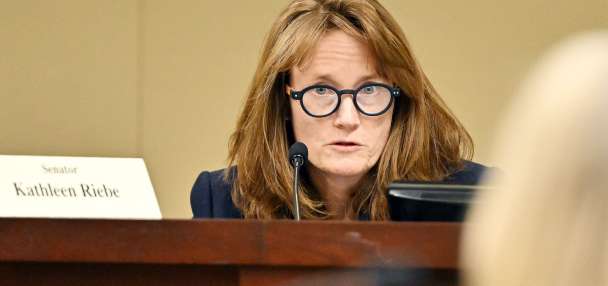

- Stephen Otterstrom, a Democrat from Salt Lake City, won Utah's House District 21.
- He ran unopposed after nearly winning a City Council race last year.
- Otterstrom plans to focus on education, maternal health and the Great Salt Lake in his first session.
SALT LAKE CITY — Election night was much different for Stephen Otterstrom this year.
In Houston for business, he tracked election results from this hotel room alone, knowing all too well that he had already won a seat he didn't think he'd even pursue a year ago.
Otterstrom, a Democrat from Salt Lake City, will be the new representative for Utah's House District 21, which primarily covers the west side of Utah's capital city. He will be sworn in next year after running unopposed.
But almost exactly a year before, he, his family and campaign staff anxiously watched a race that was much closer than many had expected. Salt Lake City Councilwoman Victoria Petro, who has represented northwest Salt Lake City since 2021, eked out a narrow 52% to 48% victory in a race decided by 118 votes, after out-fundraising Otterstrom by about a five-to-one clip.
In the wake of that loss, he realized that many of the issues he ran on — issues he heard while knocking doors in the district — aren't unique to the city's west side. They're growing statewide challenges, leading him to this moment.
"Strangely, last year, losing that race was still very energizing," he told KSL. "I felt like it showed that people were interested in the types of things that I was advocating for. ... Winning was what I was hoping for, but it was also good to know that."
A rising west-side voice
Otterstrom's rise in Utah's political scene is fairly recent.
A human resources consultant living in Salt Lake City's west side, he credits Nick Mitchell's 2022 congressional campaign as being the turning point. Otterstrom enjoyed watching politics, but never really got involved until he helped Mitchell's campaign against then-Rep. Chris Stewart.
He ultimately became good friends with Mitchell and others on the campaign, who would help him when he decided to run his own campaign that came out of a series of decisions in 2024.
The Utah Legislature passed a pair of bills that year that, combined, offered $1.8 billion toward sports projects.
Half of that was earmarked for a potential new baseball stadium, should Utah land a Major League Baseball team.
The rest was as much as Smith Entertainment Group could collect should Salt Lake City approve a 0.5% sales tax increase for a downtown redevelopment project spurred by the company's successful attempt to bring in an NHL team.
Salt Lake City approved the tax increase later that year, in a move that received mixed reviews. Otterstrom was among the residents who opposed it.
"I started to feel more disaffected with politics, and I felt like we really just didn't have anybody that was representing people that don't have tremendous means," he said, reflecting on it.
Angry, he launched a bid to unseat Petro, who was the chair of the City Council that year. Mitchell, now a member of the South Salt Lake City Council, helped him run his campaign.
They knocked on doors, gathered feedback, and — despite very few outside donations — nearly accomplished it.
Then, weeks later, Rep. Sandra Hollins, D-Salt Lake City, announced her plan to retire at the end of her expiring term.
Having that strange newfound confidence from the narrow loss, Otterstrom decided to throw his hat in the ring, plugging what he learned in the City Council race into a new bid for a state seat.
His campaign focused on state income tax reform, restoring the Great Salt Lake and creating more cooperative housing to address housing affordability.
Mitchell was one of his endorsers, alongside several community organizations, saying that Otterstrom listens to issues, researches them and finds "real solutions."
"He truly cares about other people and wants everyone to have a chance to succeed," Mitchell said.
Otterstrom ultimately won the Democratic nomination with almost 60% of the vote. No other contenders ran in the heavily Democratic district.
Getting to work early
He started drafting new proposals before Tuesday's election, authoring a few that his future colleagues have already submitted and will ultimately transfer back to him after he's sworn in.
Education and maternal health are among his top priorities right now, along with the drying Great Salt Lake. While he figured Democrats could make some gains in the Utah Legislature this election, he was surprised that it might be more than that.
I think there's a real possibility that we have people ready to do things differently.
–Utah House representative-elect Stephen Otterstrom
The results aren't final for a few more weeks, but House Republicans could lose their supermajority for the first time this century. Otterstrom added that some of his future freshman Republican colleagues are also coming into the Legislature with a similar mindset on tackling issues.
That's inspired him to consider proposing bills in his rookie session that he may have otherwise waited until he got to know everyone.
He believes 2027 could be the "honeymoon session" — or at least that's his hope heading into a job he didn't expect he'd even apply for this time a year ago.
"I think we've got a Legislature that's going to be more inclined to work toward progress than toward running a party line, or this kind of idea that I'm on one team and you're on the other team," he said. "I think there's a real possibility that we have people ready to do things differently."