

- Various Utah-based aerospace and defense industry companies partnered with Team USA to help build Olympic bobsleds.
- Companies like Albany Engineered Composites, Nammo Composite Solutions and Hexcel will provide aerospace-grade composites.
- This collaboration aims to give athletes a competitive edge for 2030 and 2034 Winter Olympics.
SALT LAKE CITY — When bobsled and skeleton athletes from Team USA torpedo down the tracks at the upcoming 2030 and 2034 Winter Olympics, they'll do so with the backing of Utah's aerospace and defense industry.
Not through sponsorships, but through a unique partnership between 47G and Utah-based companies Albany Engineered Composites, Hexcel and Nammo Composite Solutions to put aerospace-grade composites at the athletes' disposal.
The collaboration was announced Wednesday during the first day of 47G's annual Zero Gravity Summit, part of the statewide Hard Tech Week festivities.
It's a tremendous advantage for athletes in a sport where hundredths, and sometimes thousandths of a second separate the podium from the rest of the field and where weight, strength, aerodynamics and design of a sled matter more than ever.
"Our athletes give everything they have to find those hundredths of a second, and they deserve equipment that matches their commitment," Aron McGuire, CEO of USA Bobsled and Skeleton, said in a statement. "These partnerships connect our team with world-class engineers and manufacturers right here in Utah. It gives our athletes a real competitive edge as we build toward competing for medals on home ice in 2034."
More specifically, Albany Engineered Composites will work with USA Bobsled and Skeleton (the national governing body for the sport in the U.S.) to fabricate next-generation composite sled cowlings for the team's four-man bobsleds.
The cowling refers to the hull, or main shell, of a bobsled. Essentially, it's the vessel you see athletes zooming down a course in, often reaching speeds of 80 to 90 mph in the process.
Nammo will be responsible for manufacturing carbon-fiber cowlings for two-man bobsleds and Hexcel will provide raw materials needed to make bobsled parts.
"The athletes, they're relying on their equipment to perform when it counts, right? That's where we come in," said Jeff Daniel, vice president of Albany Engineered Composites' commercial segment. "We're taking this equipment, making sure it's strong. It's lightweight and gets them down the track faster."
For 47G, the catalyst in bringing the companies and USA Bobsled and Skeleton together, the collaboration is an opportunity to grow Utah's Olympic legacy beyond simply hosting the games.
"Utah has spent decades building an ecosystem where advanced manufacturing, aerospace, research and entrepreneurship intersect," said Aaron Starks, president and CEO of 47G. "As we look toward 2034, we have an opportunity not only to host the world's best athletes, but also to showcase the technologies, companies and talent helping shape the future of performance and innovation."
It's also significant for the athletes who will be relying on the precision engineering to help them earn a spot on the podium when it's all said and done.
And it's probably safe to say the Beehive State's involvement means a little extra to Kaysha Love, a Herriman native and Olympic bobsled athlete who's represented the U.S. at the 2022 and 2026 Winter Olympics.
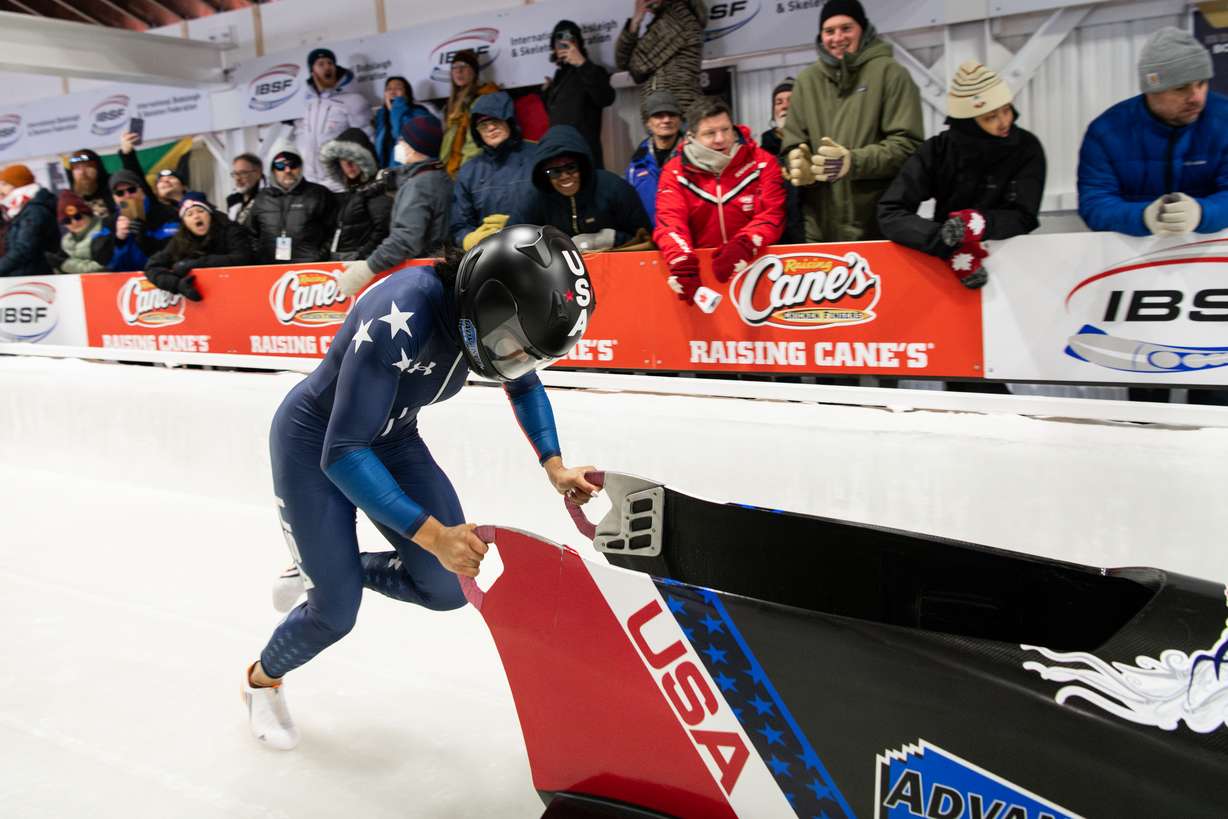
"I truly believe that nobody does sports, and no one does supporting like Utah does. At the end of the day, watching our community, watching these brands that are Utah-raised, Utah-born, and want to see not only Utah be successful, but our country be successful at the world's biggest level and greatest stage — it's so inspiring," Love said.
Of course, she's also looking forward to the competitive advantage that could be provided through bobsleds constructed from the same material that makes up F-35s and B-2s, just to name a couple, saying the upgraded technology "means everything."
"Our sport is continuing to evolve. The sleds are getting faster, the ice is getting faster (and) the tracks are changing. We're seeing evolution everywhere ... and why not in bobsleds?" she questioned.
"Knowing that some of the best engineers in aerospace are working on our equipment gives us confidence," Love said. "We get to focus on what we do best while they help us go faster."