'%3e%3cpath%20d='M34.1406%205.85938C30.3906%202.10547%2025.3047%200%2020%200C14.6953%200%209.60938%202.10547%205.85938%205.85938C2.10938%209.61328%200%2014.6953%200%2020C0%2025.3047%202.10547%2030.3906%205.85938%2034.1406C9.61328%2037.8906%2014.6953%2040%2020%2040C25.3047%2040%2030.3906%2037.8945%2034.1406%2034.1406C37.8906%2030.3906%2040%2025.3047%2040%2020C40%2014.6953%2037.8945%209.60938%2034.1406%205.85938ZM37.0117%2023.543H31.1602V13.5391H27.6328V19.9414C28.1211%2020.6914%2028.3711%2021.582%2028.3711%2022.5625V22.625C28.3711%2023.668%2028.1172%2024.6055%2027.6328%2025.4297V26.6094H36.082C33.4883%2032.9375%2027.2891%2037.3789%2020.0039%2037.3789C10.3711%2037.3789%202.62109%2029.6289%202.62109%2020C2.62109%2010.3711%2010.3711%202.62109%2020%202.62109C29.6289%202.62109%2037.3789%2010.3711%2037.3789%2020C37.3789%2021.1484%2037.2617%2022.2656%2037.0508%2023.3477C37.0391%2023.4141%2037.0234%2023.4766%2037.0117%2023.543Z'%20fill='white'/%3e%3cpath%20d='M22.3086%2018.5352C20.4336%2018.125%2019.9531%2017.8398%2019.9766%2017.1836V17.1406C19.9766%2016.6992%2020.3477%2016.2148%2021.4023%2016.2148C22.582%2016.2148%2023.8867%2016.6797%2025.0781%2017.4766L26.8516%2015.0195C25.4453%2013.8906%2023.707%2013.3398%2021.5547%2013.3398C18.5195%2013.3398%2016.4375%2015%2016.4063%2017.4766V17.5352C16.3633%2020.2617%2018.5859%2020.9805%2021.293%2021.6016C23.0391%2021.9766%2023.5703%2022.3164%2023.5703%2022.9609L23.5469%2022.9766C23.5469%2023.3906%2023.2578%2023.7031%2022.7852%2023.8359C22.5742%2023.9062%2022.1289%2023.9727%2021.5156%2023.9727C20.7617%2023.9727%2019.7539%2023.8633%2018.6328%2023.4844C18.0898%2023.2891%2017.4727%2023.0039%2016.8047%2022.6133L20.1406%2026.625C20.2813%2026.6602%2021.0977%2026.8516%2021.7734%2026.8516C25.0039%2026.8516%2027.0859%2025.2461%2027.1094%2022.6328V22.5703C27.1602%2020.1133%2025.2148%2019.1719%2022.3086%2018.5352Z'%20fill='white'/%3e%3cpath%20d='M5.24219%2013.5664V26.6133H8.75391V23.7578L10.2969%2021.9531L14.2031%2026.6133H18.3867L12.3555%2019.5195L17.4023%2013.5664H13.4531L8.75391%2019.0586V13.5664H5.24219Z'%20fill='white'/%3e%3c/g%3e%3cdefs%3e%3cclipPath%20id='clip0_97_2430'%3e%3crect%20width='40'%20height='40'%20fill='white'/%3e%3c/clipPath%3e%3c/defs%3e%3c/svg%3e)




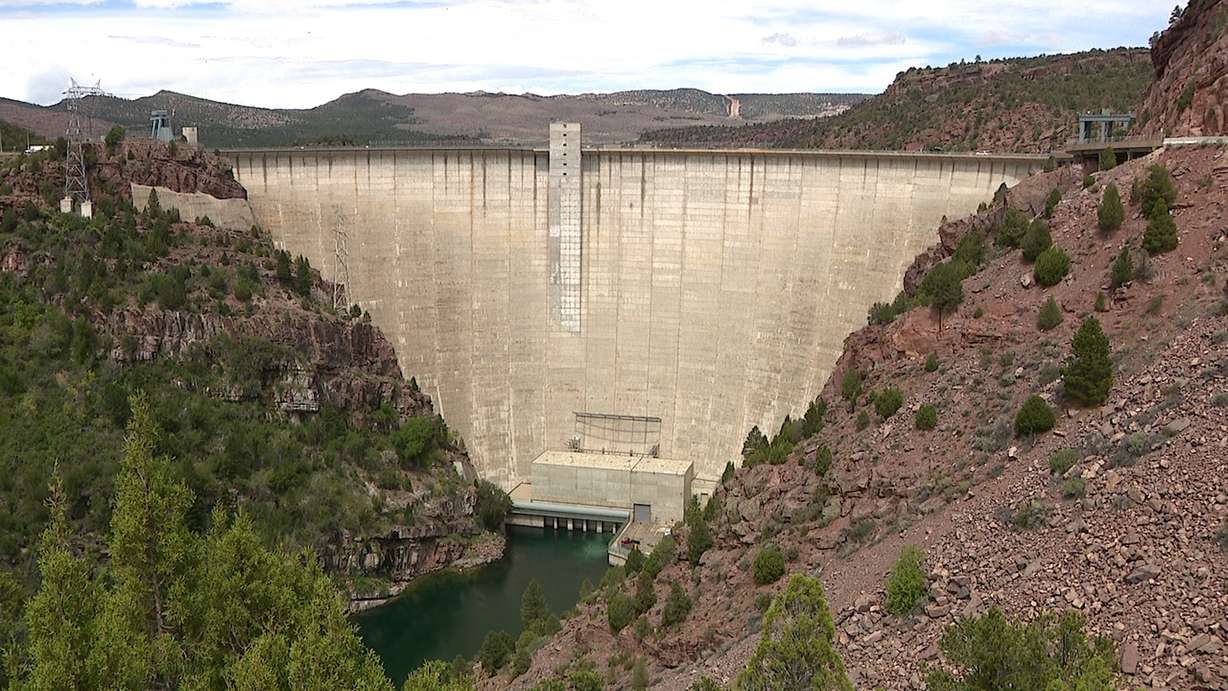
- The U.S. Bureau of Reclamation is releasing up to 1 million acre-feet of additional water from Flaming Gorge.
- The releases, occurring through April 2027, aim to help maintain Lake Powell's critical water levels.
- While important in protecting the river system, Utah officials stress Flaming Gorge shouldn't be a permanent solution.
Editor's Note: This article is published through the Colorado River Collaborative, a solutions journalism initiative supported by the Janet Quinney Lawson Institute for Land, Water, and Air at Utah State University.
DUTCH JOHN, Daggett County — For as many times as Jack Lytle has been out on Flaming Gorge Reservoir, the Daggett County commissioner still has a tough time explaining what the lake means to him.
"It's a great place," he said while taking in a boat across the reservoir.
For Lytle, who calls this corner of northeastern Utah home, Flaming Gorge is more than a reservoir.
"It does give you a place to come and relax, but also to have that peace," he said. "I love being on the water."
These days, however, the reservoir is also playing an important role in a much larger and increasingly complicated issue facing the Colorado River.
The U.S. Bureau of Reclamation is releasing between 660,000 and 1 million acre-feet of water from Flaming Gorge through April 2027 to help keep Lake Powell above critical elevations.
"The way I explain it without getting way in the weeds, it's like a spider web," said Lytle. "You tug one string here and you're touching thousands of other issues."
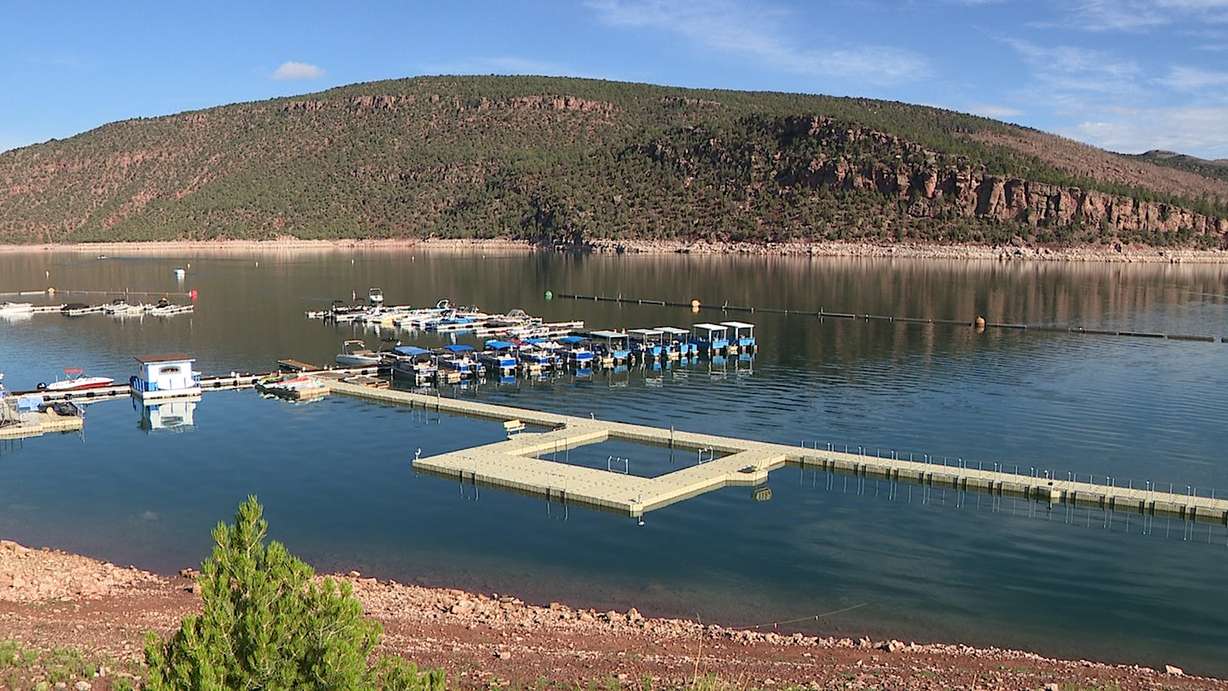
At Cedar Springs Marina, those issues are becoming increasingly visible.
John Rauch, the marina's manager, said the dropping water level has meant repeatedly moving docks and even removing some slips this season.
"It's a lot of work. No sitting down this summer," said Rauch. "It's running through the winches every couple days and moving docks. We've had to take docks out. Every day, there's a new challenge."
Despite the lower level, he stressed that there is still plenty of water in the reservoir, and people are still coming to Flaming Gorge.
But what happens over the coming months concerns him.
"Oh, 100% yeah. It's super scary," said Rauch. "It's like the unknown is what's scary."
Rauch said the marina has dealt with low water before and has learned how to adjust its operations.
The uncertainty is how much more it may have to adjust.
"We knew what we had to do to get to these positions to make it look like when you come, people don't even realize that there's water issues because it looks so good," he said. "We've been moving, we've had plans, but to not know where the rocks are going to be coming up and stuff, it's just a day-to-day challenge. One that I guess we have to accept."
The releases from Flaming Gorge are part of a broader federal effort to protect Lake Powell amid historically poor conditions throughout the Colorado River Basin.
The Bureau of Reclamation says the 2025-26 winter produced the lowest observed snowpack on record.
Lake Powell and Lake Mead both reached record-low elevations in August, and their combined storage is now lower than at any point since before Lake Powell began filling in the 1960s.
Amy Haas, executive director of the Colorado River Authority of Utah, said Utah recognizes the importance of protecting the entire river system but doesn't want Flaming Gorge to become a permanent solution to downstream shortages.
"One of the things that we're committed to in Utah is making sure that any water that gets released from this facility is fully returned or recovered," said Haas.
The concern comes as the seven Colorado River Basin states — Utah, Wyoming, Colorado, New Mexico, Arizona, Nevada and California — have been unable to reach consensus on a long-term agreement for managing the river.
The dispute is particularly difficult because the Upper and Lower Basin states experience shortages differently.
Utah and other Upper Basin officials argue that their water use is naturally reduced during dry years because of diminished snowpack and runoff, and that those reductions need to be recognized as the states negotiate future operations.
Haas said using more water from upstream reservoirs such as Flaming Gorge to address shortages downstream is not a sustainable answer.
"To put it succinctly, we have two empty reservoirs," she said. "Why would we want to empty a third?"
With the states unable to reach a long-term consensus, the Department of the Interior issued new operating guidelines in August for Lake Powell and Lake Mead for 2027 and 2028.
Those guidelines are part of a broader 10-year federal framework for managing the reservoirs through 2036, while leaving room for the seven Colorado River Basin states to continue negotiating and potentially reach a longer-term agreement.
For now, the releases from Flaming Gorge are scheduled to continue through April 2027.
That means the reservoir Lytle considers home remains connected to decisions being made hundreds of miles away… another strand in the Colorado River's complicated web.
Finding an agreement among everyone who depends on it won't be easy, Lytle said.
"It may not be painless, but here we just got to make it work," he said. "They've done it before, and they can do it again."