'%3e%3cpath%20d='M34.1406%205.85938C30.3906%202.10547%2025.3047%200%2020%200C14.6953%200%209.60938%202.10547%205.85938%205.85938C2.10938%209.61328%200%2014.6953%200%2020C0%2025.3047%202.10547%2030.3906%205.85938%2034.1406C9.61328%2037.8906%2014.6953%2040%2020%2040C25.3047%2040%2030.3906%2037.8945%2034.1406%2034.1406C37.8906%2030.3906%2040%2025.3047%2040%2020C40%2014.6953%2037.8945%209.60938%2034.1406%205.85938ZM37.0117%2023.543H31.1602V13.5391H27.6328V19.9414C28.1211%2020.6914%2028.3711%2021.582%2028.3711%2022.5625V22.625C28.3711%2023.668%2028.1172%2024.6055%2027.6328%2025.4297V26.6094H36.082C33.4883%2032.9375%2027.2891%2037.3789%2020.0039%2037.3789C10.3711%2037.3789%202.62109%2029.6289%202.62109%2020C2.62109%2010.3711%2010.3711%202.62109%2020%202.62109C29.6289%202.62109%2037.3789%2010.3711%2037.3789%2020C37.3789%2021.1484%2037.2617%2022.2656%2037.0508%2023.3477C37.0391%2023.4141%2037.0234%2023.4766%2037.0117%2023.543Z'%20fill='white'/%3e%3cpath%20d='M22.3086%2018.5352C20.4336%2018.125%2019.9531%2017.8398%2019.9766%2017.1836V17.1406C19.9766%2016.6992%2020.3477%2016.2148%2021.4023%2016.2148C22.582%2016.2148%2023.8867%2016.6797%2025.0781%2017.4766L26.8516%2015.0195C25.4453%2013.8906%2023.707%2013.3398%2021.5547%2013.3398C18.5195%2013.3398%2016.4375%2015%2016.4063%2017.4766V17.5352C16.3633%2020.2617%2018.5859%2020.9805%2021.293%2021.6016C23.0391%2021.9766%2023.5703%2022.3164%2023.5703%2022.9609L23.5469%2022.9766C23.5469%2023.3906%2023.2578%2023.7031%2022.7852%2023.8359C22.5742%2023.9062%2022.1289%2023.9727%2021.5156%2023.9727C20.7617%2023.9727%2019.7539%2023.8633%2018.6328%2023.4844C18.0898%2023.2891%2017.4727%2023.0039%2016.8047%2022.6133L20.1406%2026.625C20.2813%2026.6602%2021.0977%2026.8516%2021.7734%2026.8516C25.0039%2026.8516%2027.0859%2025.2461%2027.1094%2022.6328V22.5703C27.1602%2020.1133%2025.2148%2019.1719%2022.3086%2018.5352Z'%20fill='white'/%3e%3cpath%20d='M5.24219%2013.5664V26.6133H8.75391V23.7578L10.2969%2021.9531L14.2031%2026.6133H18.3867L12.3555%2019.5195L17.4023%2013.5664H13.4531L8.75391%2019.0586V13.5664H5.24219Z'%20fill='white'/%3e%3c/g%3e%3cdefs%3e%3cclipPath%20id='clip0_97_2430'%3e%3crect%20width='40'%20height='40'%20fill='white'/%3e%3c/clipPath%3e%3c/defs%3e%3c/svg%3e)


- A fragment of Great Salt Lake meteorite, which crashed in on August 2022, is being displayed publicly for the first time.
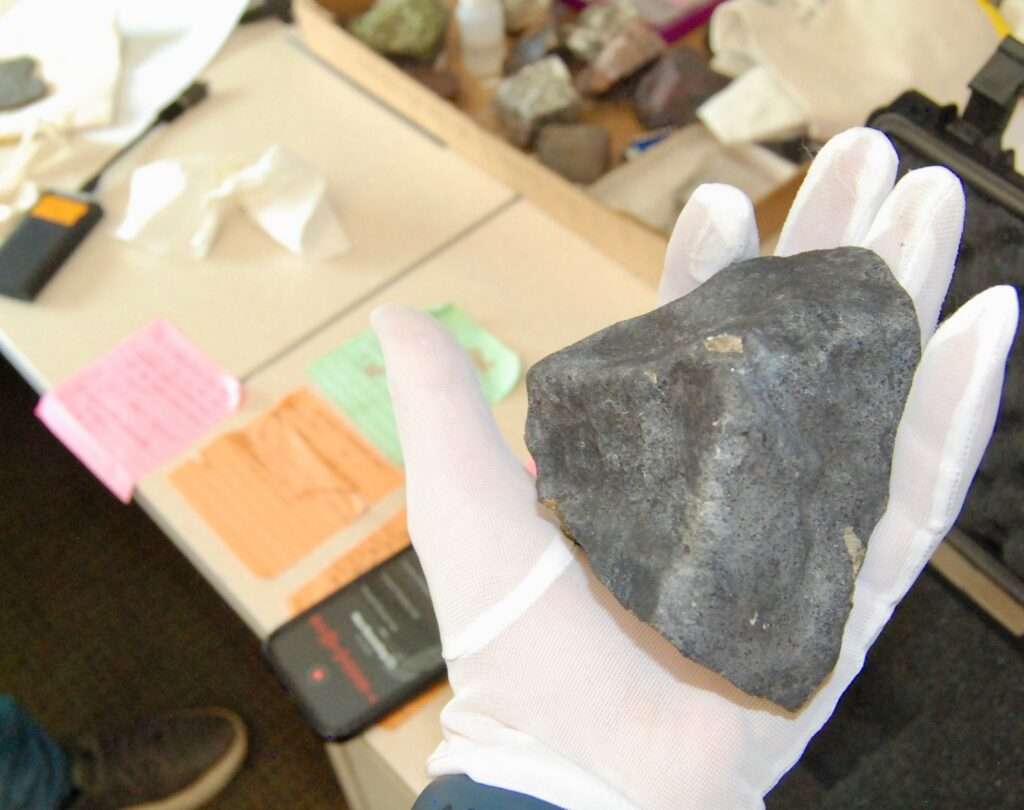
- A 774-gram fragment is the centerpiece of a new University of Utah exhibit.
- The Great Salt Lake meteorite crash was only the second-of-its-kind in Utah's history.
SALT LAKE CITY — Every year, James Karner travels to Antarctica as the principal investigator of the Antarctic Search for Meteorites to find and collect meteorites for the whole world to study.
Despite these annual pilgrimages, Karner had never witnessed a meteorite fall.
That was, until the morning of Aug. 13, 2022, when he and many others heard a loud boom echoing across the Salt Lake Valley — the sound of a falling meteorite that eventually crashed into the playa along the Great Salt Lake's south shore before becoming officially known as the Great Salt Lake meteorite
"What was kind of unique about this meteorite is that it was seen as a fireball coming across the Midwest and the Mountain States," Karner, the U.'s resident meteorite expert and research associate professor in the geology department, told KSL. "It was really cool to actually hear the event happen in my own driveway."
The fiery scene was even captured by a Snowbasin Ski Resort webcam and drew the attention of Utah Gov. Spencer Cox, who said in a social media post that he heard the boom while on a run in Salt Lake City.
Did you hear that loud boom this morning? Our web cams captured this meteor flying over Snowbasin! ☄️ pic.twitter.com/Dgv0W2Vd4H
— Snowbasin Resort (@SnowbasinResort) August 13, 2022
Now, a 774-gram fragment of the meteorite — the largest from that cosmic event and roughly the size of a fist — is being put on display in the U.'s Sutton Building as the centerpiece of an exhibit that includes video and interpretive materials telling the story of Utah's second known "fall" meteorite.
A fall meteorite, Karner explained, is a meteorite whose plummet to Earth was witnessed by people. Utah's first occurred in 1950, near Garland in Box Elder County.
Karner's first thought after witnessing the fireball event, naturally, was whether any pieces made it to the ground in the form of meteorites.
"There's all kinds of meteors falling into the Earth's atmosphere every day, but most of them are over the oceans," Karner said.
As recently as two decades ago, researchers and meteorite hunters would've had to rely on eyewitness accounts and videos (if they were lucky) to piece together a rough idea of where potential meteorites could've landed.
"In the last 20 years ... these meteors can be seen on Doppler radar. They see the explosion on Doppler radar. They see these meteorites falling to ground with the weather radar, and we can almost pinpoint exactly where they're coming down on the Earth," Karner said.
Springing to action, Karner quickly contacted a colleague at NASA's Johnson Space Center who, using weather data from Salt Lake City and Pocatello, Idaho, helped confirm meteorites had indeed fallen to the ground after the explosion.
The 774-gram Great Salt Lake meteorite was eventually discovered and donated to the U. by Arizona-based meteorite hunter Robert Ward.
Along with the Great Salt Lake meteorite, Karner said "dozens" of additional fragments were recovered from the 2022 event, and he believes there are still more remnants out there.
"I suspect there are still pieces of this meteorite out in the playa, in the lake, actually, and probably out in the salt ponds out by Morton Salt on the west side of the lake," Karner said.
To date, 3.2 kilograms have been recovered from the 2022 event.
Compositionally, Karner said the meteorite isn't particularly unique. Classified as an "ordinary chondrite," it shares composition with 80% to 85% of other meteorites.
However, by tracking the fireball event that led to the Great Salt Lake meteorite, scientists were able to calculate the fireball's pre-impact orbit back into the asteroid belt it came from.
It's a significant cosmic event that is going to happen once in a lifetime.
– Jim Karner, University of Utah research professor
"Because we have the rock that caused it, we can see what composition that is, and then telescopes can actually match the asteroid group to that specific meteorite. That hasn't happened much before. Only about 70 meteorites have ever had that kind of tracking. So, we're actually linking asteroids and asteroid families to specific meteorites." Karner said.
Apart from the scientific significance of the event, Karner said the Great Salt Lake meteorite is deserving of going on display to the public, calling it "every part of the natural history of Utah."
"It's a significant cosmic event that is going to happen once in a lifetime, and I think it's neat because I've talked to a lot of people about this event, and a lot of people in Salt Lake City heard these explosions," Karner said. "It's really the oldest thing they've ever witnessed. It's 4.56 billion years old, that rock is. The dinosaur bones you find are 60, 65 million years old."
The exhibit was officially unveiled last week inside the Department of Geology and Geophysics' main office. The office is located just off the Sutton Building's second-floor lobby, known as the Confluence, according to a release from the U.