'%3e%3cpath%20d='M34.1406%205.85938C30.3906%202.10547%2025.3047%200%2020%200C14.6953%200%209.60938%202.10547%205.85938%205.85938C2.10938%209.61328%200%2014.6953%200%2020C0%2025.3047%202.10547%2030.3906%205.85938%2034.1406C9.61328%2037.8906%2014.6953%2040%2020%2040C25.3047%2040%2030.3906%2037.8945%2034.1406%2034.1406C37.8906%2030.3906%2040%2025.3047%2040%2020C40%2014.6953%2037.8945%209.60938%2034.1406%205.85938ZM37.0117%2023.543H31.1602V13.5391H27.6328V19.9414C28.1211%2020.6914%2028.3711%2021.582%2028.3711%2022.5625V22.625C28.3711%2023.668%2028.1172%2024.6055%2027.6328%2025.4297V26.6094H36.082C33.4883%2032.9375%2027.2891%2037.3789%2020.0039%2037.3789C10.3711%2037.3789%202.62109%2029.6289%202.62109%2020C2.62109%2010.3711%2010.3711%202.62109%2020%202.62109C29.6289%202.62109%2037.3789%2010.3711%2037.3789%2020C37.3789%2021.1484%2037.2617%2022.2656%2037.0508%2023.3477C37.0391%2023.4141%2037.0234%2023.4766%2037.0117%2023.543Z'%20fill='white'/%3e%3cpath%20d='M22.3086%2018.5352C20.4336%2018.125%2019.9531%2017.8398%2019.9766%2017.1836V17.1406C19.9766%2016.6992%2020.3477%2016.2148%2021.4023%2016.2148C22.582%2016.2148%2023.8867%2016.6797%2025.0781%2017.4766L26.8516%2015.0195C25.4453%2013.8906%2023.707%2013.3398%2021.5547%2013.3398C18.5195%2013.3398%2016.4375%2015%2016.4063%2017.4766V17.5352C16.3633%2020.2617%2018.5859%2020.9805%2021.293%2021.6016C23.0391%2021.9766%2023.5703%2022.3164%2023.5703%2022.9609L23.5469%2022.9766C23.5469%2023.3906%2023.2578%2023.7031%2022.7852%2023.8359C22.5742%2023.9062%2022.1289%2023.9727%2021.5156%2023.9727C20.7617%2023.9727%2019.7539%2023.8633%2018.6328%2023.4844C18.0898%2023.2891%2017.4727%2023.0039%2016.8047%2022.6133L20.1406%2026.625C20.2813%2026.6602%2021.0977%2026.8516%2021.7734%2026.8516C25.0039%2026.8516%2027.0859%2025.2461%2027.1094%2022.6328V22.5703C27.1602%2020.1133%2025.2148%2019.1719%2022.3086%2018.5352Z'%20fill='white'/%3e%3cpath%20d='M5.24219%2013.5664V26.6133H8.75391V23.7578L10.2969%2021.9531L14.2031%2026.6133H18.3867L12.3555%2019.5195L17.4023%2013.5664H13.4531L8.75391%2019.0586V13.5664H5.24219Z'%20fill='white'/%3e%3c/g%3e%3cdefs%3e%3cclipPath%20id='clip0_97_2430'%3e%3crect%20width='40'%20height='40'%20fill='white'/%3e%3c/clipPath%3e%3c/defs%3e%3c/svg%3e)


- The Cottonwood Fire destroyed cabins despite decades of wildfire preparation by residents.
- Hi-Lo Arrowhead Fire Council's efforts included creating defensible spaces and evacuation plans.
- Residents remain committed to rebuilding and continuing wildfire prevention for future generations.
BEAVER — Before there was smoke on Beaver Mountain, there were weekends.
Weekends spent trimming trees, clearing brush and teaching neighbors how to protect the place they loved.
For more than two decades, members of the Hi-Lo Arrowhead Fire Council worked to reduce wildfire danger in their mountain community.
They organized neighborhood cleanup days, encouraged homeowners to create defensible space, and even held a "chip fest" where a wood chipper mulched as much dead wood as people could collect.
Then came the Cottonwood Fire.
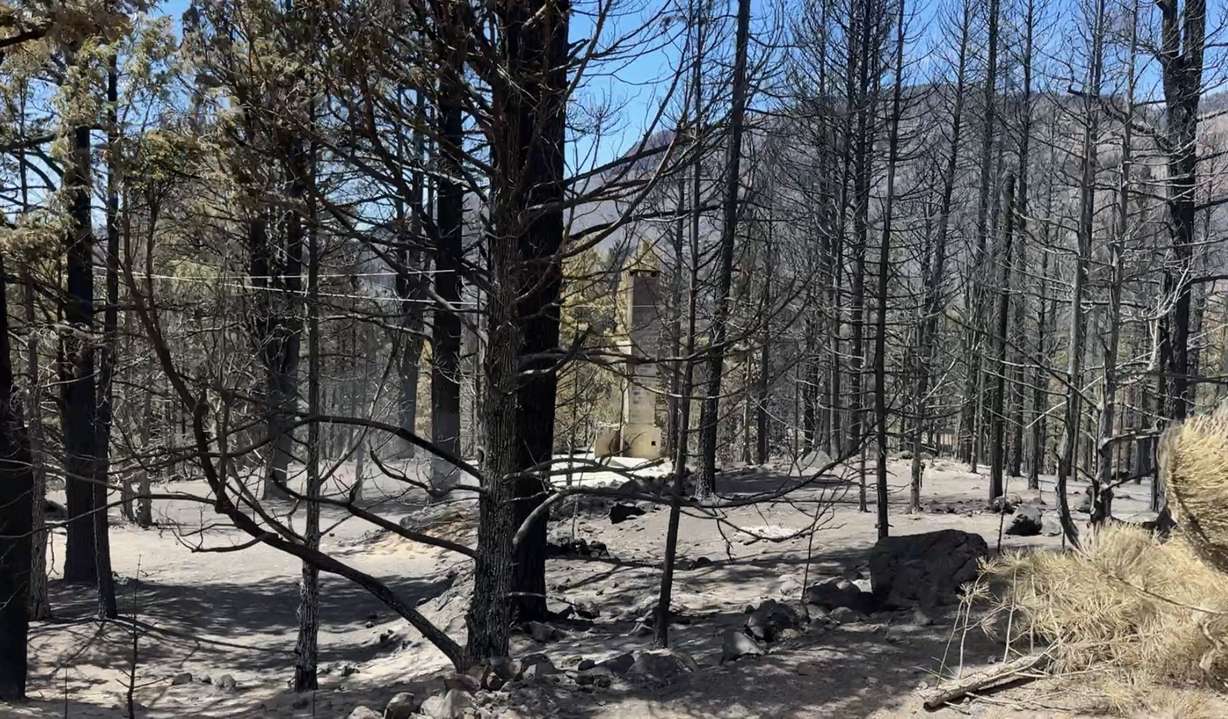
The wildfire burned through much of the area they had spent years working to protect, burning dozens of cabins to the ground, including Linda Mesinar's.
"I think I am still numb," said Mesinar. "It's just hard to believe that it's gone."
For many people looking at the devastation, it might be easy to wonder whether all those years of work were worth it.
Mesinar never questioned it.
"We're not sorry that we did it," she said. "We're not thinking that 'Oh, my gosh, all this work and it didn't save us.' We'll never think that. This was the perfect storm, and nothing could have saved it."
Mesinar and her late husband, David, helped create the Hi-Lo Arrowhead Fire Council in 2002.
"We started small," said Mesinar. "Just fliers that are available and defensible space. How do you do that? What is important? We passed those out and then came back, passed out something different, had a meeting, invited everyone, and just kept going."
What began with a handful of neighbors eventually grew to include several mountain subdivision fire councils, with Hi-Lo Arrowhead becoming a Fire Wise community in 2014.
Fire Wise is a nationally recognized program that can help communities with funding for mitigation efforts.
The certification must be renewed every year by documenting ongoing wildfire mitigation work, which Hi-Lo Arrowhead did.
"It's hard work," said Beaver County Fire Warden George Humphreys. "It's a commitment, is what it is. It's a document that shows that the community is committed to do, fire prevention and that type of work."
Over time, that work became annual community events.
"We would trim our trees, cut the underbrush, thin the trees, and then stack the brush and the tree limbs," said Mesinar. "George and his crews would come up and everybody, all the homeowners could participate, and we'd all get together on a weekend and follow the chipper."
The work wasn't only about wildfire prevention.
The Fire Council worked with local, state and federal agencies to create evacuation plans and even practiced leaving the mountain before an emergency happened.
Those efforts paid off when the Cottonwood Fire started burning.
No lives were lost in the Cottonwood Fire.
"We were fortunate," said Humphreys. "I think some of our planning was a document that I used from other areas that I've seen, and it was basic. It talked about getting prepared to leave, and then it talked about what we were taking and then where we were going, which way we were going. It was a basic plan. Most of them had it in the cupboard so they could pull it out and make sure they got what they needed and then got down the road."
However, even with all that preparation, the Cottonwood Fire still caused devastating losses.
Humphreys said that's not evidence that the work failed.
Mitigation is more about giving time to people and firefighters to have a fighting chance.
"Who would've expected the mega fire or the fire that we wish never would happen would start?" he said.
Now, even after losing cabins, many homeowners are already talking about rebuilding.
Mesinar hopes the work that began more than 20 years ago will continue when the trees and vegetation come back.
"Hopefully our children and grandchildren will take the lead on that and continue our work," she said. "We're committed to this. This is our happy place."
Wildfire preparedness resources
Fire officials say homeowners don't have to belong to a Fire Council to reduce wildfire risk around their homes.
More information is available through these programs:
Living With Fire Utah: https://utahlivingwithfire.org/
Ready, Set, Go! Wildland Fire Action Guide: https://www.wildlandfirersg.org
National Fire Protection Association Firewise resources: https://www.nfpa.org