'%3e%3cpath%20d='M34.1406%205.85938C30.3906%202.10547%2025.3047%200%2020%200C14.6953%200%209.60938%202.10547%205.85938%205.85938C2.10938%209.61328%200%2014.6953%200%2020C0%2025.3047%202.10547%2030.3906%205.85938%2034.1406C9.61328%2037.8906%2014.6953%2040%2020%2040C25.3047%2040%2030.3906%2037.8945%2034.1406%2034.1406C37.8906%2030.3906%2040%2025.3047%2040%2020C40%2014.6953%2037.8945%209.60938%2034.1406%205.85938ZM37.0117%2023.543H31.1602V13.5391H27.6328V19.9414C28.1211%2020.6914%2028.3711%2021.582%2028.3711%2022.5625V22.625C28.3711%2023.668%2028.1172%2024.6055%2027.6328%2025.4297V26.6094H36.082C33.4883%2032.9375%2027.2891%2037.3789%2020.0039%2037.3789C10.3711%2037.3789%202.62109%2029.6289%202.62109%2020C2.62109%2010.3711%2010.3711%202.62109%2020%202.62109C29.6289%202.62109%2037.3789%2010.3711%2037.3789%2020C37.3789%2021.1484%2037.2617%2022.2656%2037.0508%2023.3477C37.0391%2023.4141%2037.0234%2023.4766%2037.0117%2023.543Z'%20fill='white'/%3e%3cpath%20d='M22.3086%2018.5352C20.4336%2018.125%2019.9531%2017.8398%2019.9766%2017.1836V17.1406C19.9766%2016.6992%2020.3477%2016.2148%2021.4023%2016.2148C22.582%2016.2148%2023.8867%2016.6797%2025.0781%2017.4766L26.8516%2015.0195C25.4453%2013.8906%2023.707%2013.3398%2021.5547%2013.3398C18.5195%2013.3398%2016.4375%2015%2016.4063%2017.4766V17.5352C16.3633%2020.2617%2018.5859%2020.9805%2021.293%2021.6016C23.0391%2021.9766%2023.5703%2022.3164%2023.5703%2022.9609L23.5469%2022.9766C23.5469%2023.3906%2023.2578%2023.7031%2022.7852%2023.8359C22.5742%2023.9062%2022.1289%2023.9727%2021.5156%2023.9727C20.7617%2023.9727%2019.7539%2023.8633%2018.6328%2023.4844C18.0898%2023.2891%2017.4727%2023.0039%2016.8047%2022.6133L20.1406%2026.625C20.2813%2026.6602%2021.0977%2026.8516%2021.7734%2026.8516C25.0039%2026.8516%2027.0859%2025.2461%2027.1094%2022.6328V22.5703C27.1602%2020.1133%2025.2148%2019.1719%2022.3086%2018.5352Z'%20fill='white'/%3e%3cpath%20d='M5.24219%2013.5664V26.6133H8.75391V23.7578L10.2969%2021.9531L14.2031%2026.6133H18.3867L12.3555%2019.5195L17.4023%2013.5664H13.4531L8.75391%2019.0586V13.5664H5.24219Z'%20fill='white'/%3e%3c/g%3e%3cdefs%3e%3cclipPath%20id='clip0_97_2430'%3e%3crect%20width='40'%20height='40'%20fill='white'/%3e%3c/clipPath%3e%3c/defs%3e%3c/svg%3e)


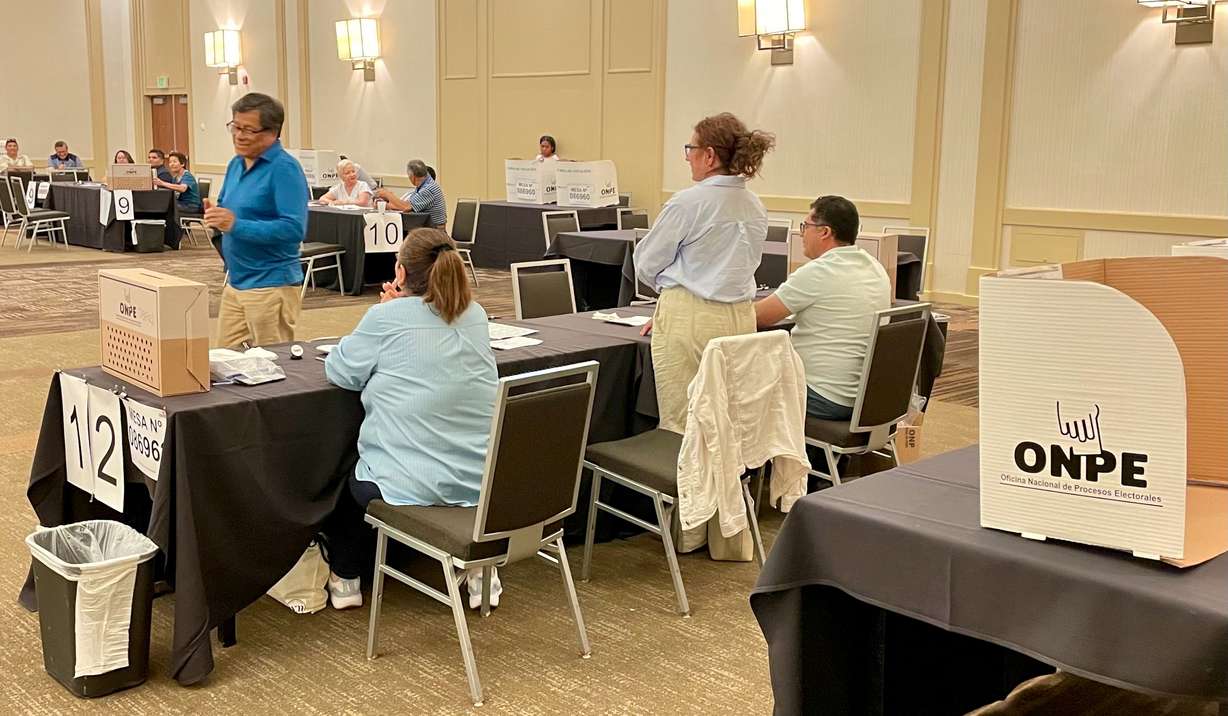
- Peruvians in Utah participated in Peru's presidential election Sunday, casting ballots at the Hilton Salt Lake City Center.
- The election featured conservative Keiko Fujimori and leftist Roberto Sanchez.
- Peruvians living abroad may vote in the nation's presidential elections and some 6,700 Peruvians in Utah were eligible to cast ballots.
SALT LAKE CITY — They may be thousands of miles from their home country, but Peru is hardly forgotten for many Peruvians living in Utah.
Some have family members in the South American country who they still visit. Many follow current events in Peru and the nation's shifting fortunes. Even if they've long lived in the United States, some still vote in Peruvian elections, and many from the expatriate community traveled Sunday to downtown Salt Lake City to cast ballots in the nation's hotly contested presidential vote.
"There's a lot of interest in voting because the two candidates are opposites," said Czibor Chicata-Sutmöller, who, as general consul of the Peruvian Consulate in Salt Lake City, was helping oversee balloting at a ballroom of the Hilton Salt Lake City Center.
The Peruvian community, he said, seems polarized between the two candidates, conservative Keiko Fujimori, daughter of the late former president of Peru Alberto Fujimori, and leftist Roberto Sanchez. Expatriate Peruvians all around the world are able to vote, not just in Utah, and the winner in the presidential balloting will ultimately take over from José María Balcázar, serving as interim president.
Regardless of the attributes of either candidate, though, those voting Sunday at the Hilton were united in their continued interest in the nation's future, even if the United States is now their home. They still regard the country with fondness, want it to thrive and see voting as a way of helping steer the country toward a better future. As of Monday, most but not all votes had been counted and the two presidential candidates were in a virtual tie, according to Associated Press.
"My roots are Peruvian. My family's there. I'm the only living in the United States," said Liliana Puma, who now lives in Alpine and was one of the many voters at the Hilton on Sunday. "Why defend Peru? Because I want a free country. I want a country my kids can visit to learn about their mother's roots. I may live in the United States, but Peru is my native land."
She worries Peru could be on a path toward socialism or communism, singling out the examples of Venezuela, Nicaragua and Cuba, which led her to vote for Keiko Fujimori. Fujimori, she said, seems to be the more liberty-minded hopeful when compared to Sanchez.
"I think all Peruvians living in the United States and other parts of the world feel the need to make our country a land of opportunity, even though we live far away," Puma said. Many leave Peru for places like the United States in search of opportunity, she said, "so why wouldn't we want our country to have those same conditions?"
Carlos Alce, now of Salt Lake City, said he feels more American than Peruvian because of the opportunity he's had to build a better life here. He's hardly forgotten Peru, though.
"The fact that we're living in a better country doesn't mean we forget the country where we were born, where we still have family members," he said. He's grateful to the United States for the opportunities he's had, he said, but he wants the same thing for his Peruvian compatriots, which brought him to the ballot box.
Vanessa Bustamante, a dual U.S.-Peruvian national now living in Salt Lake City, votes both in U.S. and Peruvian elections. Her aim in voting in Peruvian elections, she said, is to try to help those who aren't part of the South American country's power structure.
"I feel like Peru will always be my motherland," said Bustamante, brought to the United States as a young girl by her parents. "So I feel like there is this certain duty to try and look for the best in all Peruvian citizens, not just the folks that live in Lima, you know, the wealthy."
She voted for Sanchez, worried about the legacy of Keiko Fujimori's father, Alberto Fujimori, as conveyed to her by her parents. Alberto Fujimori served as president of Peru from 1990 to 2000, leading a crackdown on the Shining Path rebel group, among other things, and later serving time in prison for human rights abuses during his government, according to the British Broadcasting Corporation.
Read more:

Voces de Utah
Looking for more news from Utah's Latino community? Visit our Voces de Utah section for more stories, events and features.According to Chicata-Sutmöller, around 6,700 Peruvians in Utah are eligible to vote in the nation's presidential election. Even if that's small in Peru's overall electoral scheme, he said every vote counts, noting the narrow vote difference between the second- and third-place finishers in the first round of presidential voting on April 12. Keiko Fujimori topped the list of 35 candidates last April, followed by Sanchez, but neither garnered more than 50% of the vote, prompting Sunday's second round of balloting between them.
Voting by Peruvians living abroad has long been allowed by the Peruvian government, according to Chicata-Sutmöller.

Related stories
Most recent Voces de Utah stories
Related topics
 Tim Vandenack