- Utah's closed fire season started Monday amid above-normal fire risk statewide.
- Permits or permission are required for any open burning; officials stress caution.
- Over 200 wildfires reported in Utah this year; 85% human-caused.
SALT LAKE CITY — Utah's closed fire season began on Monday, as most of the state now faces above-normal fire potential.
The season typically begins on June 1 every year, when open burning is allowed only with a permit in areas outside any city limits — or with permission from a municipality within one — for yard waste, debris or agricultural materials. People must notify their emergency 911 dispatch center through its nonemergency line to disclose their plans.
"We want the agriculture community to be able to clear their ditches safely, but it takes all of us doing our part to prevent catastrophic wildfires. Apply for a permit, make the right call to dispatch, monitor the weather and never leave your fire unattended," said Copeland Anderson, Millard County fire warden.
Fire activity at the end of May was reminiscent of late June across the Great Basin Coordination Center range, which includes large chunks of Utah, Idaho and Nevada. Several new fires started near the Raft River Mountains at the Utah-Idaho border, said Basil Newmerzhycky, a meteorologist for Great Basin Predictive Services, in an update on fire conditions posted over the weekend.
Average temperatures were slightly above normal across the region and — aside from the Uinta Basin — drier than normal, too. That followed a trend for most of the region during the winter. With summer arriving and less precipitation expected in long-range forecasts, the National Interagency Coordination Center now lists all of Utah as having above-average risks.
"The valley areas are not the concern. It's the middle to higher elevations where we have denser brush going into (pinyon-juniper) and dense timber — those are the areas of concern," Newmerzhycky said.
That could linger into July, depending on how the summer monsoon season plays out. Long-range outlooks hint at a fairly active season for Utah, which could begin to offer relief from fire danger by July or August.
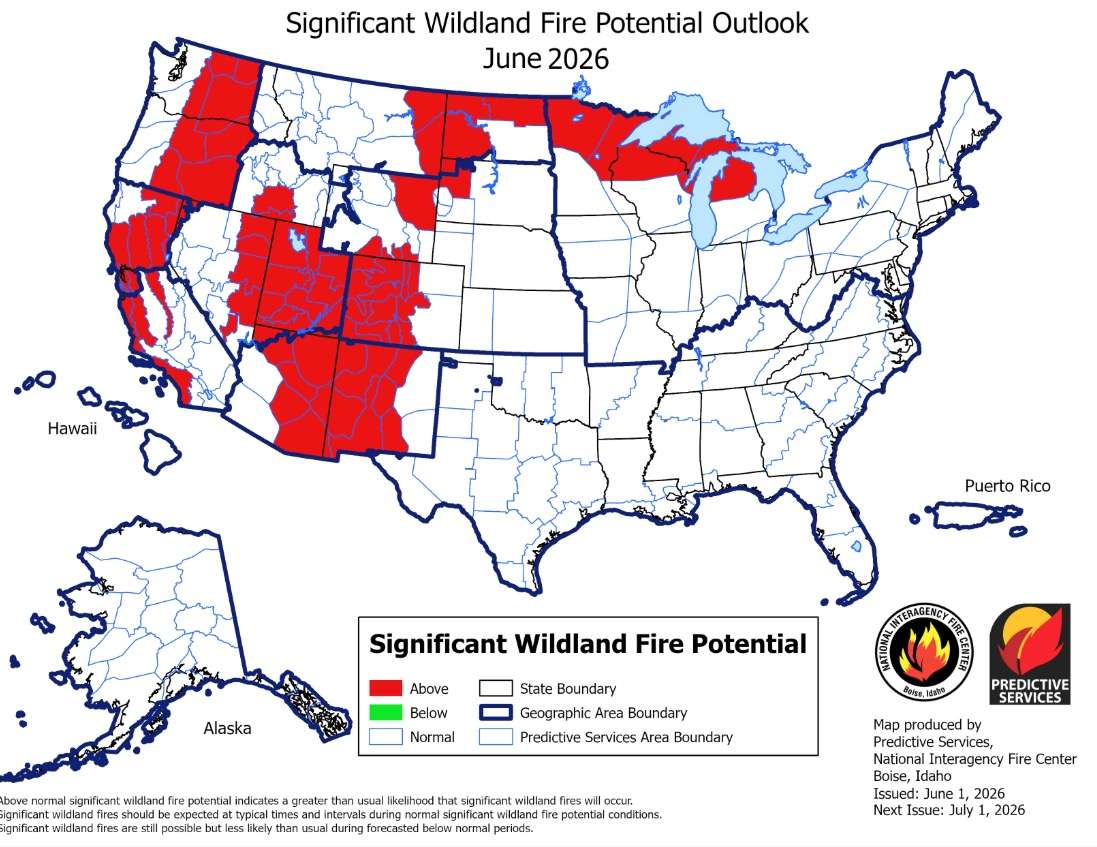
The highest fire risks could be in northern Utah and Idaho by August and September, according to the Great Basin Coordination Center. It could be a "long, hot, fiery summer" for Idaho and northeast Nevada, Newmerzhycky warned.
Its outlook will change with the summer conditions. A little more than 200 wildfires have already been reported in Utah this year, which have burned more than 8,400 acres across the state.
Nearly 85% of those have started from human causes. State leaders have urged people to use caution while outdoors, especially when it comes to activities that can start a fire.
"As temperatures rise and more people head outdoors, your awareness really is the best line of defense," Gov. Spencer Cox said last month.
Utah's closed fire season lasts through Oct. 31.