- Salt Lake City plans to indefinitely close sections of 7200 West and 200 South.
- The 7200 West closure aims to curb illegal dumping and preserve future road use.
- The 200 South closure seeks to establish a quiet zone, reducing train noise impact.
SALT LAKE CITY — Utah's capital city is considering measures to indefinitely close sections of two roads on its west side, as it deals with separate issues tied to both.
Salt Lake City is exploring a motion to extend and expand an existing closure of 7200 West, from California Avenue (1400 South) to approximately 152 S. 7200 West, as well as a segment of 200 South between Montgomery Street and 1640 West, over environmental and noise issues.
7200 West
Salt Lake City leaders, in 2024, agreed to close a slightly smaller section of 7200 West for two years, citing a severe illegal dumping problem that caused environmental concerns. More than 250 tons of large and hazardous waste had been removed from the area during a 2023 cleanup.
It was "overwhelming," said Salt Lake City Council Chairman Alejandro Puy, whose district covers a large portion of the city's west side, reflecting on the issue before the closure.
It's helped deter illegal dumping and activity since then, according to Jorge Chamorro, director of Salt Lake City's Department of Public Service, as he updated the Salt Lake City Council on Tuesday. His department estimates that more than 500 pounds of waste and $60,000 in labor and disposal costs have been avoided through the closure.
"We still see some illegal dumping, especially at the gates ... but it's far less than what we've experienced in the past," he said.
The indefinite closure would only add about 900 feet to the temporary one that extended from I-80 to California Avenue. The city worked with companies that use the route for operational needs, like Union Pacific, Rio Tinto and Waste Management, as well as emergency services, to ensure they all still had access.
"This property will remain a public right-of-way, though with restricted access with a gate at each end," he explained. "Adjacent property owners will (retain) access. They have a lock they can use on their own — they don't have to coordinate times or dates with us."
It's proposing to keep the right-of-way so that it doesn't interfere with the city's long-term vision to eventually use 7200 West as a key connecting road to connect I-80 with state Route 201, once industrial growth calls for the need, he added. The city could vote to reopen the segment once the need is ready.
200 South
A similar measure is being proposed for 200 South to include more parts of the city's west side within the federal government's quiet zone program. That's a program that allows train operators to move through crossings without blowing their horns unless there's an immediate emergency on the tracks because crossings are deemed safe enough.
Many residents within the Wasatch Front learned about this program in 2024 when a few crossings fell out of compliance, forcing extra train horns from Ogden to Provo that lasted for months. The saga finally ended in March 2025.
At the same time, Salt Lake City leaders have long desired to address train horns within west-side neighborhoods not included in the active zones.
Salt Lake City's proposal to close the segment of 200 South between Montgomery Street and 1640 West in Poplar Grove would help usher in a new quiet zone that's separate from those, said Lynn Jacobs, a transportation engineer for the city. Thus, it doesn't risk other parts of the city or other cities losing their status.
City officials estimate that it would cost tens of millions of dollars to get the diagonal railroad crossing up to quiet zone code.
"It would require pretty significant investment. ... The skew makes it really complicated," Jacob said, noting that three rail lines that cross the road sit on different levels, which adds to the challenge and estimated cost.
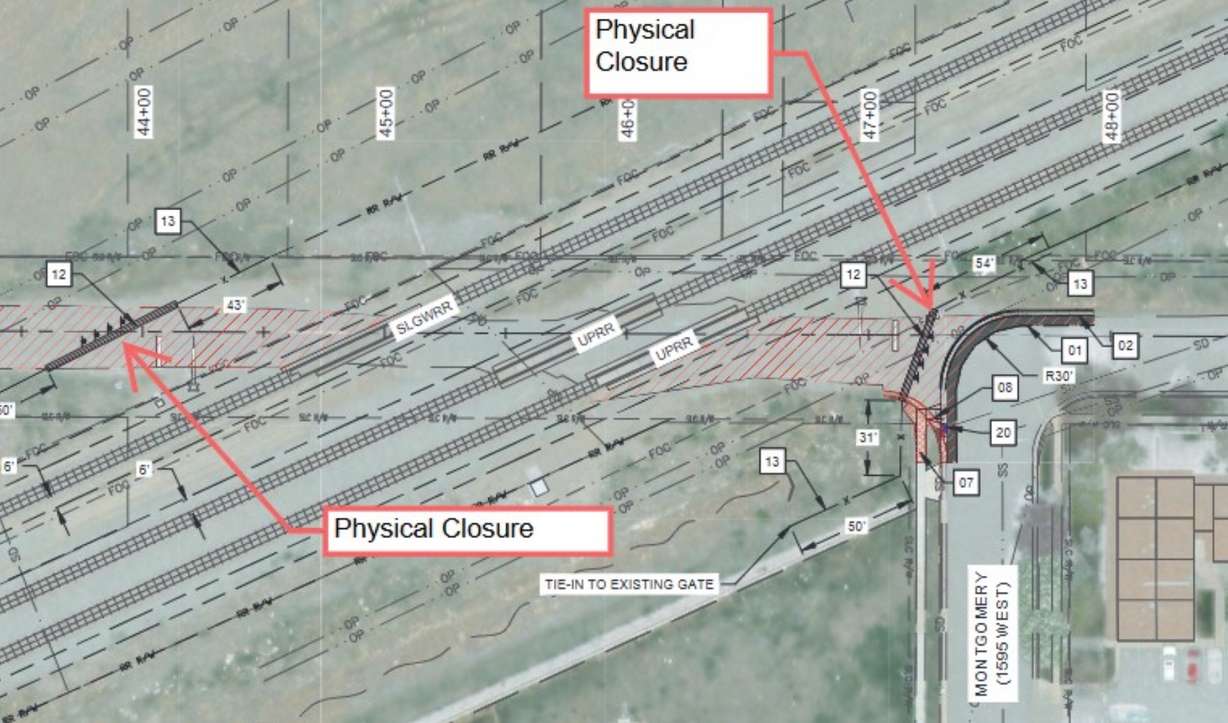
With traffic crossing this segment considered low, at fewer than 500 cars per day, city transportation officials believe closing the road section is the fastest way to receive west-side quiet zone protections.
The transportation division is also seeking to add fenced barriers on either side of the crossing, which would have 200 South bend into Montgomery Street to the east of the crossing. A cul-de-sac would be built west of the crossing to help vehicles turn around.
All of this is expected to help ensure that the 100 S. Navajo Street, 1600 W. 200 South and 300 N. Orange Street crossings all receive quiet zone protections, easing concerns from residents near those crossings.
The next steps
Members of the City Council appeared to support both measures, but they also anticipated that the latter could cause blowback from people who do use that segment of 200 South.
"I worry that not engaging the neighbors would be a mistake," Puy said, urging transportation officials to alert Poplar Grove residents about the proposal, but also anticipating that residents might be OK with it if they know what would be gained.
The City Council plans to hold a public hearing on both proposals during its May 19 meeting, before a tentative vote in June.