- Utah leaders return from Milan Cortina Winter Olympics with insights for 2034.
- Brad Wilson emphasizes long-term planning for Utah's upcoming Winter Games.
- Snow is a concern, with snow storage, preservation and transportation techniques are being studied.
SALT LAKE CITY — With the Milan Cortina Winter Olympics now firmly in the rearview mirror, Utah leaders are returning from Italy with new ideas and their sights set on 2034, when the Winter Olympic and Paralympic Games return to the Beehive State.
On Wednesday, a handful of those leaders shared their insights and experiences during a panel discussion hosted by the Kem C. Gardner Policy Institute.
Natalie Gochnour, director of the Gardner Institute, reflected on a statement made by former NBC Sports president and Olympic ambassador Dick Ebersol, who described the 2002 Winter Olympics as "far and away, the most successful Olympics, summer or winter, in history."
Of course, a lot has changed for Utah since then.
For one, the state's population has grown from 2.3 million in 2002 to about 3.5 million today. By 2034, Gochnour said the population could nearly double from what it was in 2002, to nearly 5 million people.
'We are planning for decades'
Brad Wilson, CEO of Utah's 2034 Winter Games and former Utah House Speaker, said he believes Utah's previous Olympic hosting experience gives the state a leg up in preparation for 2034.
"We also have the advantage of getting our Games awarded to us three years earlier than is normal," Wilson said, adding that the added time allows the organizing committee to take a different approach than it did in 2002.
"We are not planning an event for 17 days. We are planning for decades when we think about this," Wilson said.

Jennifer Wesselhoff, president and CEO of Visit Park City, echoed Wilson's future-thinking sentiment.
Wesselhoff said Park City and Summit County as a whole have started to think about the Olympic Games as a "catalyst" to advance infrastructure priorities in the county related to transit and transportation.
"We host millions and millions of visitors a year, and those visitors have an impact to our quality of life. So how do we balance that? And how do we use the Games as a catalyst to make some of these improvements that we want to make as part of our long-range vision that will last long beyond 2034?" she asked.
What about the snow?
With a solid amount of infrastructure in place from the state's last time hosting, Wesselhoff said Utah doesn't necessarily need to reinvent the wheel when it comes to new facilities.
Still, she emphasized the "critical" need for improvements and enhancements to the state's facilities, "especially as we look at the season in a stingy snow year."

"What does the technology look like, in terms of snow making and ... snow farming and moving snow around?" Wesselhoff said. "We're thinking a lot about that."
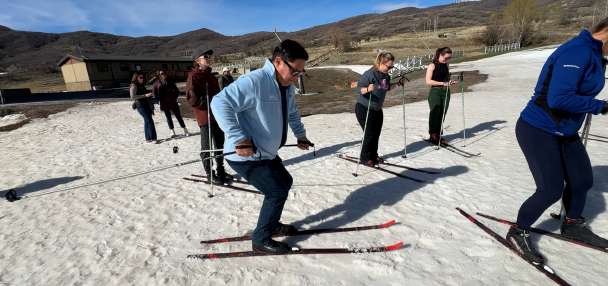
Some methods are already being tested at Soldier Hollow, the venue for cross-country skiing and biathlon during the 2002 Olympic Games and planned site for 2034.
One of the operations that Utah's Olympic leaders studied while in Italy was a snow storage technique already in use in parts of Europe.
By covering massive piles of snow with large, insulated tarps, the idea is to keep the snow from melting. If proven effective, it could prove to be a welcome method for the state, which has seen warmer temperatures this winter and even some ski resorts prematurely closing for the season.
While it's logical to think all eyes will be on Utah during the 2034 Winter Olympics, Gochnour said one of the biggest things she learned during her time in Italy was how much of an international gathering the event is.
"We think this is about Utah and Salt Lake City, the university, and Ogden, and all these things. It's really about the United States. It's an international gathering. Nobody's looking (at Utah); I mean, they are a little bit, but we represent our country," Gochnour said.